358 posters, 97 topics, 122 sessions, 958 authors, 239 institutions
ePostersLive by SciGen Technologies S.A. All rights reserved.
79th PostGraduate Assembly in Anesthesiology 2025
December 12 - 15, 2025 | New York City

2043
Spontaneous Subdural Hematoma after an Atraumatic Labor Epidural Injection. A Rare Complication and Review
Poster Presenter
Authors
Affiliations
Part of Topic
Obstetrics - Regional and Acute Pain
SPONTANEOUS SUBDURALHEMATOMA AFTER AN ATRAUMATIC LABOR EPIDURAL INJECTION.
A RARE COMPLICATION AND REVIEW
Shoaib Nawaz, MD. | EjazKhan, MD. | RoniMendonca, MD.
INTRODUCTION:
Epidural analgesia is the most effective and commonly used technique for labor pain relief. Despite its excellent safety profile, rare complications can occur, including post-dural puncture headache (PDPH) and subdural hematoma. We report a case of a 19-year-old female who developed a spontaneous subdural hematoma following an apparently atraumatic epidural injection, likely secondary to a cerebrospinal fluid (CSF) leak and intracranial hypotension.
CASE:
A 19-year-old primigravida at 38 weeks gestation received an epidural for labor analgesia using a 17G Tuohy needle at the L3–L4 level via the loss-of-resistance technique with air. The procedure was uneventful, with no evidence of dural puncture or blood aspiration. 12 hours postpartum, she developed a positional headache, neck pain, and dizziness consistent with PDPH. Conservative management with fluids and analgesics led to temporary improvement, & she declined an epidural blood patch.
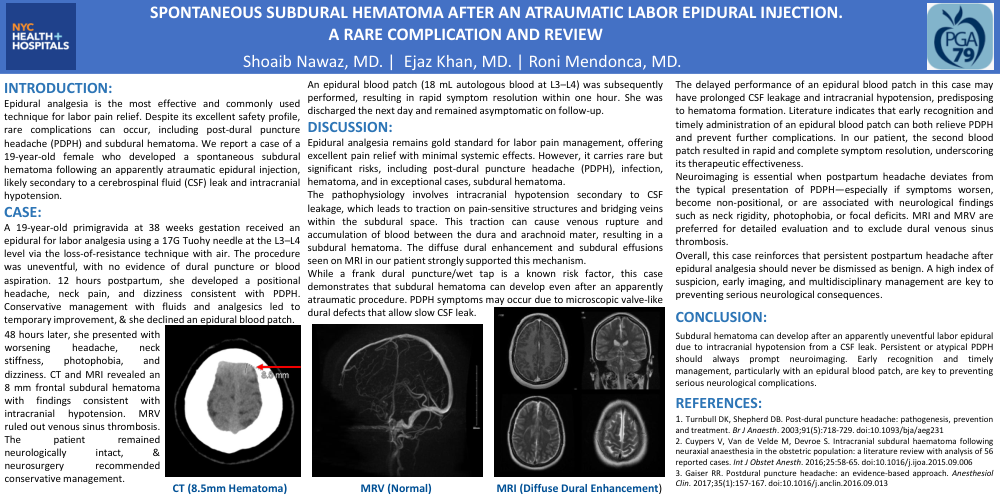
48 hours later, she presented with worsening headache, neck stiffness, photophobia, and dizziness. CT and MRI revealed an 8 mm frontal subdural hematoma with findings consistent with intracranial hypotension. MRV ruled out venous sinus thrombosis. The patient remained neurologically intact, & neurosurgery recommended conservative management.
An epidural blood patch (18 mL autologous blood at L3–L4) was subsequently performed, resulting in rapid symptom resolution within one hour. She was discharged the next day and remained asymptomatic on follow-up.
DISCUSSION:
Epidural analgesia remains gold standard for labor pain management, offering excellent pain relief with minimal systemic effects. However, it carries rare but significant risks, including post-dural puncture headache (PDPH), infection, hematoma, and in exceptional cases, subdural hematoma.
The pathophysiology involves intracranial hypotension secondary to CSF leakage, which leads to traction on pain-sensitive structures and bridging veins within the subdural space. This traction can cause venous rupture and accumulation of blood between the dura and arachnoid mater, resulting in a subdural hematoma. The diffuse dural enhancement and subdural effusions seen on MRI in our patient strongly supported this mechanism.
While a frank dural puncture/wet tap is a known risk factor, this case demonstrates that subdural hematoma can develop even after an apparently atraumatic procedure. PDPH symptoms may occur due to microscopic valve-like dural defects that allow slow CSF leak.
The delayed performance of an epidural blood patch in this case may have prolonged CSF leakage and intracranial hypotension, predisposing to hematoma formation. Literature indicates that early recognition and timely administration of an epidural blood patch can both relieve PDPH and prevent further complications. In our patient, the second blood patch resulted in rapid and complete symptom resolution, underscoring its therapeutic effectiveness.
Neuroimaging is essential when postpartum headache deviates from the typical presentation of PDPH—especially if symptoms worsen, become non-positional, or are associated with neurological findings such as neck rigidity, photophobia, or focal deficits. MRI and MRV are preferred for detailed evaluation and to exclude dural venous sinus thrombosis.
Overall, this case reinforces that persistent postpartum headache after epidural analgesia should never be dismissed as benign. A high index of suspicion, early imaging, and multidisciplinary management are key to preventing serious neurological consequences.
CONCLUSION:
Subdural hematoma can develop after an apparently uneventful labor epidural due to intracranial hypotension from a CSF leak. Persistent or atypical PDPH should always prompt neuroimaging. Early recognition and timely management, particularly with an epidural blood patch, are key to preventing serious neurological complications.
REFERENCES:
1.Turnbull DK, Shepherd DB. Post-dural puncture headache: pathogenesis, prevention and treatment. Br J Anaesth. 2003;91(5):718-729. doi:10.1093/bja/aeg231
2. Cuypers V, Van de Velde M, Devroe S. Intracranial subdural haematoma following neuraxial anaesthesia in the obstetric population: a literature review with analysis of 56 reported cases. Int J Obstet Anesth. 2016;25:58-65. doi:10.1016/j.ijoa.2015.09.006
3. Gaiser RR. Postdural puncture headache: an evidence-based approach. Anesthesiol Clin. 2017;35(1):157-167. doi:10.1016/j.anclin.2016.09.013
An epidural blood patch (18 mL autologous blood at L3–L4) was subsequently performed, resulting in rapid symptom resolution within one hour. She was discharged the next day and remained asymptomatic on follow-up.