358 posters, 97 topics, 122 sessions, 958 authors, 239 institutions
ePostersLive by SciGen Technologies S.A. All rights reserved.
79th PostGraduate Assembly in Anesthesiology 2025
December 12 - 15, 2025 | New York City

2098
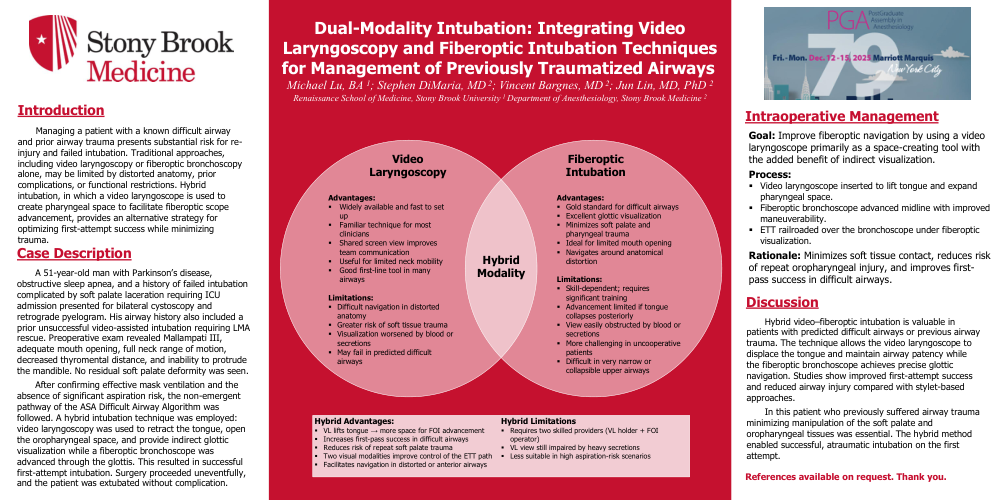
Dual-Modality Intubation: Integrating Video Laryngoscopy and Fiberoptic Intubation Techniques for Management of Previously Traumatized Airways
Poster Presenter
Part of Topic
Airway - Perioperative Management
Dual-Modality Intubation: Integrating Video Laryngoscopy and Fiberoptic Intubation Techniques for Management of Previously Traumatized Airways
Michael Lu, BA 1; Stephen DiMaria, MD 2; Vincent Bargnes, MD 2; Jun Lin, MD, PhD 2
Renaissance School of Medicine, Stony Brook University 1 Department of Anesthesiology, Stony Brook Medicine 2
Introduction
Managing a patient with a known difficult airway and prior airway trauma presents substantial risk for re-injury and failed intubation. Traditional approaches, including video laryngoscopy or fiberoptic bronchoscopy alone, may be limited by distorted anatomy, prior complications, or functional restrictions. Hybrid intubation, in which a video laryngoscope is used to create pharyngeal space to facilitate fiberoptic scope advancement, provides an alternative strategy for optimizing first-attempt success while minimizing trauma.
Case Description
A 51-year-old man with Parkinson’s disease, obstructive sleep apnea, and a history of failed intubation complicated by soft palate laceration requiring ICU admission presented for bilateral cystoscopy and retrograde pyelogram. His airway history also included a prior unsuccessful video-assisted intubation requiring LMA rescue. Preoperative exam revealed Mallampati III, adequate mouth opening, full neck range of motion, decreased thyromental distance, and inability to protrude the mandible. No residual soft palate deformity was seen.
After confirming effective mask ventilation and the absence of significant aspiration risk, the non-emergent pathway of the ASA Difficult Airway Algorithm was followed. A hybrid intubation technique was employed: video laryngoscopy was used to retract the tongue, open the oropharyngeal space, and provide indirect glottic visualization while a fiberoptic bronchoscope was advanced through the glottis. This resulted in successful first-attempt intubation. Surgery proceeded uneventfully, and the patient was extubated without complication.
Intraoperative Management
Goal: Improve fiberoptic navigation by using a video laryngoscope primarily as a space-creating tool with the added benefit of indirect visualization.
Process:
Rationale: Minimizes soft tissue contact, reduces risk of repeat oropharyngeal injury, and improves first-pass success in difficult airways.
Discussion
Hybrid video–fiberoptic intubation is valuable in patients with predicted difficult airways or previous airway trauma. The technique allows the video laryngoscope to displace the tongue and maintain airway patency while the fiberoptic bronchoscope achieves precise glottic navigation. Studies show improved first-attempt success and reduced airway injury compared with stylet-based approaches.
In this patient who previously suffered airway trauma minimizing manipulation of the soft palate and oropharyngeal tissues was essential. The hybrid method enabled successful, atraumatic intubation on the first attempt.