358 posters, 97 topics, 122 sessions, 958 authors, 239 institutions
ePostersLive by SciGen Technologies S.A. All rights reserved.
79th PostGraduate Assembly in Anesthesiology 2025
December 12 - 15, 2025 | New York City

2047
A Sharp Surprise: Impacted Safety Pin in the Posterior Nasopharynx
Poster Presenter
Authors
Affiliations
Part of Topic
Airway - Perioperative Management
A Sharp Surprise: Impacted Safety Pin in the Posterior Nasopharynx
Airway, Aspiration, and Perforation Risk Considerations
Mary Housny¹, Nirali Patel¹, Dr. Ayman Farag MD²
¹Touro College of Osteopathic Medicine, New York, NY 10027
²Department of Anesthesiology, Saint John’s Episcopal Hospital, Far Rockaway, NY 11691
Introduction
Foreign body impaction in the upper airway presents a unique set of clinical and anesthetic challenges, particularly when the object is sharp and located in a region that is difficult to access. While safety pin ingestion is most commonly associated with children or individuals with psychiatric conditions, cases involving otherwise healthy patients are not unheard of. When such an object becomes lodged in the posterior nasopharynx, careful coordination between surgical and anesthesia teams is essential to ensure a safe and effective intervention.
From an anesthetic perspective, airway management in these scenarios requires a nuanced approach. The goal is to maintain a balance between adequate anesthesia for patient comfort and surgical access whenever possible. The risks of airway trauma, bleeding, or aspiration heighten the complexity of the case, particularly if the foreign body is mobile or situated near critical structures.
This case report details the removal of an open safety pin from the posterior nasopharynx of an adult patient and outlines the anesthetic considerations involved in its management. It highlights the anesthetic considerations and intraoperative airway management required for successful removal in the context of a shared surgical field.
Case Report
A 57-year-old female with a history of depression and psychomotor disorder presented to the emergency department after attempting to pierce her nose with a safety pin, which became lodged in the posterior nasopharynx. She reported mild bleeding and pain but had stable vital signs and no respiratory distress.
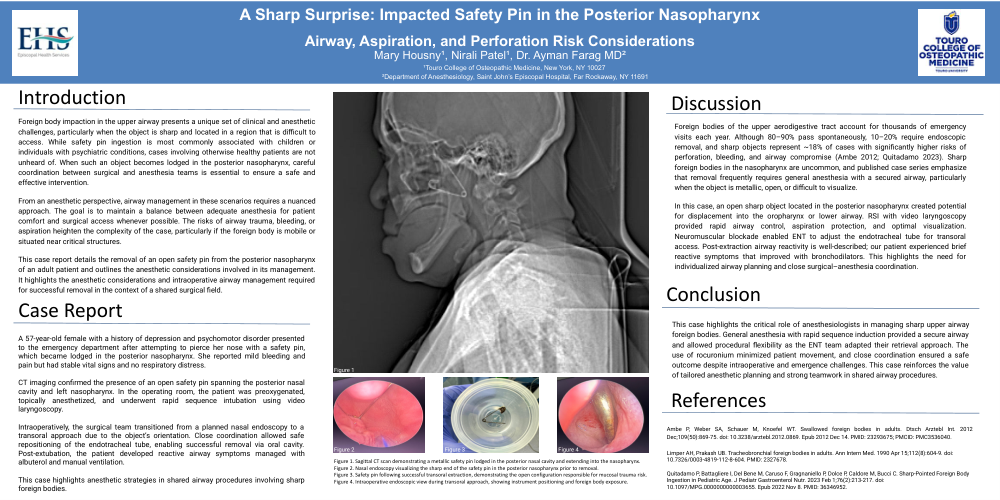
CT imaging confirmed the presence of an open safety pin spanning the posterior nasal cavity and left nasopharynx. In the operating room, the patient was preoxygenated, topically anesthetized, and underwent rapid sequence intubation using video laryngoscopy.
Intraoperatively, the surgical team transitioned from a planned nasal endoscopy to a transoral approach due to the object’s orientation. Close coordination allowed safe repositioning of the endotracheal tube, enabling successful removal via oral cavity. Post-extubation, the patient developed reactive airway symptoms managed with albuterol and manual ventilation.
This case highlights anesthetic strategies in shared airway procedures involving sharp foreign bodies.
Discussion
Foreign bodies of the upper aerodigestive tract account for thousands of emergency visits each year. Although 80–90% pass spontaneously, 10–20% require endoscopic removal, and sharp objects represent ~18% of cases with significantly higher risks of perforation, bleeding, and airway compromise (Ambe 2012; Quitadamo 2023). Sharp foreign bodies in the nasopharynx are uncommon, and published case series emphasize that removal frequently requires general anesthesia with a secured airway, particularly when the object is metallic, open, or difficult to visualize.
In this case, an open sharp object located in the posterior nasopharynx created potential for displacement into the oropharynx or lower airway. RSI with video laryngoscopy provided rapid airway control, aspiration protection, and optimal visualization. Neuromuscular blockade enabled ENT to adjust the endotracheal tube for transoral access. Post-extraction airway reactivity is well-described; our patient experienced brief reactive symptoms that improved with bronchodilators. This highlights the need for individualized airway planning and close surgical–anesthesia coordination.
Conclusion
This case highlights the critical role of anesthesiologists in managing sharp upper airway foreign bodies. General anesthesia with rapid sequence induction provided a secure airway and allowed procedural flexibility as the ENT team adapted their retrieval approach. The use of rocuronium minimized patient movement, and close coordination ensured a safe outcome despite intraoperative and emergence challenges. This case reinforces the value of tailored anesthetic planning and strong teamwork in shared airway procedures.
Ambe P, Weber SA, Schauer M, Knoefel WT. Swallowed foreign bodies in adults. Dtsch Arztebl Int. 2012 Dec;109(50):869-75. doi: 10.3238/arztebl.2012.0869. Epub 2012 Dec 14. PMID: 23293675; PMCID: PMC3536040.
Limper AH, Prakash UB. Tracheobronchial foreign bodies in adults. Ann Intern Med. 1990 Apr 15;112(8):604-9. doi: 10.7326/0003-4819-112-8-604. PMID: 2327678.
Quitadamo P, Battagliere I, Del Bene M, Caruso F, Gragnaniello P, Dolce P, Caldore M, Bucci C. Sharp-Pointed Foreign Body Ingestion in Pediatric Age. J Pediatr Gastroenterol Nutr. 2023 Feb 1;76(2):213-217. doi: 10.1097/MPG.0000000000003655. Epub 2022 Nov 8. PMID: 36346952.