358 posters, 97 topics, 122 sessions, 958 authors, 239 institutions
ePostersLive by SciGen Technologies S.A. All rights reserved.
79th PostGraduate Assembly in Anesthesiology 2025
December 12 - 15, 2025 | New York City

2034
Unilateral Anesthesia Mumps Following Robotic Gynecologic Surgery
Poster Presenter
Part of Topic
Airway - Perioperative Management
Unilateral Anesthesia Mumps following Robotic Gynecologic Surgery
1 F. Vlahos MS-4, 2 E. Panagodimou MD, 2 E. Sgouta MS-3, 3 I. Giannakikou MD
1University of Milano-Bicocca, IT - 2National and Kapodistrian University of Athens, GR - 3Hygeia Hospital, Department of Anesthesia, Athens, GR
Introduction
“Anesthesia Mumps” (acute transient sialadenitis) is a rare postoperative complication (incidence 0.16-0.2%). It presents as unilateral (rarely bilateral) swelling of the parotid gland following general or regional anesthesia. It is usually benign and self-limiting. There are multiple proposed mechanisms (duct obstruction, venous congestion, increased salivation, etc). It can rarely lead to serious complications, such as airway obstruction and post-mumps facial nerve palsy.
Case Presentation
- Patient: 63-year-old woman
- PMH: HTN on amlodipine, no salivary gland disease
- Surgery: robotic-assisted hysterectomy with bilateral salpingo-oophorectomy for endometrial Ca
- Position: lithotomy, steep Trendelenburg (20°) with shoulder supports
- Duration: 178 mins
- Anesthesia: general endotracheal
- Induction: propofol, fentanyl, rocuronium
- Intubation: easy mask ventilation, Glidescope-assisted intubation
- Maintenance: low-dose sevoflurane, propofol, remifentanil
- Emergence: Smooth, sugammadex for reversal
- Medications: cefoxitin, ondansetron, dexamethasone, metoclopramide, cimetidine, paracetamol, parecoxib, Tramadol, remifentanil, fentanyl and 50 ml 20% mannitol
- Emergence: smooth, sugammadex for reversal
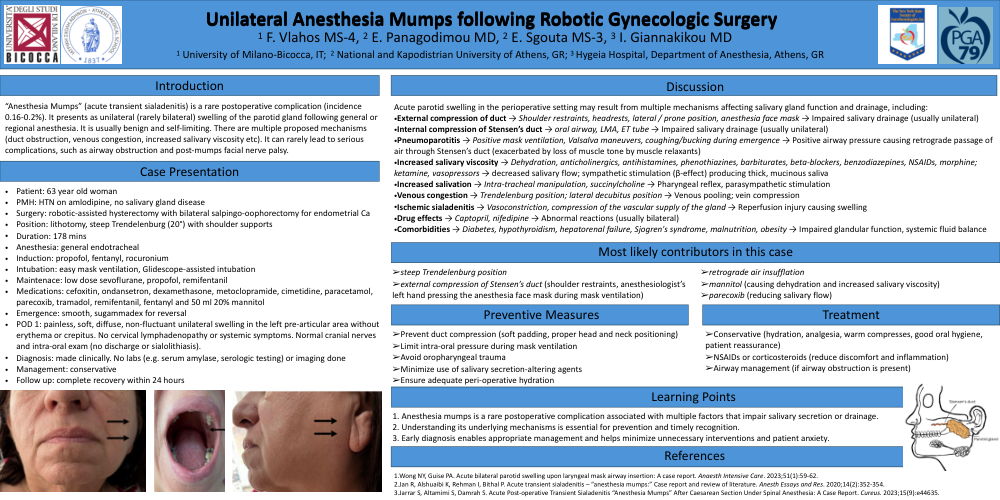
- POD 1: painless, soft, diffuse, non-fluctuant unilateral swelling in the left pre-articular area without erythema or crepitus. No cervical lymphadenopathy or systemic symptoms. Normal cranial nerves and intraoral exam (no discharge or sialolithiasis)
- Diagnosis: made clinically. No labs (e.g., serum amylase, serologic testing) or imaging done
- Management: Conservative
- Follow up: Complete recovery within 24 hours
Discussion
Acute parotid swelling in perioperative settings may result from multiple mechanisms affecting salivary gland function and drainage, including:
- External compression of the Stensen’s duct → Shoulder restraints, headrests, lateral/ prone position, anesthesia face mask → Impaired salivary drainage (usually unilateral)
- Internal compression of the Stensen’s duct → Oral airway, LMA, ET tube → Impaired salivary drainage (usually unilateral)
- Pneumoparotitis → Positive mask ventilation, Valsalva maneuvers, coughing/bucking during emergence → Positive airway pressure causing retrograde passage of air through Stensen’s duct (exacerbated by loss of muscle tone by muscle relaxants)
- Increased salivary viscosity → Dehydration, anticholinergics, antihistamines, phenothiazines, barbiturates, beta-blockers, benzodiazepines, NSAIDs, morphine, ketamine, vasopressors → decreased salivary flow; sympathetic stimulation (β-effect) producing thick, mucinous saliva.
- Increased salivation → Intra-tracheal manipulation, Succinylcholine → Pharyngeal reflex, parasympathetic stimulation
- Venous congestion → Trendelenburg position, lateral decubitus position → Venous pooling, vein compression
- Ischemic sialadenitis → Vasoconstriction, Compression of the vascular supply of the gland → Reperfusion injury causing swelling
- Drug effects → Captopril, nifedipine → Abnormal reactions (usually bilateral)
- Comorbidities → Diabetes, hypothyroidism, hepatorenal failure, Sjogren's syndrome, malnutrition, obesity → Impaired glandular function and systemic fluid balance
Most likely contributors in this case
- steep Trendelenburg position
- external compression of Stensen’s duct (shoulder restraints, anesthesiologist’s left hand pressing the anesthesia face mask during mask ventilation)
- retrograde air insufflation
- mannitol (causing dehydration, increasing salivary viscosity)
- parecoxib (reducing salivary flow)
Preventive Measures
- Prevent duct compression (soft padding, proper head and neck positioning)
- Limit intraoral pressure during mask ventilation
- Avoid oropharyngeal trauma
- Minimize the use of salivary secretion-altering agents
- Ensure adequate perioperative hydration
Treatment
- Conservative (hydration, analgesia, warm compresses, good oral hygiene, and patient reassurance)
- NSAIDs or corticosteroids (reduce discomfort and inflammation)
- Airway management (if airway obstruction is present)
Learning Points
1. Anesthesia mumps is a rare postoperative complication associated with multiple factors that impair salivary secretion or drainage.
2. Understanding its underlying mechanisms is essential for prevention and timely recognition.
3. Early diagnosis enables appropriate management and helps minimize unnecessary interventions and patient anxiety
References
- Wong NY, Guise PA. Acute bilateral parotid swelling upon laryngeal mask airway insertion: A case report. Anaesthesia and Intensive Care. 2022;51(1):59-62.
- Jan R, Alshuaibi K, Rehman I, Bithal P. Acute transient sialadenitis – “anesthesia mumps:” Case report and review of literature. Anesthesia: Essays and Res. 2020;14(2):352.
- Jarrar S, Altamimi S, Damrah S. Acute Post-operative Transient Sialadenitis “Anesthesia Mumps” After Caesarean Section Under Spinal Anesthesia: A Case Report. Cureus. Published online September 4, 2023.