358 posters, 97 topics, 122 sessions, 958 authors, 239 institutions
ePostersLive by SciGen Technologies S.A. All rights reserved.
79th PostGraduate Assembly in Anesthesiology 2025
December 12 - 15, 2025 | New York City

2033
Combined HELP and Bean Bag Positioning in Morbid Obesity for Robotic Pelvic Surgery
Poster Presenter
Part of Topic
Airway - Perioperative Management
Combined use of HELP/ramped position pillow and Bean Bag in a morbidly obese patient
undergoing robotic pelvic surgery
Fotios Vlahos MS 1 , Evangelia Sgouta MS 2 , Iosifina Giannakikou MD 3
1. University of Milano-Bicocca, IT; 2. National and Kapodistrian University of Athens, GR; 3. Hygeia Hospital, Department of Anesthesia, GR.
Introduction
Morbid obesity increases the risk of difficult airway management, aspiration, and postoperative
respiratory compromise, for which the HELP (head elevated laryngoscopy position) or ramped
position can improve airway alignment, enhance ventilation, and reduce aspiration risk.
We report a case in which a ramp pillow was kept atop a vacuum bean bag for the entire procedure,
eliminating the need for repositioning after intubation and before extubation.
Case Presentation
Ø A 56-year-old female with Class III morbid obesity (BMI 55 kg/m 2 ; 180 kg, 180 cm)
underwent a robotic hysterectomy with bilateral salpingo-oophorectomy.
Ø PMH: HTN, HLD, T2DM, grade 3 steatosis, GER, diaphragmatic hernia, OSA (on CPAP).
Ø Preoperative evaluation: central obesity, large breasts,
neck circumference of 48 cm, and a Mallampati I airway.
Ø Surgery lasted 213 minutes in steep Trendelenburg (27°) and lithotomy, with both arms
secured alongside the torso.
Ø Positioning was challenging due to her body habitus and surgical demands.
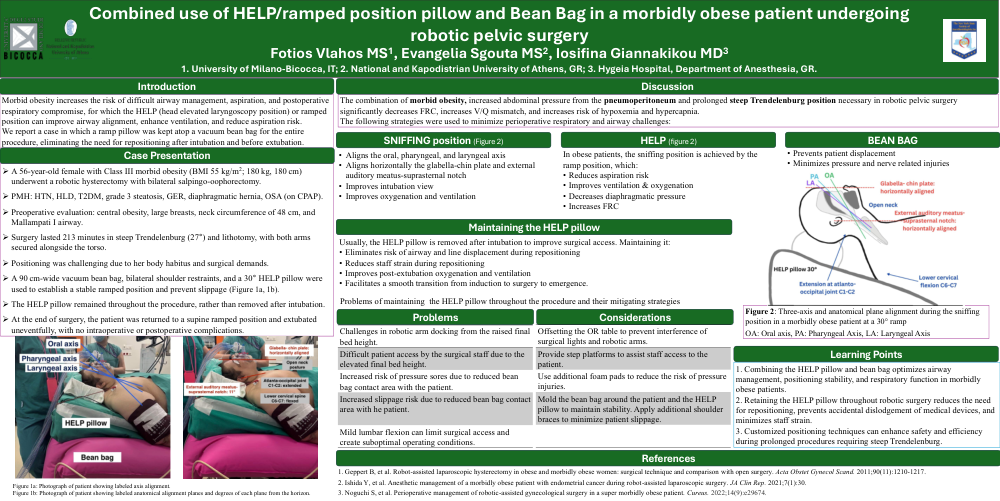
Ø A 90 cm-wide vacuum bean bag, bilateral shoulder restraints, and a 30° HELP pillow were
used to establish a stable ramped position and prevent slippage (Figure 1a, 1b).
Ø The HELP pillow remained throughout the procedure, rather than removed after intubation.
Ø At the end of surgery, the patient was returned to a supine ramped position and extubated
uneventfully, with no intraoperative or postoperative complications.
Figure 1a: Photograph of patient showing labeled axis alignment.
Figure 1b: Photograph of patient showing labeled anatomical alignment planes and degrees of each
plane from the horizon.
Discussion
The combination of morbid obesity, increased abdominal pressure from the pneumoperitoneum
and prolonged steep Trendelenburg position necessary in robotic pelvic surgery significantly decreases FRC,
increases V/Q mismatch, and increases risk of hypoxemia and hypercapnia.
The following strategies were used to minimize perioperative respiratory and airway challenges:
SNIFFING position (Figure 2)
• Aligns the oral, pharyngeal, and laryngeal axis
• Aligns horizontally the glabella-chin plate and external auditory meatus-suprasternal notch
• Improves intubation view
• Improves oxygenation and ventilation
HELP (figure 2)
In obese patients, the sniffing position is achieved by the ramp position, which:
• Reduces aspiration risk
• Improves ventilation & oxygenation
• Decreases diaphragmatic pressure
• Increases FRC
BEAN BAG
• Prevents patient displacement
• Minimizes pressure and nerve related injuries
Maintaining the HELP pillow
Usually, the HELP pillow is removed after intubation to improve surgical access. Maintaining it:
• Eliminates risk of airway and line displacement during repositioning
• Reduces staff strain during repositioning
• Improves post-extubation oxygenation nd ventilation
• Facilitates a smooth transition from induction to surgery to emergence
Figure 2: Three-axis and anatomical plane alignment during the sniffing position in a morbidly obese
patient at a 30° ramp
OA: Oral axis, PA: Pharyngeal Axis, LA: Laryngeal Axis
Problems
Challenges in robotic arm docking from the raised final bed height.
Difficult patient access by the surgical staff due to the elevated final bed height.
Increased risk of pressure sores due to reduced bean bag contact area with the patient.
Increased slippage risk due to reduced bean bag contact area with he patient.
Mild lumbar flexion can limit surgical access and create suboptimal operating conditions.
Considerations
Offsetting the OR table to prevent interference of surgical lights and robotic arms.
Provide step platforms to assist staff access to the patient.
Use additional foam pads to reduce the risk of pressure injuries.
Mold the bean bag around the patient and the HELP pillow to maintain stability. Apply additional shoulder braces to minimize patient slippage.
Learning Points
1. Combining the HELP pillow and bean bag optimizes airway management, positioning stability, and
respiratory function in morbidly obese patients.
2. Retaining the HELP pillow throughout robotic surgery reduces the need for repositioning, prevents
accidental dislodgement of medical devices, and minimizes staff strain.
3. Customized positioning techniques can enhance safety and efficiency during prolonged
procedures requiring steep Trendelenburg.
References
1. Geppert B, et al. Robot-assisted laparoscopic hysterectomy in obese and morbidly obese
women: surgical technique and comparison with open surgery. Acta Obstet Gynecol Scand.
2011;90(11):1210-1217.
2. Ishida Y, et al. Anesthetic management of a morbidly obese patient with endometrial cancer
during robot-assisted laparoscopic surgery. JA Clin Rep. 2021;7(1):30.
3. Noguchi S, et al. Perioperative management of robotic-assisted gynecological surgery in a
super morbidly obese patient. Cureus. 2022;14(9):e29674.