358 posters, 97 topics, 122 sessions, 958 authors, 239 institutions
ePostersLive by SciGen Technologies S.A. All rights reserved.
79th PostGraduate Assembly in Anesthesiology 2025
December 12 - 15, 2025 | New York City

2054
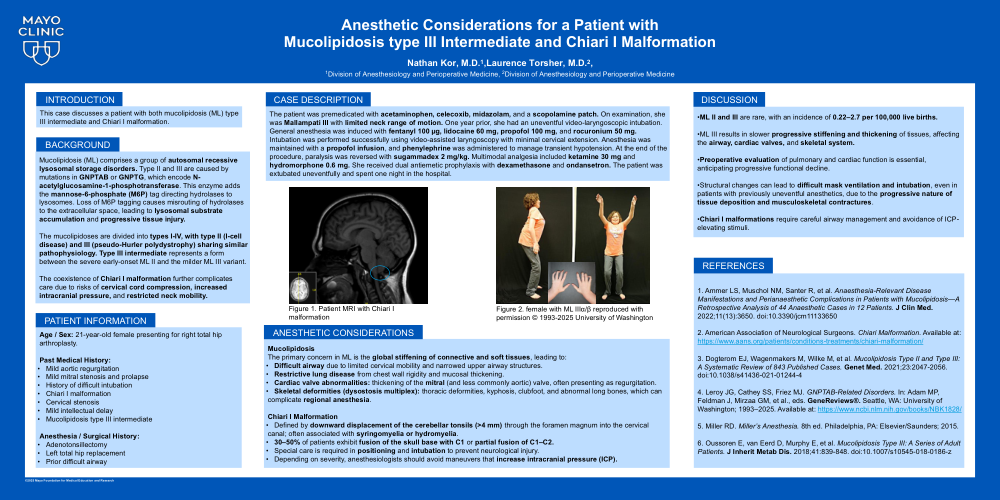
Anesthetic Considerations for a Patient with? Mucolipidosis type III Intermediate and Chiari I Malformation
Poster Presenter
Authors
Affiliations
Part of Topic
Airway - Perioperative Management
Anesthetic Considerations for a Patient with
Mucolipidosis type III Intermediate and Chiari I Malformation
Nathan Kor, M.D.1,Laurence Torsher, M.D.2
INTRODUCTION
This case discusses a patient with both mucolipidosis (ML) type
III intermediate and Chiari I malformation.
BACKGROUND
Mucolipidosis (ML) comprises a group of autosomal recessive
lysosomal storage disorders. Type II and III are caused by
mutations in GNPTAB or GNPTG, which encode N-
acetylglucosamine-1-phosphotransferase. This enzyme adds
the mannose-6-phosphate (M6P) tag directing hydrolases to
lysosomes. Loss of M6P tagging causes misrouting of hydrolases
to the extracellular space, leading to lysosomal substrate
accumulation and progressive tissue injury.
The mucolipidoses are divided into types I-IV, with type II (I-cell
disease) and III (pseudo-Hurler polydystrophy) sharing similar
pathophysiology. Type III intermediate represents a form
between the severe early-onset ML II and the milder ML III variant.
The coexistence of Chiari I malformation further complicates
care due to risks of cervical cord compression, increased
intracranial pressure, and restricted neck mobility.
PATIENT INFORMATION
Age / Sex: 21-year-old female presenting for right total hip
arthroplasty.
Past Medical History:
• Mild aortic regurgitation
• Mild mitral stenosis and prolapse
• History of difficult intubation
• Chiari I malformation
• Cervical stenosis
• Mild intellectual delay
• Mucolipidosis type III intermediate
Anesthesia / Surgical History:
• Adenotonsillectomy
• Left total hip replacement
• Prior difficult airway
CASE DESCRIPTION
The patient was premedicated with acetaminophen, celecoxib, midazolam, and a scopolamine patch. On examination, she
was Mallampati III with limited neck range of motion. One year prior, she had an uneventful video-laryngoscopic intubation.
General anesthesia was induced with fentanyl 100 µg, lidocaine 60 mg, propofol 100 mg, and rocuronium 50 mg.
Intubation was performed successfully using video-assisted laryngoscopy with minimal cervical extension. Anesthesia was
maintained with a propofol infusion, and phenylephrine was administered to manage transient hypotension. At the end of the
procedure, paralysis was reversed with sugammadex 2 mg/kg. Multimodal analgesia included ketamine 30 mg and
hydromorphone 0.6 mg. She received dual antiemetic prophylaxis with dexamethasone and ondansetron. The patient was
extubated uneventfully and spent one night in the hospital.
ANESTHETIC CONSIDERATIONS
Mucolipidosis
The primary concern in ML is the global stiffening of connective and soft tissues, leading to:
• Difficult airway due to limited cervical mobility and narrowed upper airway structures.
• Restrictive lung disease from chest wall rigidity and mucosal thickening.
• Cardiac valve abnormalities: thickening of the mitral (and less commonly aortic) valve, often presenting as regurgitation.
• Skeletal deformities (dysostosis multiplex): thoracic deformities, kyphosis, clubfoot, and abnormal long bones, which can
complicate regional anesthesia.
Chiari I Malformation
• Defined by downward displacement of the cerebellar tonsils (>4 mm) through the foramen magnum into the cervical
canal; often associated with syringomyelia or hydromyelia.
• 30–50% of patients exhibit fusion of the skull base with C1 or partial fusion of C1–C2.
• Special care is required in positioning and intubation to prevent neurological injury.
• Depending on severity, anesthesiologists should avoid maneuvers that increase intracranial pressure (ICP).
DISCUSSION
•ML II and III are rare, with an incidence of 0.22–2.7 per 100,000 live births.
•ML III results in slower progressive stiffening and thickening of tissues, affecting
the airway, cardiac valves, and skeletal system.
•Preoperative evaluation of pulmonary and cardiac function is essential,
anticipating progressive functional decline.
•Structural changes can lead to difficult mask ventilation and intubation, even in
patients with previously uneventful anesthetics, due to the progressive nature of
tissue deposition and musculoskeletal contractures.
•Chiari I malformations require careful airway management and avoidance of ICP-
elevating stimuli.
REFERENCES
Figure 1. Patient MRI with Chiari I
malformation
Figure 2. female with ML IIIα/β reproduced with
permission © 1993-2025 University of Washington
1. Ammer LS, Muschol NM, Santer R, et al. Anaesthesia-Relevant Disease
Manifestations and Perianaesthetic Complications in Patients with Mucolipidosis—A
Retrospective Analysis of 44 Anaesthetic Cases in 12 Patients. J Clin Med.
2022;11(13):3650. doi:10.3390/jcm11133650
2. American Association of Neurological Surgeons. Chiari Malformation. Available at:
https://www.aans.org/patients/conditions-treatments/chiari-malformation/
3. Dogterom EJ, Wagenmakers M, Wilke M, et al. Mucolipidosis Type II and Type III:
A Systematic Review of 843 Published Cases. Genet Med. 2021;23:2047-2056.
doi:10.1038/s41436-021-01244-4
4. Leroy JG, Cathey SS, Friez MJ. GNPTAB-Related Disorders. In: Adam MP,
Feldman J, Mirzaa GM, et al., eds. GeneReviews®. Seattle, WA: University of
Washington; 1993–2025. Available at: https://www.ncbi.nlm.nih.gov/books/NBK1828/
5. Miller RD. Miller’s Anesthesia. 8th ed. Philadelphia, PA: Elsevier/Saunders; 2015.
6. Oussoren E, van Eerd D, Murphy E, et al. Mucolipidosis Type III: A Series of Adult
Patients. J Inherit Metab Dis. 2018;41:839-848. doi:10.1007/s10545-018-0186-z