358 posters, 97 topics, 122 sessions, 958 authors, 239 institutions
ePostersLive by SciGen Technologies S.A. All rights reserved.
79th PostGraduate Assembly in Anesthesiology 2025
December 12 - 15, 2025 | New York City

4035
Stepping Up Perioperative Safety: The Impact of Peripheral Neuropathy on Gait and Mobility
Poster Presenter
Part of Topic
Perioperative Management - Regional and Acute Pain
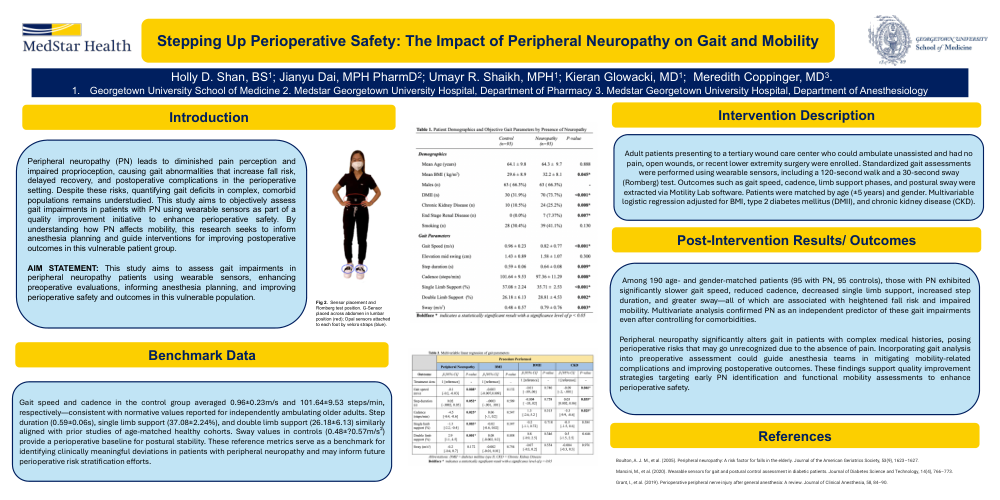
| Stepping Up Perioperative Safety: The Impact of Peripheral Neuropathy on Gait and Mobility | |
| Peripheral neuropathy (PN) leads to diminished pain perception and impaired proprioception, causing gait abnormalities that increase fall risk, delayed recovery, and postoperative complications in the perioperative setting. Despite these risks, quantifying gait deficits in complex, comorbid populations remains understudied. This study aims to objectively assess gait impairments in patients with PN using wearable sensors as part of a quality improvement initiative to enhance perioperative safety. By understanding how PN affects mobility, this research seeks to inform anesthesia planning and guide interventions for improving postoperative outcomes in this vulnerable patient group. | |
| This study aims to assess gait impairments in peripheral neuropathy patients using wearable sensors, enhancing preoperative evaluations, informing anesthesia planning, and improving perioperative safety and outcomes in this vulnerable population. | |
| Gait speed and cadence in the control group averaged 0.96?±?0.23?m/s and 101.64?±?9.53 steps/min, respectively—consistent with normative values reported for independently ambulating older adults. Step duration (0.59?±?0.06?s), single limb support (37.08?±?2.24%), and double limb support (26.18?±?6.13%) similarly aligned with prior studies of age-matched healthy cohorts. Sway values in controls (0.48?±?0.57?m/s²) provide a perioperative baseline for postural stability. These reference metrics serve as a benchmark for identifying clinically meaningful deviations in patients with peripheral neuropathy and may inform future perioperative risk stratification efforts. | |
| Adult patients presenting to a tertiary wound care center who could ambulate unassisted and had no pain, open wounds, or recent lower extremity surgery were enrolled. Standardized gait assessments were performed using wearable sensors, including a 120-second walk and a 30-second sway (Romberg) test. Outcomes such as gait speed, cadence, limb support phases, and postural sway were extracted via Motility Lab software. Patients were matched by age (±5 years) and gender. Multivariable logistic regression adjusted for BMI, type 2 diabetes mellitus (DMII), and chronic kidney disease (CKD). | |
| A total of 190 patients were analyzed, evenly divided between neuropathy and control groups. Both groups were similar in age and gender. Patients with neuropathy had higher BMI (p?=?0.045) and greater prevalence of diabetes (p? | |
| Boulton, A. J. M., et al. (2005). Peripheral neuropathy: A risk factor for falls in the elderly. Journal of the American Geriatrics Society, 53(9), 1623–1627. Mancini, M., et al. (2020). Wearable sensors for gait and postural control assessment in diabetic patients. Journal of Diabetes Science and Technology, 14(4), 766–773. Grant, I., et al. (2019). Perioperative peripheral nerve injury after general anesthesia: A review. Journal of Clinical Anesthesia, 58, 84–90. |
|
| Saturday, December 13 | |
| Perioperative Management Regional and Acute Pain |