358 posters, 97 topics, 122 sessions, 958 authors, 239 institutions
ePostersLive by SciGen Technologies S.A. All rights reserved.
79th PostGraduate Assembly in Anesthesiology 2025
December 12 - 15, 2025 | New York City

2023
An Emerging Concern: Weight Loss Medications and Their Effects on Regional Anesthesiology—Vasovagal Reaction and Emesis During Peripheral Nerve Block
Poster Presenter
Authors
Affiliations
Part of Topic
Perioperative Management - Regional and Acute Pain
Title: An Emerging Concern: Weight Loss Medications and Vasovagal reaction during Peripheral Nerve Block
Authors: Aminat Haruna, MD, MPH1; Austin Puchany DO, Mario Montoya MD1
Organization: 1Department of Anesthesiology & Perioperative Medicine, University of Pittsburgh & University of Pittsburgh Medical Center, Pittsburgh, PA
Introduction:
The rising use of sympathomimetic weight loss medication introduces new perioperative considerations
These agents can alter autonomic tone, increase vagal sensitivity and delay gastric emptying1
Physiological changes can impact hemodynamic stability and aspiration risk during anaesthesia.
Case highlights potential peri block safety concern in patients on phentermine or similar agents
Case Summary:
51-year-old male with morbid obesity, presents for ventral hernia repair.
Bilateral paravtebral blocks for post operative pain management
After needle insertion patient had Vasovagal event
Symptoms: bradycardia, hypotension, syncope, nausea and vomiting
Response: Ephedrine, glycopyrrolate, famotidine, ondansetron
Imaging: EKG showed NSR, no ST changes
The regional procedure was aborted.
Induced uneventfully with RSI and video laryngoscopy
Surgery proceeded uneventfully, without need for vasopressors
Successful extubation at end of case
Main Diagnosis/Interventions:
Rapid growth in Anti-obesity medications has been observed in recent years
Phentermine: A sympathomimetic amine historically used for short-term weight loss; can increase catecholaminergic activity and may affect autonomic tone1.
Emesis secondary to vagal event or Delayed gastric emptying, or combination of both?
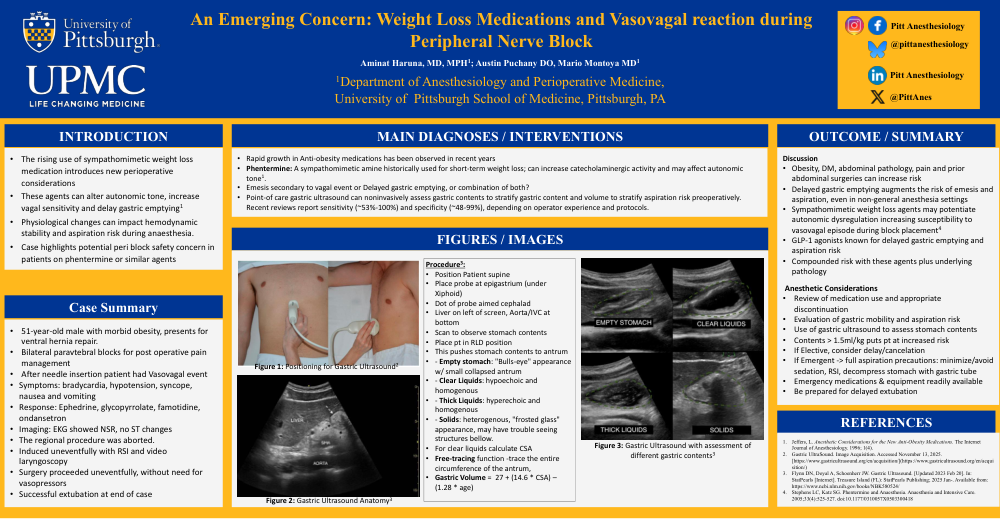
Point-of care gastric ultrasound can noninvasively assess gastric contents to stratify gastric content and volume to stratify aspiration risk preoperatively. Recent reviews report sensitivity (~53%-100%) and specificity (~48-99%), depending on operator experience and protocols.
Figures/Images:
Procedure3:
Position Patient supine
Place probe at epigastrium (under Xiphoid)
Dot of probe aimed cephalad
Liver on left of screen, Aorta/IVC at bottom
Scan to observe stomach contents
Place pt in RLD position
This pushes stomach contents to antrum
- Empty stomach: "Bulls-eye" appearance w/ small collapsed antrum
- Clear Liquids: hypoechoic and homogenous
- Thick Liquids: hyperechoic and homogenous
- Solids: heterogenous, "frosted glass" appearance, may have trouble seeing structures bellow.
For clear liquids calculate CSA
Free-tracing function -trace the entire circumference of the antrum,
Gastric Volume = 27 + (14.6 * CSA) – (1.28 * age)
Discussion:
Discussion
Obesity, DM, abdominal pathology, pain and prior abdominal surgeries can increase risk
Delayed gastric emptying augments the risk of emesis and aspiration, even in non-general anesthesia settings
Sympathomimetic weight loss agents may potentiate autonomic dysregulation increasing susceptibility to vasovagal episode during block placement4
GLP-1 agonists known for delayed gastric emptying and aspiration risk
Compounded risk with these agents plus underlying pathology
Anesthetic Considerations
Review of medication use and appropriate discontinuation
Evaluation of gastric mobility and aspiration risk
Use of gastric ultrasound to assess stomach contents
Contents > 1.5ml/kg puts pt at increased risk
If Elective, consider delay/cancelation
If Emergent -> full aspiration precautions: minimize/avoid sedation, RSI, decompress stomach with gastric tube
Emergency medications & equipment readily available
Be prepared for delayed extubation
References:
Jeffers, L. Anesthetic Considerations for the New Anti-Obesity Medications. The Internet Journal of Anesthesiology. 1996; 1(4).
Gastric UltraSound. Image Acquisition. Accessed November 13, 2025. [https://www.gastricultrasound.org/en/acquisition/](https://www.gastricultrasound.org/en/acquisition/)
Flynn DN, Doyal A, Schoenherr JW. Gastric Ultrasound. [Updated 2023 Feb 20]. In: StatPearls [Internet]. Treasure Island (FL): StatPearls Publishing; 2025 Jan-. Available from: https://www.ncbi.nlm.nih.gov/books/NBK580524/
Stephens LC, Katz SG. Phentermine and Anaesthesia. Anaesthesia and Intensive Care. 2005;33(4):525-527. doi:10.1177/0310057X0503300418