358 posters, 97 topics, 122 sessions, 958 authors, 239 institutions
ePostersLive by SciGen Technologies S.A. All rights reserved.
79th PostGraduate Assembly in Anesthesiology 2025
December 12 - 15, 2025 | New York City

2027
Successful Bilateral Quadratus Lumborum Catheters in a Trauma Patient with Retroperitoneal Hematoma
Poster Presenter
Authors
Affiliations
Part of Topic
Perioperative Management - Regional and Acute Pain
Title: Successful Bilateral Quadratus Lumborum Catheters in a Trauma Patient with Retroperitoneal Hematoma
Authors: Aminat Haruna, MD, MPH1; Austin Puchany, DO1; Yue Qiu, MD1; Beverly Pearce-Smith, MD1
Organization: 1Department of Anesthesiology & Perioperative Medicine, University of Pittsburgh & University of Pittsburgh Medical Center, Pittsburgh, PA
Introduction:
Effective postoperative pain management in complex trauma patients poses unique challenges.
This can be due to patient comorbidities, complexity of traumatic injuries, as well as traumatic induced coagulopathy.
Regional anesthesia can be an effective perioperative pain management strategy especially in opiate tolerant patients but should be used cautiously in coagulopathic patients[1].
This case highlights the utility of perioperative regional anesthesia in the setting of major abdominal trauma and coagulopathy.
Patient Case:
65-year-old male with history of chronic pain and SUD, presented as a trauma after a bicycle accident.
Injury complex:
hemorrhagic shock secondary to large retroperitoneal hematoma, hemoperitoneum, hemopneumothorax, multiple abdominal wall hematomas
Surgical course:
exploratory laparotomy, hemicolectomy, and small bowel resection, multiple abdominal surgeries over a five-day course until end anastomosis and abdominal wall closure were obtained.
The patient remained intubated postoperatively in the ICU on ketamine and fentanyl infusions.
Bilateral QL catheters were performed.
Imaging/Methods:
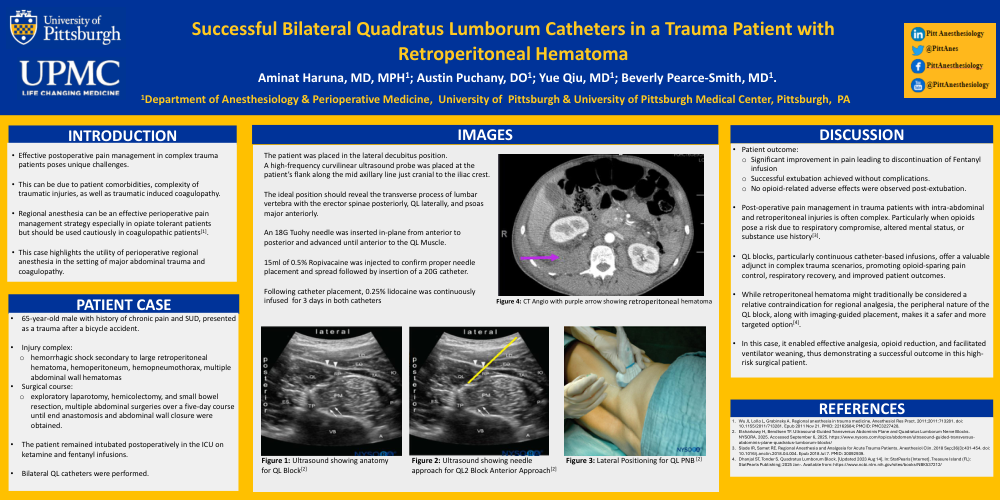
The patient was placed in the lateral decubitus position.
A high-frequency curvilinear ultrasound probe was placed at the patient’s flank along the mid axillary line just cranial to the iliac crest.
The ideal position should reveal the transverse process of lumbar vertebra with the erector spinae posteriorly, QL laterally, and psoas major anteriorly.
An 18G Tuohy needle was inserted in-plane from anterior to posterior and advanced until anterior to the QL Muscle.
15ml of 0.5% Ropivacaine was injected to confirm proper needle placement and spread followed by insertion of a 20G catheter.
Following catheter placement, 0.25% lidocaine was continuously infused for 3 days in both catheters
Discussion:
Patient outcome:
Significant improvement in pain leading to discontinuation of Fentanyl infusion
Successful extubation achieved without complications.
No opioid-related adverse effects were observed post-extubation.
Post-operative pain management in trauma patients with intra-abdominal and retroperitoneal injuries is often complex. Particularly when opioids pose a risk due to respiratory compromise, altered mental status, or substance use history[3].
QL blocks, particularly continuous catheter-based infusions, offer a valuable adjunct in complex trauma scenarios, promoting opioid-sparing pain control, respiratory recovery, and improved patient outcomes.
While retroperitoneal hematoma might traditionally be considered a relative contraindication for regional analgesia, the peripheral nature of the QL block, along with imaging-guided placement, makes it a safer and more targeted option[4].
In this case, it enabled effective analgesia, opioid reduction, and facilitated ventilator weaning, thus demonstrating a successful outcome in this high-risk surgical patient.
References:
Wu JJ, Lollo L, Grabinsky A. Regional anesthesia in trauma medicine. Anesthesiol Res Pract. 2011;2011:713281. doi: 10.1155/2011/713281. Epub 2011 Nov 21. PMID: 22162684; PMCID: PMC3227428.
Elsharkawy H, Bendtsen TF. Ultrasound‑Guided Transversus Abdominis Plane and Quadratus Lumborum Nerve Blocks. NYSORA. 2025. Accessed September 6, 2025. https://www.nysora.com/topics/abdomen/ultrasound-guided-transversus-abdominis-plane-quadratus-lumborum-blocks/
Slade IR, Samet RE. Regional Anesthesia and Analgesia for Acute Trauma Patients. Anesthesiol Clin. 2018 Sep;36(3):431-454. doi: 10.1016/j.anclin.2018.04.004. Epub 2018 Jul 7. PMID: 30092939.
Dhanjal ST, Tonder S. Quadratus Lumborum Block. [Updated 2023 Aug 14]. In: StatPearls [Internet]. Treasure Island (FL): StatPearls Publishing; 2025 Jan-. Available from: https://www.ncbi.nlm.nih.gov/sites/books/NBK537212/