Loading...

358 posters, 97 topics, 122 sessions, 958 authors, 239 institutions

ePostersLive by SciGen Technologies S.A. All rights reserved.

79th PostGraduate Assembly in Anesthesiology 2025

December 12 - 15, 2025 | New York City

79th PostGraduate Assembly in Anesthesiology 2025 banner

4023

Improving the Education Gap in Perioperative Antibiotic Selection for Patients with Penicillin Allergies
Part of Topic

Perioperative Management

INTRODUCTION

 •Misconceptions about penicillin allergies often lead to the use of less effective alternatives.

•Patients who do not receive cephalosporins face a significantly increased risk of developing a surgical site infection (SSI) postoperatively [1].
•SSIs can increase hospital length of stay and readmission rates, leading to poorer patient outcomes and higher hospital expenses [2].
• Our project aims to improve antibiotic selection practices at Northwell by making these changes by July 2025:
•Increasing cephalosporin use in penicillin-allergic patients to at least 75%.
•Conducting at least two targeted educational interventions.
•Expanding data collection across additional sites.
 

METHODS

•Our intervention was tested in iterative cycles through a phased implementation approach:
•We collected baseline data on cephalosporin use in penicillin-allergic patients during the pre-intervention (January-July 2024) period to assess existing prescribing patterns.
•An updated Northwell antibiotic policy was implemented on July 17, 2024.
•We then collected data in the post-intervention (August-December 2024) period to monitor changes in practice.
 

RESULTS

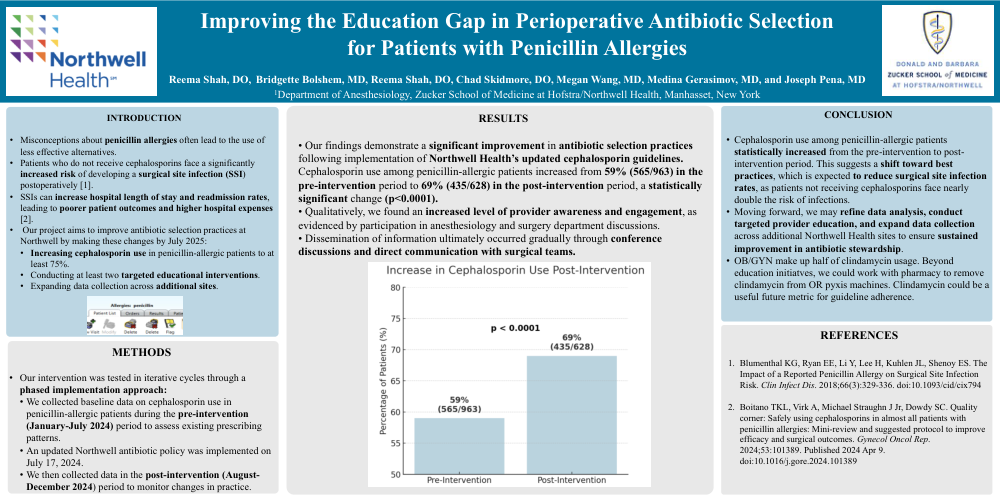
• Our findings demonstrate a significant improvement in antibiotic selection practices following implementation of Northwell Health’s updated cephalosporin guidelines.

Cephalosporin use among penicillin-allergic patients increased from 59% (565/963) in the pre-intervention period to 69% (435/628) in the post-intervention period, a statistically significant change (p<0.0001).

• Qualitatively, we found an increased level of provider awareness and engagement, as evidenced by participation in anesthesiology and surgery department discussions.

• Dissemination of information ultimately occurred gradually through conference discussions and direct communication with surgical teams.


CONCLUSION

•Cephalosporin use among penicillin-allergic patients statistically increased from the pre-intervention to post-intervention period. This suggests a shift toward best practices, which is expected to reduce surgical site infection rates, as patients not receiving cephalosporins face nearly double the risk of infections.
•Moving forward, we may refine data analysis, conduct targeted provider education, and expand data collection across additional Northwell Health sites to ensure sustained improvement in antibiotic stewardship.
•OB/GYN make up half of clindamycin usage. Beyond education initiatves, we could work with pharmacy to remove clindamycin from OR pyxis machines. Clindamycin could be a useful future metric for guideline adherence.
pga2025 banner
Copyright © 2015-2026, ePostersLive® SciGen is a registered trademark of SciGen Technologies S.A. Patent pending.

This website and third-party tools we use rely on cookies for the best user experience. By selecting "I agree", you agree to cookie usage as described in our Privacy Policy.