358 posters, 97 topics, 122 sessions, 958 authors, 239 institutions
ePostersLive by SciGen Technologies S.A. All rights reserved.
79th PostGraduate Assembly in Anesthesiology 2025
December 12 - 15, 2025 | New York City

2060
Anesthetic Management for Patients with Medium-Chain Acyl-CoA Dehydrogenase Deficiency (MCADD): A Case Report
Poster Presenter
Part of Topic
Perioperative Management
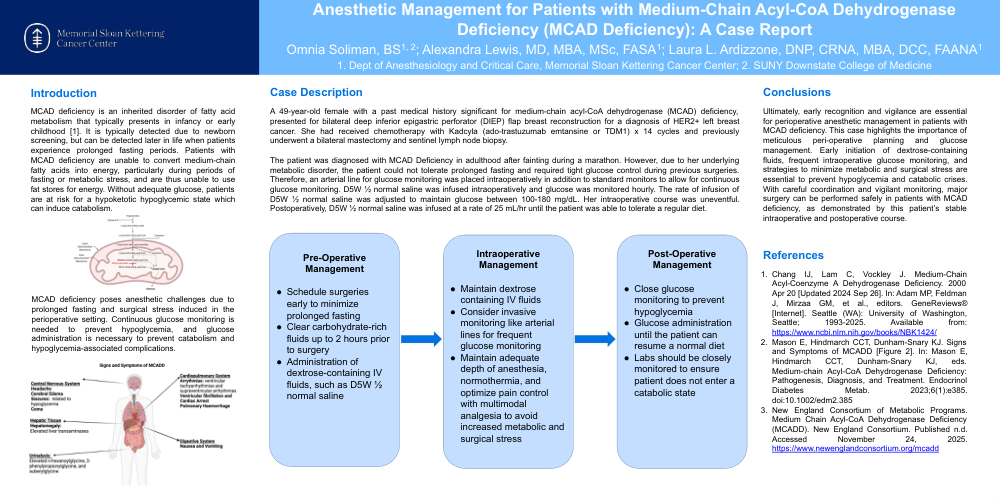
MCAD deficiency is an inherited disorder of fatty acid metabolism that typically presents in infancy or early childhood [1]. It is typically detected due to newborn screening, but can be detected later in life when patients experience prolonged fasting periods. Patients with MCAD deficiency are unable to convert medium-chain fatty acids into energy, particularly during periods of fasting or metabolic stress, and are thus unable to use fat stores for energy. Without adequate glucose, patients are at risk for a hypoketotic hypoglycemic state which can induce catabolism.
MCAD deficiency poses anesthetic challenges due to prolonged fasting and surgical stress induced in the perioperative setting. Continuous glucose monitoring is needed to prevent hypoglycemia, and glucose administration is necessary to prevent catabolism and hypoglycemia-associated complications.
A 49-year-old female with a past medical history significant for medium-chain acyl-CoA dehydrogenase (MCAD) deficiency, presented for bilateral deep inferior epigastric perforator (DIEP) flap breast reconstruction for a diagnosis of HER2+ left breast cancer. She had received chemotherapy with Kadcyla (ado-trastuzumab emtansine or TDM1) x 14 cycles and previously underwent a bilateral mastectomy and sentinel lymph node biopsy.
The patient was diagnosed with MCAD Deficiency in adulthood after fainting during a marathon. However, due to her underlying metabolic disorder, the patient could not tolerate prolonged fasting and required tight glucose control during previous surgeries. Therefore, an arterial line for glucose monitoring was placed intraoperatively in addition to standard monitors to allow for continuous glucose monitoring. D5W ½ normal saline was infused intraoperatively and glucose was monitored hourly. The rate of infusion of D5W ½ normal saline was adjusted to maintain glucose between 100-180 mg/dL. Her intraoperative course was uneventful. Postoperatively, D5W ½ normal saline was infused at a rate of 25 mL/hr until the patient was able to tolerate a regular diet.
Ultimately, early recognition and vigilance are essential for perioperative anesthetic management in patients with MCAD deficiency. This case highlights the importance of meticulous peri-operative planning and glucose management. Early initiation of dextrose-containing fluids, frequent intraoperative glucose monitoring, and strategies to minimize metabolic and surgical stress are essential to prevent hypoglycemia and catabolic crises. With careful coordination and vigilant monitoring, major surgery can be performed safely in patients with MCAD deficiency, as demonstrated by this patient’s stable intraoperative and postoperative course.