358 posters, 97 topics, 122 sessions, 958 authors, 239 institutions
ePostersLive by SciGen Technologies S.A. All rights reserved.
79th PostGraduate Assembly in Anesthesiology 2025
December 12 - 15, 2025 | New York City

4016
A Subset Analysis: Understanding Factors Leading to Surgical Delay for Patients with Hip Fractures
Poster Presenter
Authors
Affiliations
Part of Topic
Perioperative Management
BACKGROUND
Timely surgical intervention for hip fractures is critical, as
delays beyond 24 hours after admission is associated
with increased morbidity and mortality. (1)
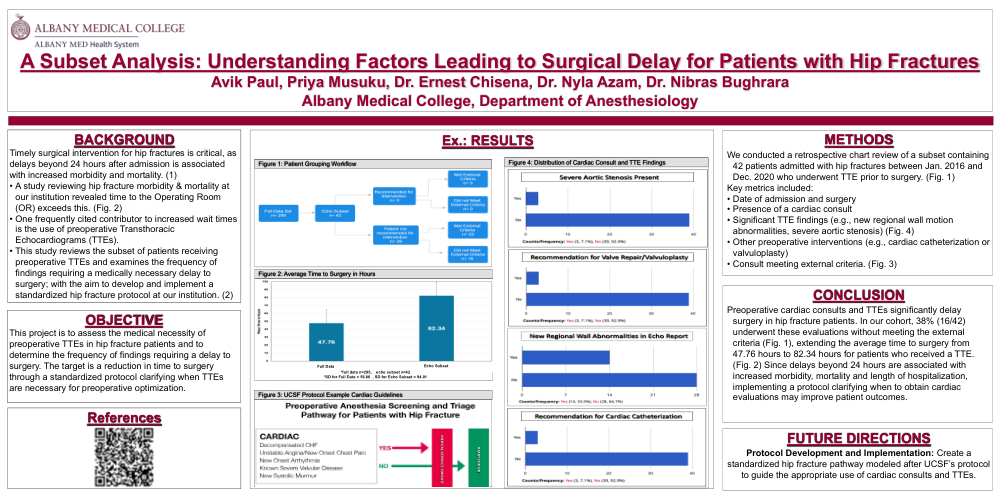
• A study reviewing hip fracture morbidity & mortality at
our institution revealed time to the Operating Room
(OR) exceeds this. (Fig. 2)
• One frequently cited contributor to increased wait times
is the use of preoperative Transthoracic
Echocardiograms (TTEs).
• This study reviews the subset of patients receiving
preoperative TTEs and examines the frequency of
findings requiring a medically necessary delay to
surgery; with the aim to develop and implement a
standardized hip fracture protocol at our institution. (2)
OBJECTIVE
This project is to assess the medical necessity of
preoperative TTEs in hip fracture patients and to
determine the frequency of findings requiring a delay to
surgery. The target is a reduction in time to surgery
through a standardized protocol clarifying when TTEs
are necessary for preoperative optimization.
METHODS
We conducted a retrospective chart review of a subset containing
42 patients admitted with hip fractures between Jan. 2016 and
Dec. 2020 who underwent TTE prior to surgery. (Fig. 1)
Key metrics included:
• Date of admission and surgery
• Presence of a cardiac consult
• Significant TTE findings (e.g., new regional wall motion
abnormalities, severe aortic stenosis) (Fig. 4)
• Other preoperative interventions (e.g., cardiac catheterization or
valvuloplasty)
• Consult meeting external criteria. (Fig. 3)
CONCLUSION
Preoperative cardiac consults and TTEs significantly delay
surgery in hip fracture patients. In our cohort, 38% (16/42)
underwent these evaluations without meeting the external
criteria (Fig. 1), extending the average time to surgery from
47.76 hours to 82.34 hours for patients who received a TTE.
(Fig. 2) Since delays beyond 24 hours are associated with
increased morbidity, mortality and length of hospitalization,
implementing a protocol clarifying when to obtain cardiac
evaluations may improve patient outcomes.
FUTURE DIRECTIONS
Protocol Development and Implementation: Create a
standardized hip fracture pathway modeled after UCSF’s protocol
to guide the appropriate use of cardiac consults and TTEs.