358 posters, 97 topics, 122 sessions, 958 authors, 239 institutions
ePostersLive by SciGen Technologies S.A. All rights reserved.
79th PostGraduate Assembly in Anesthesiology 2025
December 12 - 15, 2025 | New York City

3152
Perioperative Gait Analysis Following Lower Extremity Amputation: Implications for Anesthesia Risk Stratification
Poster Presenter
Part of Topic
Perioperative Management - Regional and Acute Pain
| Perioperative Gait Analysis Following Lower Extremity Amputation: Implications for Anesthesia Risk Stratification | |
| Patients undergoing limb salvage or amputation often present with complex comorbidities, such as peripheral vascular disease, diabetes, and neuropathy, which compound perioperative risk. Beyond medical optimization, these patients frequently exhibit altered gait, balance, and proprioception—factors that are critical when planning anesthetic management. Impaired mobility can increase susceptibility to perioperative falls, delayed ambulation, and prolonged recovery, particularly after neuraxial or regional anesthesia. For anesthesiologists, understanding the functional limitations imposed by various levels of amputation is essential when tailoring perioperative care, including decisions around block selection, hemodynamic support, and postoperative physical therapy coordination. While transmetatarsal amputation (TMA) is typically preferred over below-knee amputation (BKA) to preserve mobility, limited evidence exists comparing functional outcomes between these groups. This study ai ms to objectively quantify gait and balance differences across amputation levels to inform anesthetic risk stratification and promote safer, individualized perioperative plans for this high-risk population. | |
| A retrospective cohort study was conducted from June 2021 to July 2024 among adults =45 years old presenting to a tertiary wound care center. Participants who could ambulate unassisted and had no pain, wounds, or lower extremity surgery in the past 90 days were enrolled. Patients were stratified into three groups: no amputation, TMA, or BKA. Gait data was collected using Opal wearable sensors (ADPM) during a 120-second walk and 30-second Romberg sway test. Extracted parameters included gait speed, cadence, step duration, mid-swing elevation, limb support times, stride length, and RMS sway. Patient demographics and comorbidities (e.g., PVD, neuropathy, CKD) were recorded. Gait differences were analyzed using t-tests and multivariate regression controlling for age, sex, and Charlson Comorbidity Index. Anesthesia-relevant outcomes included RMS sway (for balance) and mid-swing elevation (for fall risk stratification). | |
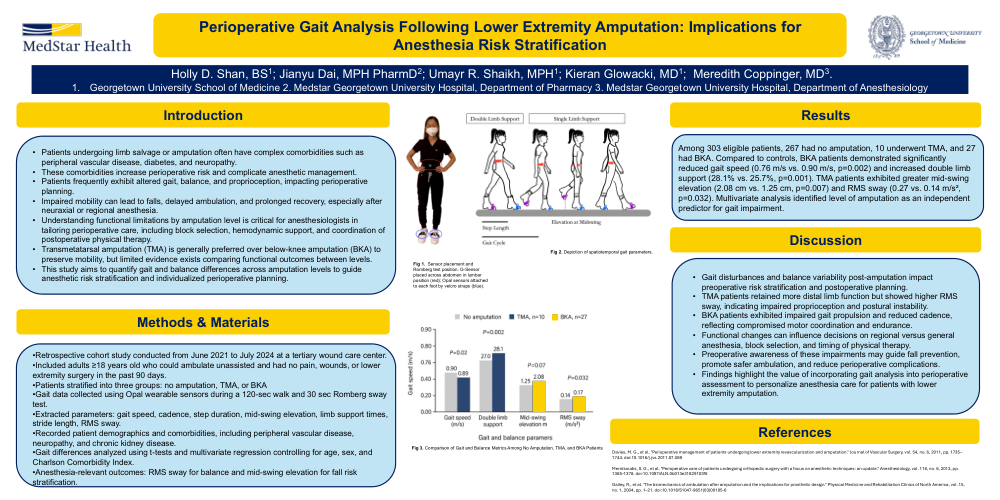
| Among 303 eligible patients, 267 had no amputation, 10 underwent TMA, and 27 had BKA. Compared to controls, BKA patients demonstrated significantly reduced gait speed (0.76 m/s vs. 0.90 m/s, p=0.002) and increased double limb support (28.1% vs. 25.7%, p=0.001). TMA patients exhibited greater mid-swing elevation (2.08 cm vs. 1.25 cm, p=0.007) and RMS sway (0.27 vs. 0.14 m/s², p=0.032). Multivariate analysis identified level of amputation as an independent predictor for gait impairment. | |
| From an anesthetic perspective, gait disturbances and balance variability post-amputation have implications for preoperative risk stratification and postoperative planning. TMA patients, despite retaining more distal limb function, exhibited higher RMS sway, suggesting impaired proprioception and greater postural instability during standing. Conversely, BKA patients demonstrated impaired gait propulsion and reduced cadence, which may reflect compromised motor coordination and endurance. These functional changes can affect decisions on regional versus general anesthesia, block selection, and physical therapy timing. Awareness of these impairments preoperatively may guide fall prevention protocols, promote safer ambulation, and reduce perioperative complications. Our findings underscore the importance of incorporating gait analysis into perioperative assessment to personalize anesthesia care for patients with lower extremity amputation. | |
| Davies, M. G., et al. "Perioperative management of patients undergoing lower extremity revascularization and amputation." Journal of Vascular Surgery, vol. 54, no. 6, 2011, pp. 1735–1744. doi:10.1016/j.jvs.2011.07.089 Memtsoudis, S. G., et al. "Perioperative care of patients undergoing orthopedic surgery with a focus on anesthetic techniques: an update." Anesthesiology, vol. 118, no. 6, 2013, pp. 1365–1378. doi:10.1097/ALN.0b013e31829103f6 Gailey, R., et al. "The biomechanics of ambulation after amputation and the implications for prosthetic design." Physical Medicine and Rehabilitation Clinics of North America, vol. 15, no. 1, 2004, pp. 1–21. doi:10.1016/S1047-9651(03)00105-6 |
|
| Saturday, December 13 | |
| Perioperative Management Regional and Acute Pain |