358 posters, 97 topics, 122 sessions, 958 authors, 239 institutions
ePostersLive by SciGen Technologies S.A. All rights reserved.
79th PostGraduate Assembly in Anesthesiology 2025
December 12 - 15, 2025 | New York City

3120
Diaphragmatic Breathing and Pain Control in the First 24 Hours After Primary Total Knee Arthroplasty: A Non-Randomized Clinical Study
Poster Presenter
Authors
Brandon Tang, Sean Woytowitz, Denny Cha, Mahsa Babaei, Yao-Ping Zhang, Christina Ratto
Affiliations
Part of Topic
Perioperative Management - Regional and Acute Pain
Diaphragmatic Breathing and Pain Control in the First 24 Hours After Primary Total Knee Arthroplasty: A Non-Randomized Clinical Study
Intro
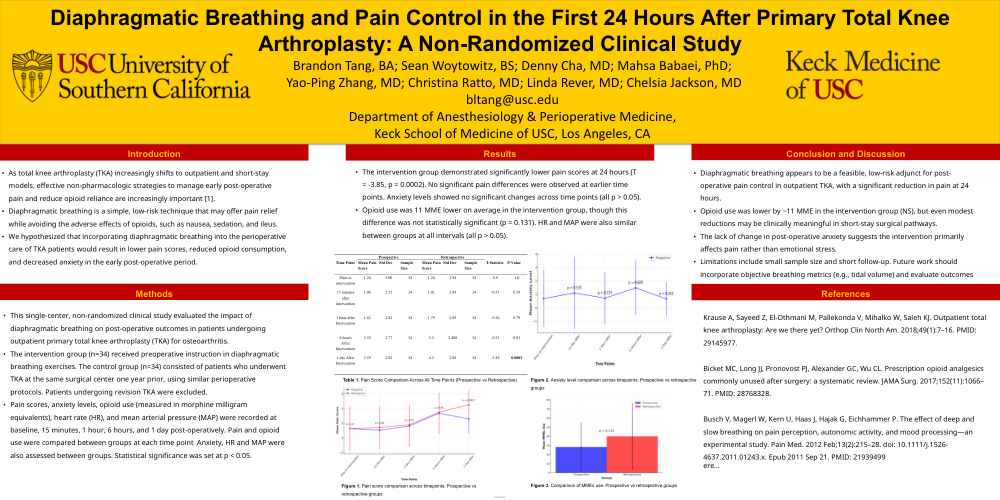
As total knee arthroplasty (TKA) increasingly shifts to outpatient and short-stay models, effective non-pharmacologic strategies to manage early post-operative pain and reduce opioid reliance are increasingly important [1]. Diaphragmatic breathing is a simple, low-risk technique that may offer pain relief while avoiding the adverse effects of opioids, such as nausea, sedation, and ileus. We hypothesized that incorporating diaphragmatic breathing into the perioperative care of TKA patients would result in lower pain scores, reduced opioid consumption, and decreased anxiety in the early post-operative period.
Methods
This single-center, non-randomized clinical study evaluated the impact of diaphragmatic breathing on post-operative outcomes in patients undergoing outpatient primary total knee arthroplasty (TKA) for osteoarthritis. The intervention group (n=34) received preoperative instruction in diaphragmatic breathing exercises. The control group (n=34) consisted of patients who underwent TKA at the same surgical center one year prior, using similar perioperative protocols. Patients undergoing revision TKA were excluded.
Pain scores, anxiety levels, opioid use (measured in morphine milligram equivalents), heart rate (HR), and mean arterial pressure (MAP) were recorded at baseline, 15 minutes, 1 hour, 6 hours, and 1 day post-operatively. Pain and opioid use were compared between groups at each time point using the Mann-Whitney U test; pain trends over time were also assessed using repeated measures ANOVA. Anxiety was analyzed using a mixed-effects model, with time as a fixed effect and patients as random effects; Tukey’s HSD test was used for pairwise comparisons. HR and MAP were also assessed between groups using the Mann-Whitney U test. Statistical significance was set at p < 0.05. All analyses were performed using R version 4.2.3.
Results
The intervention group demonstrated significantly lower pain scores at 24 hours (T = -3.85, p = 0.0002). No significant pain differences were observed at earlier time points. Anxiety levels showed no significant changes across time points (all p > 0.05). Opioid use was 11 MME lower on average in the intervention group, though this difference was not statistically significant (p = 0.131). HR and MAP were also similar between groups at all intervals (all p > 0.05).
Conclusion/Discussion
Diaphragmatic breathing may serve as a feasible, non-pharmacologic adjunct for post-operative pain management in outpatient TKA. A significant reduction in pain at 24 hours suggests benefit during the transition from anesthesia to discharge. Although opioid use trended lower in the intervention group (11 MME on average), the difference was not statistically significant. However, even modest reductions in opioid exposure during the perioperative period may be clinically meaningful, particularly in short-stay surgical settings where discharge with opioid prescriptions is routine. Prior studies have shown that unused opioids after surgery are a major source of diversion and misuse [2]. The intervention did not significantly impact post-operative anxiety levels, suggesting a more specific effect on pain relief than emotional stress. Study limitations include small sample size, short follow-up, and lack of physiologic measures of breathing quality. Future studies might consider objective metrics such as tidal volume or respiratory rate to assess engagement with the breathing technique, and explore additional endpoints such as discharge readiness and patient satisfaction.
Diaphragmatic breathing may serve as a feasible, non-pharmacologic adjunct for post-operative pain management in outpatient TKA. A significant reduction in pain at 24 hours suggests benefit during the transition from anesthesia to discharge. Although opioid use trended lower in the intervention group (11 MME on average), the difference was not statistically significant. Still, modest reductions in perioperative opioid exposure may be clinically meaningful, especially in short-stay surgical settings where opioid prescriptions are routine. Prior studies have shown that unused opioids after surgery are a major source of diversion and misuse [2]. The intervention did not significantly impact post-operative anxiety, suggesting a more targeted effect on pain rather than emotional stress. Limitations include small sample size, short follow-up, and no physiologic measures of breathing quality. Future studies should consider objective metrics (e.g., tidal volume, respiratory rate) to assess engagement and explore additional endpoints such as discharge readiness and patient satisfaction.
References
Krause A, Sayeed Z, El-Othmani M, Pallekonda V, Mihalko W, Saleh KJ. Outpatient total knee arthroplasty: Are we there yet? Orthop Clin North Am. 2018;49(1):7–16. PMID: 29145977.
Bicket MC, Long JJ, Pronovost PJ, Alexander GC, Wu CL. Prescription opioid analgesics commonly unused after surgery: a systematic review. JAMA Surg. 2017;152(11):1066–71. PMID: 28768328.
Busch V, Magerl W, Kern U, Haas J, Hajak G, Eichhammer P. The effect of deep and slow breathing on pain perception, autonomic activity, and mood processing—an experimental study. Pain Med. 2012 Feb;13(2):215–28. doi: 10.1111/j.1526-4637.2011.01243.x. Epub 2011 Sep 21. PMID: 21939499