358 posters, 97 topics, 122 sessions, 958 authors, 239 institutions
ePostersLive by SciGen Technologies S.A. All rights reserved.
79th PostGraduate Assembly in Anesthesiology 2025
December 12 - 15, 2025 | New York City

3070
Mitigating Aspiration Risk in GLP-1 Agonist Users: A Potential Role for Preoperative Proton Pump Inhibitors
Poster Presenter
Authors
Affiliations
Rowan-Virtua School of Osteopathic Medicine, CUNY School of Medicine
Part of Topic
Perioperative Management
Abstract
Title: Mitigating Aspiration Risk in GLP-1 Agonist Users: A Potential Role for Preoperative Proton Pump Inhibitors
Presenting author: Umar Sannoh, Daniel Annan, Dr. Donna Kiel, MD
Introduction/Background:
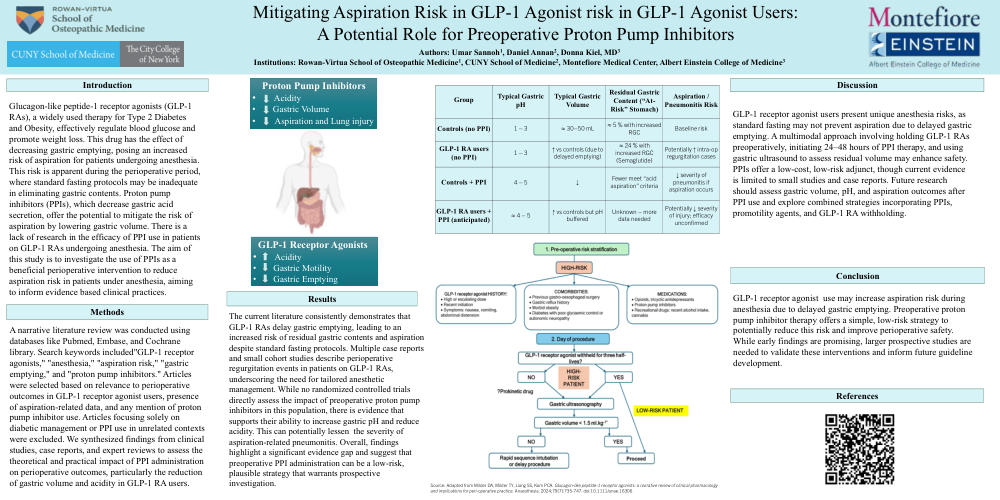
Glucagon-like peptide-1 receptor agonists (GLP-1 RAs), a widely used therapy for type 2 diabetes and obesity, effectively regulate blood glucose and promote weight loss. This drug has the effect of decreasing gastric emptying, posing an increased risk of aspiration for patients undergoing anesthesia. This risk is apparent during the perioperative period, where standard fasting protocols may be inadequate in eliminating gastric contents. Proton pump inhibitors (PPIs), which decrease gastric acid secretion, offer the potential to mitigate the risk of aspiration by lowering gastric volume. There is a lack of research in the efficacy of PPI use in patients on GLP-1 RAs undergoing anesthesia. The aim of this study is to investigate the use of PPIs as a beneficial perioperative intervention to reduce aspiration risk in patients under anesthesia, aiming to inform evidence based clinical practices.
Objectives:
The aim of this literature review is to evaluate existing literature regarding the risk of aspiration in GLP-1 receptor agonist users undergoing anesthesia and assess whether preoperative PPI use could reduce the incidence or severity of aspiration events.
Methods:
A narrative literature review was conducted using databases like Pubmed, Embase, and Cochrane library. Search keywords included "GLP-1 receptor agonists," "anesthesia," "aspiration risk," "gastric emptying," and "proton pump inhibitors." Articles were selected based on relevance to perioperative outcomes in GLP-1 receptor antagonists users, presence of aspiration-related data, and any mention of proton pump inhibitor use. Articles focusing solely on diabetic management or PPI use in unrelated contexts were excluded. We synthesized findings from clinical studies, case reports, and expert reviews to assess the theoretical and practical impact of PPI administration on perioperative outcomes, particularly the reduction of gastric volume and acidity in GLP-1 RA users
Discussion:
Patients on GLP-1 receptor antagonists are currently at risk of pulmonary aspiration while under anesthesia. Due to lack of robust evidence of the use of PPIs in patients on GLP-1 RAs, we suggest preoperative use of PPIs to reduce gastric acidity and volume, therefore mitigating aspiration risks. Further research efforts should be conducted to highlight the significance of this intervention for patients on GLP-1 receptor antagonists who will undergo anesthesia.