358 posters, 97 topics, 122 sessions, 958 authors, 239 institutions
ePostersLive by SciGen Technologies S.A. All rights reserved.
79th PostGraduate Assembly in Anesthesiology 2025
December 12 - 15, 2025 | New York City

3036
Uvular Injury: A Review of the Literature
Poster Presenter
Authors
Affiliations
Part of Topic
Airway - Perioperative Management
Uvular Injury: A Narrative Review
Sheetal D. Bapu B.S.1, Serena J. Tan B.S.1, Sridhar R. Musuku M.D.2, Divya Cherukupalli M.D.2, Alexander D. Shapeton M.D.3
1Albany Medical College, Albany, NY, USA
2Department of Anesthesiology, Albany Medical Health System, Albany, NY, USA
3Department of Anesthesiology, Critical Care and Pain Medicine, Boston Veterans Affairs Healthcare System and Tufts University School of Medicine, Boston, MA, USA
Background
The uvula plays essential roles in velopharyngeal closure, speech, mucosal lubrication, immune defense, and aspiration prevention.
Uvular injury is uncommon but often under-recognized, presenting with sore throat, dysphagia, odynophagia, foreign-body sensation, and rarely airway obstruction.
Etiologies span multiple specialties and include:
Mechanical trauma from airway or endoscopic devices
Non-mechanical angioedema and medication-related reactions
Infectious causes
Pediatric trauma, infections, and hair-thread tourniquet syndrome
Idiopathic isolated uvular edema
No standardized diagnostic or management guidelines exist.
Methods
Conducted a narrative review of MEDLINE, Embase, and Google Scholar (1978–2025).
Search terms included uvular injury, uvular necrosis, uvulitis, uvular edema, and related terms.
Included case reports/series, retrospective studies, and reviews; excluded congenital palate conditions and unrelated studies.
Two reviewers independently screened and extracted data on demographics, procedures, mechanisms, symptoms, treatments, and resolution timelines.
Cases were categorized as mechanical, non-mechanical, infectious, idiopathic, or pediatric.
Results
|
Table 1: Summary Table of Uvular Injury |
||||
|
Avg. Age |
Male: Female Ratio |
Most Common Instruments Used |
Common Presentation |
Management |
|
Mechanical Causes of Uvular Injury |
||||
|
38.7 |
2.9:1 |
ETT, Upper GI endoscope |
Uvular edema and necrosis, sore throat, foreign body sensation, dysphagia, and odynophagia |
Conservative with analgesics |
|
Non-Mechanical Causes of Uvular Injury |
||||
|
36.8 |
1:0 |
Cocaine Use |
Uvular edema, sore throat, dysphagia, and foreign body sensation. |
Corticosteroid |
|
Infectious Causes of Uvular Injury |
||||
|
43.7 |
1:0 |
COVID-19 Infection |
Uvular edema, foreign body sensation and sore throat |
Treat the underlying cause |
|
Idiopathic causes of Uvular Injury |
||||
|
24 |
1:1 |
N/A |
Uvular edema, sore throat, foreign body sensation, and dysphagia |
Corticosteroid |
|
Pediatric Cases of Uvular Injury |
||||
|
4.5 |
7:8 |
Mechanical injury and uvulitis |
Fever, sore throat, lethargy, drooling, and irritability |
Antibiotics, analgesic |
|
Table 2: Grading system of uvular injury secondary to endotracheal intubation |
||||
|
Grade |
Type of Injury |
Clinical Presentation and Exam Findings |
Management and Intervention |
Notes |
|
I |
Uvular Edema |
Distended, enlarged, translucent, shiny uvula with increased turgor and acute swelling |
Conservative management (saline gargles, topical anesthetics, antihistamines, mouthwashes) |
Typically self-resolving; no surgical intervention necessary |
|
II |
Uvulitis |
Erythematous, inflamed uvula, possible minor hemorrhages or ecchymoses |
Conservative management, may require steroids or antibiotics if persistent inflammation or secondary infection is suspected |
Often responsive to initial conservative measures |
|
III |
Uvular Necrosis |
Clearly demarcated necrotic areas (dark red or gray-white), significant swelling, necrosis of tip |
Initial conservative management, surgical excision considered if conservative management fails or clear demarcation of devitalized tissue exists after two weeks |
Surgical intervention considered based on clinical progression |
|
IV |
Uvular Auto-amputation |
Shortened uvula, irregular borders following spontaneous amputation |
Generally no intervention, microsurgical reconstruction may be considered if significant velopharyngeal insufficiency occurs |
Rarely requires intervention, mostly self-resolving |
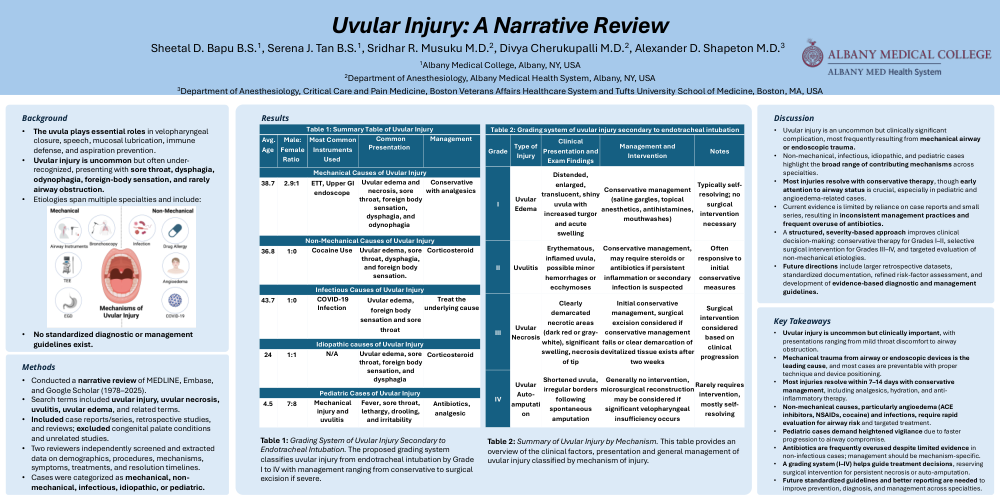
Table 1: Grading System of Uvular Injury Secondary to Endotracheal Intubation. The proposed grading system classifies uvular injury from endotracheal intubation by Grade I to IV with management ranging from conservative to surgical excision if severe.
Table 2: Summary of Uvular Injury by Mechanism. This table provides an overview of the clinical factors, presentation and general management of uvular injury classified by mechanism of injury.
Discussion
Uvular injury is an uncommon but clinically significant complication, most frequently resulting from mechanical airway or endoscopic trauma.
Non-mechanical, infectious, idiopathic, and pediatric cases highlight the broad range of contributing mechanisms across specialties.
Most injuries resolve with conservative therapy, though early attention to airway status is crucial, especially in pediatric and angioedema-related cases.
Current evidence is limited by reliance on case reports and small series, resulting in inconsistent management practices and frequent overuse of antibiotics.
A structured, severity-based approach improves clinical decision-making: conservative therapy for Grades I–II, selective surgical intervention for Grades III–IV, and targeted evaluation of non-mechanical etiologies.
Future directions include larger retrospective datasets, standardized documentation, refined risk-factor assessment, and development of evidence-based diagnostic and management guidelines.
Key Takeaways
Uvular injury is uncommon but clinically important, with presentations ranging from mild throat discomfort to airway obstruction.
Mechanical trauma from airway or endoscopic devices is the leading cause, and most cases are preventable with proper technique and device positioning.
Most injuries resolve within 7–14 days with conservative management, including analgesics, hydration, and anti-inflammatory therapy.
Non-mechanical causes, particularly angioedema (ACE inhibitors, NSAIDs, cocaine) and infections, require rapid evaluation for airway risk and targeted treatment.
Pediatric cases demand heightened vigilance due to faster progression to airway compromise.
Antibiotics are frequently overused despite limited evidence in non-infectious cases; management should be mechanism-specific.
A grading system (I–IV) helps guide treatment decisions, reserving surgical intervention for persistent necrosis or auto-amputation.
Future standardized guidelines and better reporting are needed to improve prevention, diagnosis, and management across specialties.