358 posters, 97 topics, 122 sessions, 958 authors, 239 institutions
ePostersLive by SciGen Technologies S.A. All rights reserved.
79th PostGraduate Assembly in Anesthesiology 2025
December 12 - 15, 2025 | New York City

3008
The Impact of Preoperative Scalp Blocks on Opioid Consumption and Length of Stay in Deep Brain Stimulation Surgery: A Retrospective Analysis
Part of Topic
Perioperative Management - Regional and Acute Pain
The Impact of Preoperative Scalp Blocks on Opioid Consumption and Length of Stay in Deep Brain Stimulation Surgery: A Retrospective Analysis
Scalp blocks have been shown to be effective in craniotomy procedures, significantly reducing postoperative pain scores and opioid consumption. [1] Multiple studies on craniotomies have explored the use of various local anesthetics to compare their effects on postoperative pain and opioid requirements. [2-5] However, limited research exists on the benefits of scalp blocks in patients undergoing deep brain stimulation (DBS) surgery. DBS surgery, as with any surgery, is associated with postoperative pain, which is often managed with opioids.
Opioid use in the perioperative setting can contribute to prolonged opioid dependence, increased hospital stays, and opioid-related adverse effects. The opioid epidemic remains a major public health crisis, with over 80,00 opioid-related overdose deaths in the U.S. from 2023 to 2024 alone. [6] Reducing perioperative opioid exposure through multimodal analgesia, including regional anesthesia techniques like scalp blocks, may help mitigate opioid-related complications and support enhanced recovery after surgery.
This study evaluates the impact of preoperative scalp blocks on opioid use and length of stay in patients undergoing DBS surgery, contributing to the broader effort to minimize opioid reliance in postoperative pain management.
A retrospective analysis was performed to compare outcomes between patients who received a preoperative scalp block and those who did not (n = 70; 35 in each group). The scalp block group included patients who received bupivacaine 0.25%, bupivacaine 0.5%, or bupivacaine 0.5% with additives such as dexamethasone or dexmedetomidine. The primary outcomes assessed were opioid consumption, measured in morphine milligram equivalents (MME), in the post-anesthesia care unit (PACU) and during the first 24 hours postoperatively. Secondary outcomes included hospital length of stay. Descriptive statistics and independent t-tests were employed to compare outcomes between the two groups.
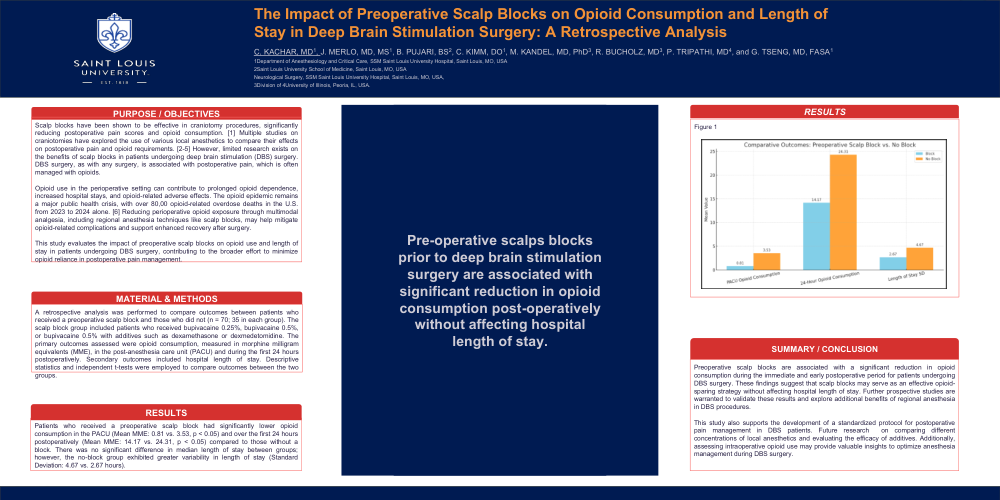
Patients who received a preoperative scalp block had significantly lower opioid consumption in the PACU (Mean MME: 0.81 vs. 3.53, p < 0.05) and over the first 24 hours postoperatively (Mean MME: 14.17 vs. 24.31, p < 0.05) compared to those without a block. There was no significant difference in median length of stay between groups; however, the no-block group exhibited greater variability in length of stay (Standard Deviation: 4.67 vs. 2.67 hours).
Preoperative scalp blocks are associated with a significant reduction in opioid consumption during the immediate and early postoperative period for patients undergoing DBS surgery. These findings suggest that scalp blocks may serve as an effective opioid-sparing strategy without affecting hospital length of stay. Further prospective studies are warranted to validate these results and explore additional benefits of regional anesthesia in DBS procedures.
This study also supports the development of a standardized protocol for postoperative pain management in DBS patients. Future research on comparing different concentrations of local anesthetics and evaluating the efficacy of additives. Additionally, assessing intraoperative opioid use may provide valuable insights to optimize anesthesia management during DBS surgery.