358 posters, 97 topics, 122 sessions, 958 authors, 239 institutions
ePostersLive by SciGen Technologies S.A. All rights reserved.
79th PostGraduate Assembly in Anesthesiology 2025
December 12 - 15, 2025 | New York City

2233
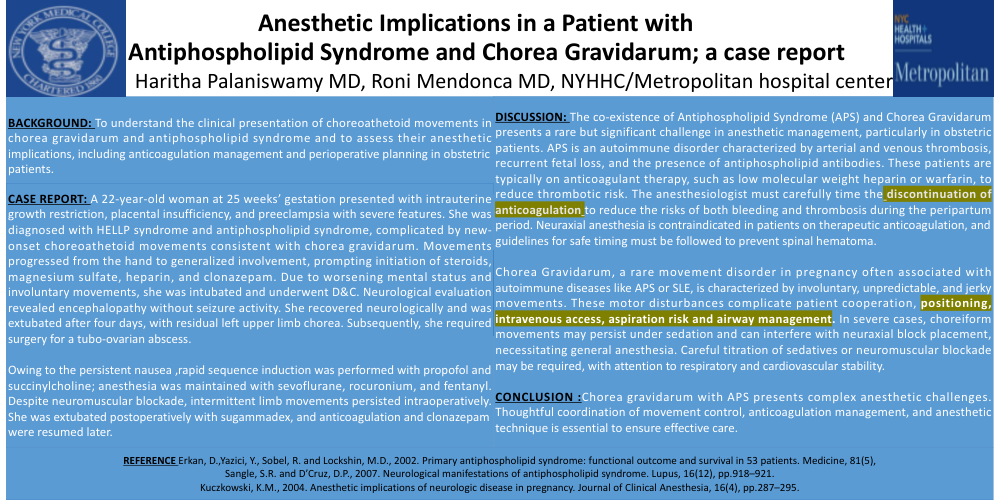
Anesthetic Implications in a Patient with Antiphospholipid Syndrome and Chorea Gravidarum ; a case report
Poster Presenter
Authors
Affiliations
Part of Topic
Perioperative Management
| Anesthetic Implications in a Patient with Antiphospholipid Syndrome and Chorea Gravidarum ; a case report | |
| To understand the clinical presentation of choreoathetoid movements in chorea gravidarum and antiphospholipid syndrome and to assess their anesthetic implications, including anticoagulation management and perioperative planning in obstetric patients. | |
| A 22-year-old woman at 25 weeks’ gestation presented with intrauterine growth restriction, placental insufficiency, and preeclampsia with severe features. She was diagnosed with HELLP syndrome and antiphospholipid syndrome, complicated by new-onset choreoathetoid movements consistent with chorea gravidarum. Movements progressed from the hand to generalized involvement, prompting initiation of steroids, magnesium sulfate, heparin, and clonazepam. Due to worsening mental status and involuntary movements, she was intubated and underwent D&C. Neurological evaluation revealed encephalopathy without seizure activity. She recovered neurologically and was extubated after four days, with residual left upper limb chorea. Subsequently, she required surgery for a tubo-ovarian abscess. Owing to the persistent nausea ,rapid sequence induction was performed with propofol and succinylcholine; anesthesia was maintained with sevoflurane, rocuronium, and fentanyl. Despite neuromuscular blockade, intermittent limb movements persisted intraoperatively. She was extubated postoperatively with sugammadex, and anticoagulation and clonazepam were resumed later. | |
| The co-existence of Antiphospholipid Syndrome (APS) and Chorea Gravidarum presents a rare but significant challenge in anesthetic management, particularly in obstetric patients. APS is an autoimmune disorder characterized by arterial and venous thrombosis, recurrent fetal loss, and the presence of antiphospholipid antibodies. These patients are typically on anticoagulant therapy, such as low molecular weight heparin or warfarin, to reduce thrombotic risk. The anesthesiologist must carefully time the discontinuation of anticoagulation to reduce the risks of both bleeding and thrombosis during the peripartum period. Neuraxial anesthesia is contraindicated in patients on therapeutic anticoagulation, and guidelines for safe timing must be followed to prevent spinal hematoma. Chorea Gravidarum, a rare movement disorder in pregnancy often associated with autoimmune diseases like APS or systemic lupus erythematosus, is characterized by involuntary, unpredictable, and jerky movements. These motor disturbances complicate patient cooperation, positioning, intravenous access, and airway management. In severe cases, choreiform movements may persist under sedation and can interfere with neuraxial block placement, necessitating general anesthesia. Careful titration of sedatives or neuromuscular blockade may be required, with attention to respiratory and cardiovascular stability. The anesthetic plan should be multidisciplinary, involving obstetrics, neurology, and hematology. An individualized, risk-balanced anesthetic approach is essential in these cases. |
|
| Erkan, D., Yazici, Y., Sobel, R. and Lockshin, M.D., 2002. Primary antiphospholipid syndrome: functional outcome and survival in 53 patients. Medicine, 81(5), pp.281–288. Sangle, S.R. and D’Cruz, D.P., 2007. Neurological manifestations of antiphospholipid syndrome. Lupus, 16(12), pp.918–921. Kuczkowski, K.M., 2004. Anesthetic implications of neurologic disease in pregnancy. Journal of Clinical Anesthesia, 16(4), pp.287–295. |