Loading...

358 posters, 97 topics, 122 sessions, 958 authors, 239 institutions

ePostersLive by SciGen Technologies S.A. All rights reserved.

79th PostGraduate Assembly in Anesthesiology 2025

December 12 - 15, 2025 | New York City

79th PostGraduate Assembly in Anesthesiology 2025 banner

2219

Anesthesia for laparoscopic surgery in patient with pulmonary hypertension
Part of Topic

Perioperative Management

Anesthesia for laparoscopic surgery in patient with pulmonary hypertension

Presenter: Aleksandra Nikolić

Authors: Nataša Petrović, Adi Hadzibegović, Bojan Jovanović, Marija Milenković, Miodrag Milenović


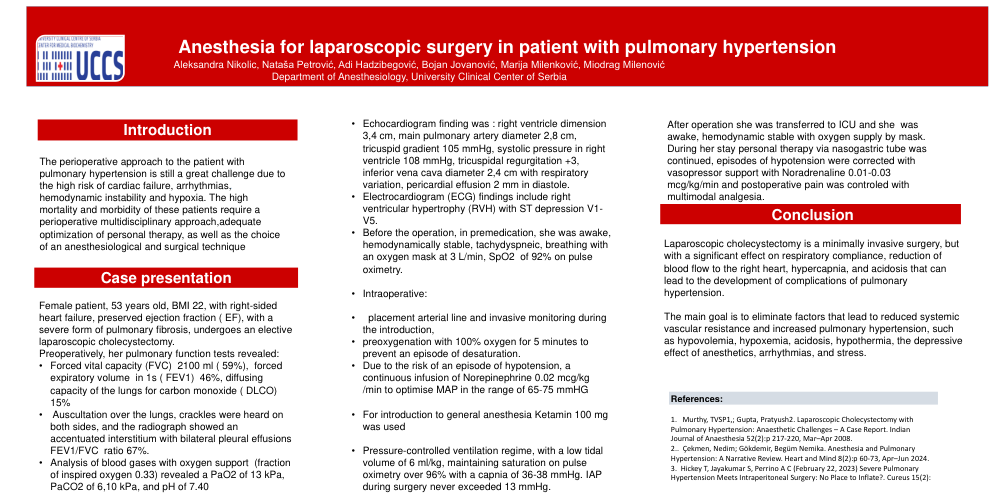
The perioperative approach to the patient with pulmonary hypertension is still a great challenge due to the high risk of cardiac failure, arrhythmias, hemodynamic instability and hypoxia. The high mortality and morbidity of these patients require a perioperative multidisciplinary approach,adequate optimization of personal therapy, as well as the choice of an anesthesiological and surgical technique.

Female patient, 53 years old, BMI 22, with right-sided heart failure, preserved ejection fraction ( EF), with a severe form of pulmonary fibrosis, undergoes an elective laparoscopic cholecystectomy.

Preoperatively, her pulmonary function tests revealed:

•Forced vital capacity (FVC)  2100 ml ( 59%),  forced expiratory volume  in 1s ( FEV1)  46%, diffusing capacity of the lungs for carbon monoxide ( DLCO)  15%
• Auscultation over the lungs, crackles were heard on both sides, and the radiograph showed an accentuated interstitium with bilateral pleural effusions  FEV1/FVC  ratio 67%.
•Analysis of blood gases with oxygen support  (fraction of inspired oxygen 0.33) revealed a PaO2 of 13 kPa, PaCO2 of 6,10 kPa, and pH of 7.40
 
•Echocardiogram finding was : right ventricle dimension  3,4 cm, main pulmonary artery diameter 2,8 cm, tricuspid gradient 105 mmHg, systolic pressure in right ventricle 108 mmHg, tricuspidal regurgitation +3,  inferior vena cava diameter 2,4 cm with respiratory variation, pericardial effusion 2 mm in diastole.
•Electrocardiogram (ECG) findings include right ventricular hypertrophy (RVH) with ST depression V1-V5.
•Before the operation, in premedication, she was awake, hemodynamically stable, tachydyspneic, breathing with an oxygen mask at 3 L/min, SpO2  of 92% on pulse oximetry.
•
•Intraoperative:
•  placement arterial line and invasive monitoring during the introduction,
•preoxygenation with 100% oxygen for 5 minutes to prevent an episode of desaturation.
•Due to the risk of an episode of hypotension, a continuous infusion of Norepinephrine 0.02 mcg/kg /min to optimise MAP in the range of 65-75 mmHG
•
•For introduction to general anesthesia Ketamin 100 mg was used
•
•Pressure-controlled ventilation regime, with a low tidal volume of 6 ml/kg, maintaining saturation on pulse oximetry over 96% with a capnia of 36-38 mmHg. IAP during surgery never exceeded 13 mmHg.
 

Laparoscopic cholecystectomy is a minimally invasive surgery, but with a significant effect on respiratory compliance, reduction of blood flow to the right heart, hypercapnia, and acidosis that can lead to the development of complications of pulmonary hypertension.

The main goal is to eliminate factors that lead to reduced systemic vascular resistance and increased pulmonary hypertension, such as hypovolemia, hypoxemia, acidosis, hypothermia, the depressive effect of anesthetics, arrhythmias, and stress.


pga2025 banner
Copyright © 2015-2026, ePostersLive® SciGen is a registered trademark of SciGen Technologies S.A. Patent pending.

This website and third-party tools we use rely on cookies for the best user experience. By selecting "I agree", you agree to cookie usage as described in our Privacy Policy.