358 posters, 97 topics, 122 sessions, 958 authors, 239 institutions
ePostersLive by SciGen Technologies S.A. All rights reserved.
79th PostGraduate Assembly in Anesthesiology 2025
December 12 - 15, 2025 | New York City

2166
The Space Between: Identifying and Managing Subdural Catheter Placement
Poster Presenter
Part of Topic
Obstetrics
Introduction:
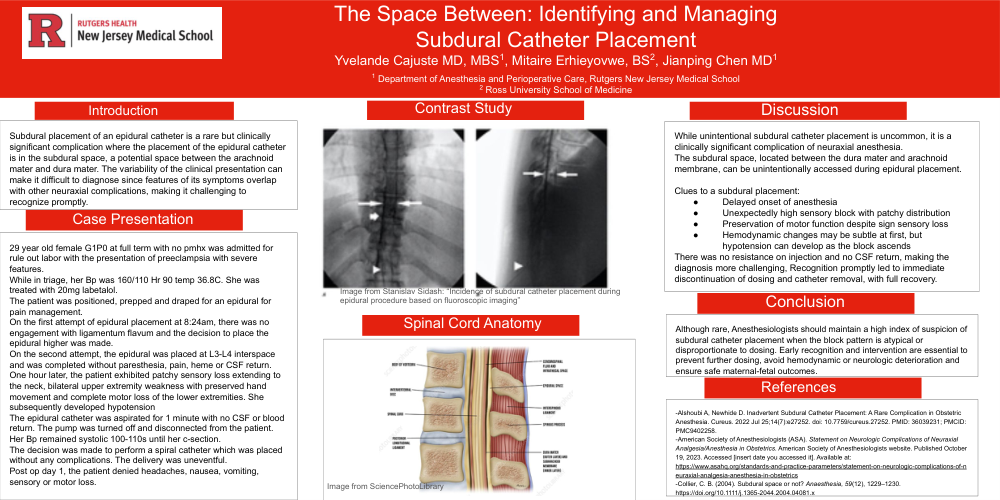
Subdural placement of an epidural catheter is a rare but clinically significant complication where the placement of the epidural catheter is in the subdural space, a potential space between the arachnoid mater and dura mater. The variability of the clinical presentation can make it difficult to diagnose since features of its symptoms overlap with other neuraxial complications, making it challenging to recognize promptly.
Case Presentation:
29 year old female G1P0 at full term with no pmhx was admitted for rule out labor with the presentation of preeclampsia with severe features.
While in triage, her Bp was 160/110 Hr 90 temp 36.8C. She was treated with 20mg labetalol.
The patient was positioned, prepped and draped for an epidural for pain management.
On the first attempt of epidural placement at 8:24am, there was no engagement with ligamentum flavum and the decision to place the epidural higher was made.
On the second attempt, the epidural was placed at L3-L4 interspace and was completed without paresthesia, pain, heme or CSF return.
One hour later, the patient exhibited patchy sensory loss extending to the neck, bilateral upper extremity weakness with preserved hand movement and complete motor loss of the lower extremities. She subsequently developed hypotension
The epidural catheter was aspirated for 1 minute with no CSF or blood return. The pump was turned off and disconnected from the patient.
Her Bp remained systolic 100-110s until her c-section.
The decision was made to perform a spiral catheter which was placed without any complications. The delivery was uneventful.
Post op day 1, the patient denied headaches, nausea, vomiting, sensory or motor loss.
Discussion:
While unintentional subdural catheter placement is uncommon, it is a clinically significant complication of neuraxial anesthesia.
The subdural space, located between the dura mater and arachnoid membrane, can be unintentionally accessed during epidural placement.
Clues to a subdural placement:
-
Delayed onset of anesthesia
-
Unexpectedly high sensory block with patchy distribution
-
Preservation of motor function despite sign sensory loss
-
Hemodynamic changes may be subtle at first, but hypotension can develop as the block ascends
There was no resistance on injection and no CSF return, making the diagnosis more challenging, Recognition promptly led to immediate discontinuation of dosing and catheter removal, with full recovery.
Conclusion:
Although rare, Anesthesiologists should maintain a high index of suspicion of subdural catheter placement when the block pattern is atypical or disproportionate to dosing. Early recognition and intervention are essential to prevent further dosing, avoid hemodynamic or neurologic deterioration and ensure safe maternal-fetal outcomes.