358 posters, 97 topics, 122 sessions, 958 authors, 239 institutions
ePostersLive by SciGen Technologies S.A. All rights reserved.
79th PostGraduate Assembly in Anesthesiology 2025
December 12 - 15, 2025 | New York City

2148
Malignant Hyperthermia (MH) post anesthesia for electroconvulsive therapy. Case Report.
Poster Presenter
Authors
Vanessa Carvalho, Maria Carolina Ferreira, Glenna Machado, Derli Munhoz, Luiz Tazima, Marcos Melo
Affiliations
Part of Topic
Perioperative Management
Learning Objective
Malignant Hyperthermia is a rare condition.
Anesthesiologists must stay aware and prepared to treat
ECT itself is not a direct trigger for MH; succinylcholine is.
Dantrolene must stay close.
Case Description
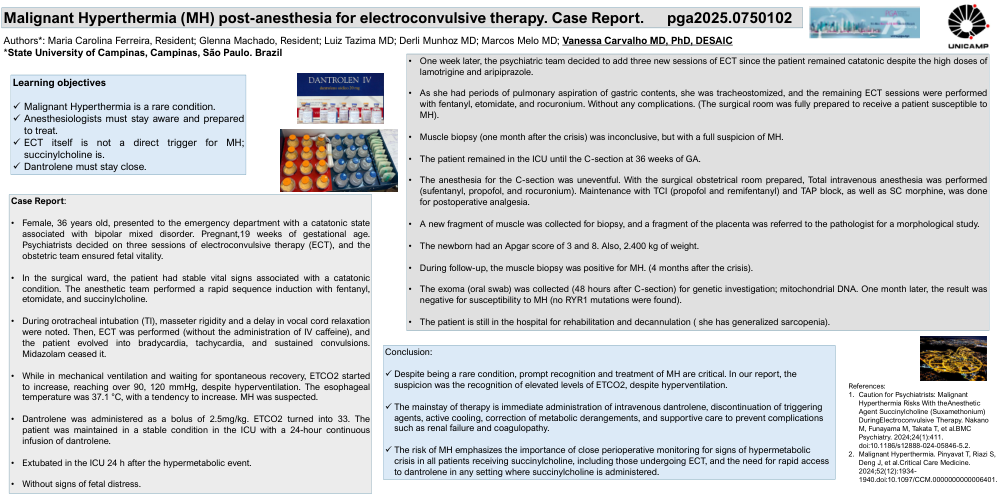
Female, 36 years old, presented to the emergency department witha catatonic state associated with bipolar mixed disorder. Pregnant,19 weeks of gestational age. Psychiatrists decided on threesessions of electroconvulsive therapy (ECT), and the obstetric teamensured fetal vitality. In the surgical ward, the patient had stable vitalsigns associated with a catatonic condition. The anesthetic teamperformed a rapid sequence induction with fentanyl, etomidate, andsuccinylcholine. During orotracheal intubation (TI), masseter rigidityand a delay in vocal cord relaxation were noted. Then, ECT wasperformed, and the patient evolved into bradycardia, tachycardia,and sustained convulsions. Midazolam ceased it. While in mechanical ventilation and waiting for spontaneous recovery,ETCO2 started to increase, over 90, despite hyperventilation.Esophageal temperature: 37.1 with an increasing tendency. MH was suspected. Dantrolene was administered. ETCO2 turned into 33.The patient was maintained stable in the ICU. During follow-up,muscle biopsy was positive for MH.
Discussion
Despite being a rare condition, prompt recognition and treatment of MH are critical. In our report, the suspicion was the recognition ofelevated levels of ETCO2, despite hyperventilation. The mainstay oftherapy is immediate administration of intravenous dantrolene,discontinuation of triggering agents, active cooling, correction of metabolic derangements, and supportive care to preventcomplications such as renal failure and coagulopathy. The risk ofMH emphasizes the importance of close perioperative monitoring forsigns of hypermetabolic crisis in all patients receivingsuccinylcholine, including those undergoing ECT, and the need forrapid access to dantrolene in any setting where succinylcholine is administered.
References
1. Caution for Psychiatrists: Malignant Hyperthermia Risks With theAnesthetic Agent Succinylcholine (Suxamethonium) DuringElectroconvulsive Therapy. Nakano M, Funayama M, Takata T, et al.BMC Psychiatry. 2024;24(1):411. doi:10.1186/s12888-024-05846-5.
2. Malignant Hyperthermia. Pinyavat T, Riazi S, Deng J, et al.Critical Care Medicine. 2024;52(12):1934-1940.doi:10.1097/CCM.0000000000006401.