226 posters, 5 topics, 20 sessions, 599 authors, 292 institutions
ePostersLive by SciGen Technologies S.A. All rights reserved.
Obstetric Anaesthesia Annual Scientific Meeting 2026
14-15 May 2026 | Liverpool Convention Centre

7161191
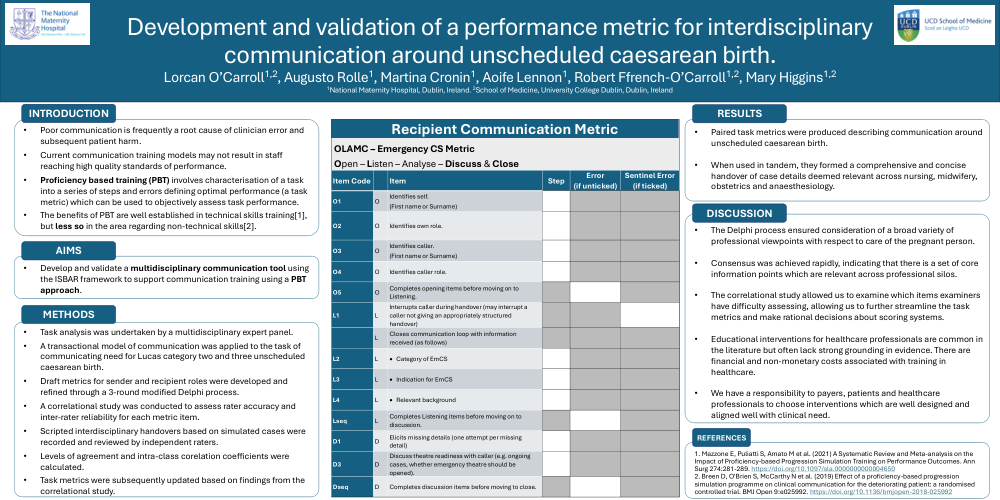
Development and validation of a performance metric for interdisciplinary communication around unscheduled caesarean birth.
Poster Presenter
Part of Topic
Original Research
When used in tandem, they formed a comprehensive and concise handover of case details deeme relevant across nursing, midwifery, obstetrics and anaesthesiology.
The Delphi process ensured consideration of a broad variety of professional viewpoints with respect to care of the pregnant person.
Consensus was achieved rapidly, indicating that there is a set of core information points which are relevant across professional silos.
The correlational study allowed us to examine which items examiners have difficulty assessing, allowing us to further streamline the task metrics and make rational decisions about scoring systems.
Educational interventions for healthcare professionals are common in the literature but often lack strong grounding in evidence. There are financial and non-monetary costs associated with training in healthcare.
We have a responsibility to payers, patients and healthcare professionals to choose interventions which are well designed and aligned well with clinical need.
1. Mazzone E, Puliatti S, Amato M et al. (2021) A Systematic Review and Meta-analysis on the Impact of Proficiency-based Progression Simulation Training on Performance Outcomes. Ann Surg 274:281-289. https://doi.org/10.1097/sla.0000000000004650
2. Breen D, O'Brien S, McCarthy N et al. (2019) Effect of a proficiency-based progression simulation programme on clinical communication for the deteriorating patient: a randomised controlled trial. BMJ Open 9:e025992. https://doi.org/10.1136/bmjopen-2018-025992