226 posters, 5 topics, 20 sessions, 599 authors, 292 institutions
ePostersLive by SciGen Technologies S.A. All rights reserved.
Obstetric Anaesthesia Annual Scientific Meeting 2026
14-15 May 2026 | Liverpool Convention Centre

7148571
High flow nasal oxygen versus face mask preoxygenation of pregnant patients with high body mass:a crossover noninferiority randomised controlled trial
Poster Presenter
Authors
Patrick Chee Fei Tan, Philip Peyton, Julia Unterscheider, Adam Deane, Alicia Dennis
Affiliations
Royal Women’s Hospital (VIC) and The University of Melbourne, Austin Health and The University of Melbourne, Royal Melbourne Hospital and The University of Melbourne, Western Health, The University of Melbourne, Deakin University, and Brigham and Women's Hospital, Royal Women's Hospital (VIC, Australia)
Part of Topic
Original Research
High flow nasal oxygen versus face mask pre-oxygenation of pregnant patients with high body mass index - a crossover non-inferiorityrandomised controlled trial
Obesity in pregnancy confers higher risk of airway management complications[1]. Obstetric guidelines recommend best practice pre-oxygenation as target end tidal oxygen (etO2) ≥ 90%[2]. Our prior study showed very strong evidence that high flow nasal oxygen (HFNO) was superior to face mask oxygen (FM) at achieving this threshold in pregnant patients[3]. The efficacy of HFNO & FM pre-oxygenation in pregnant patients with high body mass index (BMI), particularly obesity class II or above is uncertain.
Hypothesis:
That HFNO is non-inferior to FM for increasing etO2 after pre-oxygenation of pregnant patients with BMI ≥ 30 kg/m2 in late pregnancy.
Cohort: Pregnant patients ≥ 36 weeks gestation with BMI ≥ 30 kg/m2.
Eligibility: Elective caesarean delivery, antenatal clinics. Exclusion: age < 18 years, significant nasal pathology, severe systemic disease, preeclampsia, sepsis, labour/multiple pregnancy.
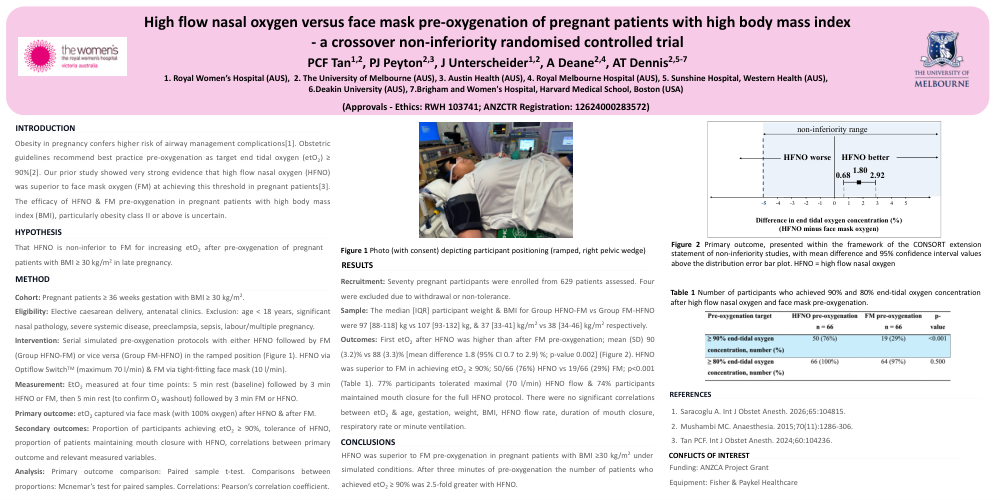
Intervention: Serial simulated pre-oxygenation protocols with either HFNO followed by FM (Group HFNO-FM) or vice versa (Group FM-HFNO) in the ramped position (Figure 1). HFNO via OptiflowSwitchTM (maximum 70 l/min) & FM via tight-fitting face mask (10 l/min).
Measurement: EtO2 measured at four time points: 5 min rest (baseline) followed by 3 min HFNO or FM, then 5 min rest (to confirm O2 washout) followed by 3 min FM or HFNO.
Primary outcome: etO2 captured via face mask (with 100% oxygen) after HFNO & after FM.
Secondary outcomes: Proportion of participants achieving etO2 ≥ 90%, tolerance of HFNO, proportion of patients maintaining mouth closure with HFNO, correlations between primary outcome and relevant measured variables.
Analysis: Primary outcome comparison: Paired sample t-test. Comparisons between proportions: Mcnemar’s test for paired samples. Correlations: Pearson’s correlation coefficient.
Results
Recruitment: Seventy pregnant participants were enrolled from 629 patients assessed. Four were excluded due to withdrawal or non-tolerance.
Sample: The median [IQR] participant weight & BMI for Group HFNO-FM vs Group FM-HFNO were 97 [88-118] kg vs 107 [93-132] kg, & 37 [33-41] kg/m2 vs 38 [34-46] kg/m2 respectively.
Outcomes: First etO2 after HFNO was higher than after FM pre-oxygenation; mean (SD) 90 (3.2)% vs 88 (3.3)% [mean difference 1.8 (95% CI 0.7 to 2.9) %; p-value 0.002] (Figure 2). HFNO was superior to FM in achieving etO2 ≥ 90%; 50/66 (76%) HFNO vs 19/66 (29%) FM; p<0.001 (Table 1). 77% participants tolerated maximal (70 l/min) HFNO flow & 74% participants maintained mouth closure for the full HFNO protocol. There were no significant correlations between etO2 & age, gestation, weight, BMI, HFNO flow rate, duration of mouth closure, respiratory rate or minute ventilation.
Conclusions
HFNO was superior to FM pre-oxygenation in pregnant patients with BMI ≥30 kg/m2under simulated conditions. After three minutes of pre-oxygenation the number of patients who achieved etO2 ≥ 90% was 2.5-fold greater with HFNO.