226 posters, 5 topics, 20 sessions, 599 authors, 292 institutions
ePostersLive by SciGen Technologies S.A. All rights reserved.
Obstetric Anaesthesia Annual Scientific Meeting 2026
14-15 May 2026 | Liverpool Convention Centre

7148572
Short term haemodynamic effects of high flow nasal oxygen in pregnant patients with hypertension - a safety and feasibility study
Poster Presenter
Part of Topic
Original Research
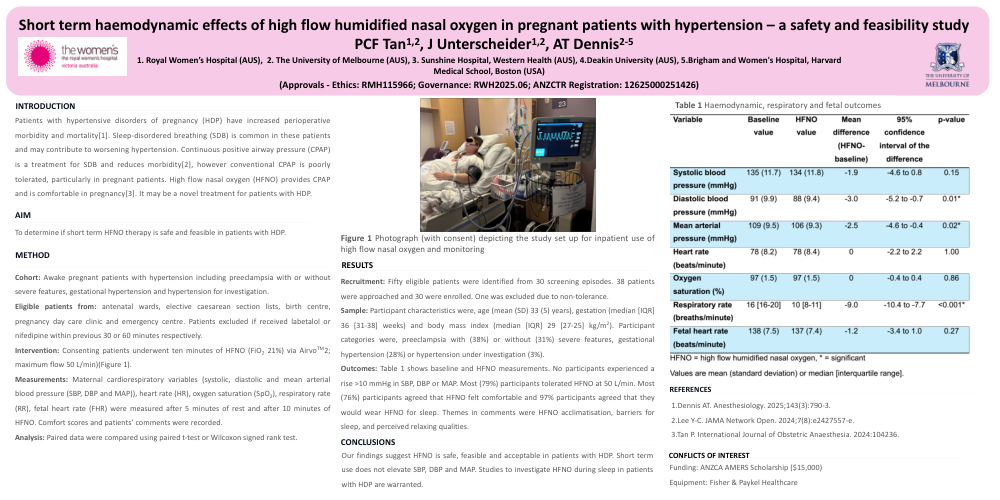
Short term haemodynamic effects of high flow humidified nasal oxygen in pregnant patients with hypertension – a safety and feasibility study
Patients with hypertensive disorders of pregnancy (HDP) have increased perioperative morbidity and mortality[1]. Sleep-disordered breathing (SDB) is common in these patients and may contribute to worsening hypertension. Continuous positive airway pressure (CPAP) is a treatment for SDB and reduces morbidity[2], however conventional CPAP is poorly tolerated, particularly in pregnant patients. High flow nasal oxygen (HFNO) provides CPAP and is comfortable in pregnancy[3]. It may be a novel treatment for patients with HDP.
Aim:
To determine if short term HFNO therapy is safe and feasible in patients with HDP.
Method:
Cohort: Awake pregnant patients with hypertension including preeclampsia with or without severe features, gestational hypertension and hypertension for investigation.
Eligible patients from: antenatal wards, elective caesarean section lists, birth centre, pregnancy day care clinic and emergency centre. Patients excluded if received labetalol or nifedipine within previous 30 or 60 minutes respectively.
Intervention: Consenting patients underwent ten minutes of HFNO (FiO2 21%) via AirvoTM2; maximum flow 50 L/min)(Figure 1).
Measurements: Maternal cardiorespiratory variables (systolic, diastolic and mean arterial blood pressure (SBP, DBP and MAP)), heart rate (HR), oxygen saturation (SpO2), respiratory rate (RR), fetal heart rate (FHR) were measured after 5 minutes of rest and after 10 minutes of HFNO. Comfort scores and patients’ comments were recorded.
Analysis: Paired data were compared using paired t-test or Wilcoxon signed rank test.
Results
Recruitment: Fifty eligible patients were identified from 30 screening episodes. 38 patients were approached and 30 were enrolled. One was excluded due to non-tolerance.
Sample: Participant characteristics were, age (mean (SD) 33 (5) years), gestation (median [IQR] 36 [31-38] weeks) and body mass index (median [IQR] 29 [27-25] kg/m2). Participant categories were, preeclampsia with (38%) or without (31%) severe features, gestational hypertension (28%) or hypertension under investigation (3%).
Outcomes: Table 1 shows baseline and HFNO measurements. No participants experienced a rise >10 mmHg in SBP, DBP or MAP. Most (79%) participants tolerated HFNO at 50 L/min. Most (76%) participants agreed that HFNO felt comfortable and 97% participants agreed that they would wear HFNO for sleep. Themes in comments were HFNO acclimatisation, barriers for sleep, and perceived relaxing qualities.
Conclusions
Our findings suggest HFNO is safe, feasible and acceptable in patients with HDP. Short term use does not elevate SBP, DBP and MAP. Studies to investigate HFNO during sleep in patients with HDP are warranted.