226 posters, 5 topics, 20 sessions, 599 authors, 292 institutions
ePostersLive by SciGen Technologies S.A. All rights reserved.
Obstetric Anaesthesia Annual Scientific Meeting 2026
14-15 May 2026 | Liverpool Convention Centre

7146777
Chronic pain and impaired recovery after caesarean delivery -- A nationwide prospective cohort study
Poster Presenter
Authors
Patricia Duch, Helene K Nedergaard, Christoffer C Jψrgensen, Kim Wildgaard
Affiliations
Department of Anesthesia, University Hospital of Copenhagen, Northern Zealand, Hillerψd, Denmark, Department of Anesthesia and Intensive care, University Hospital of Southern Denmark, Kolding, Department of Anesthesia, Surgery, and Intensive Care, University Hospital of Copenhagen, Herlev, Denmark, University Hospital of Copenhagen, Northern Zealand
Part of Topic
Original Research
Chronic pain and impaired recovery after caesarean delivery - A nationwide prospective cohort study
Patricia Duch1, Helene K. Nedergaard2,Christoffer C. Jørgensen1, Kim Wildgaard3
1Department of Anesthesia, University Hospital of Copenhagen, Northern Zealand, Hillerød, Denmark, 2Department of Anesthesia and Intensive care, University Hospital of Southern Denmark, Kolding 3Department Department of Anesthesia, Surgery, and Intensive Care, University Hospital of Copenhagen, Herlev, Denmark.
Introduction
Chronic pain after caesarean delivery is estimated to affect millions of women worldwide, yet its prevalence and clinical significance is not well established1. Assessing chronic pain and the impact on recovery is challenging, as its multidimensional nature cannot be captured by pain scores alone2.
Methods
Prospective multicentre cohort study, including 19 of 22 Danish maternity hospitals.
Frequent short RedCAP surveyswere sent via SMS
in the immediate postpartum period and at 1, 2, 3, 6, and 12 months following caesarean delivery.
Outcomes: Pain (NRS > 3), pain-related functional impairment (15 items), neuropathic pain (5 items), pain localisation, and self-assessed health.
Results
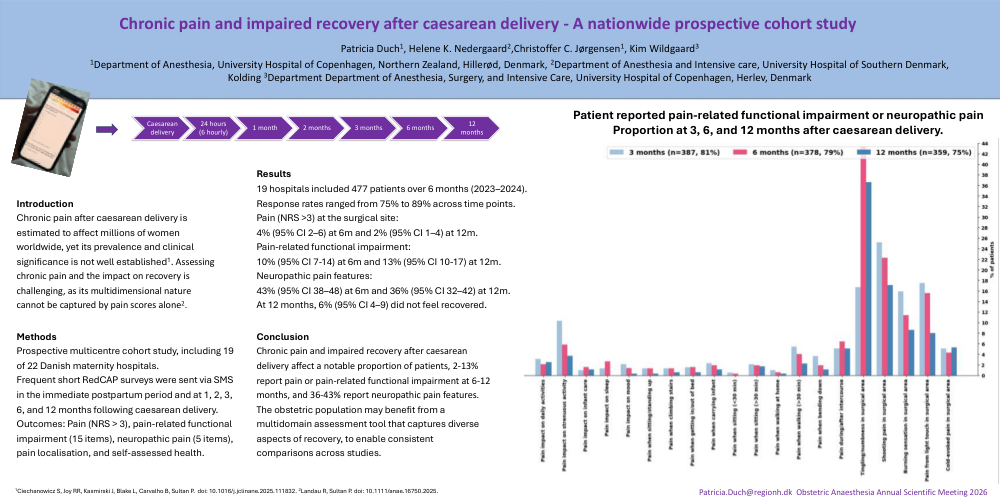
19 hospitals included 477 patients over 6 months (2023–2024).
Response rates ranged from 75% to 89% across time points.
Pain (NRS >3) at the surgical site:
4% (95% CI 2–6) at 6m and 2% (95% CI 1–4) at 12m.
Pain-related functional impairment:
10% (95% CI 7-14) at 6m and 13% (95% CI 10-17) at 12m.
Neuropathic pain features:
43% (95% CI 38–48) at 6m and 36% (95% CI 32–42) at 12m.
At 12 months, 6% (95% CI 4–9) did not feelrecovered.
Conclusion
Chronic pain and impaired recovery after caesarean delivery affect a notable proportion of patients, 2-13% reportpain or pain-related functional impairment at 6-12 months, and 36-43% report neuropathic pain features. The obstetric population may benefit from a multidomain assessment tool that captures diverse aspects of recovery, to enable consistent comparisons across studies.
Patricia.Duch@regionh.dk Obstetric Anaesthesia Annual Scientific Meeting 2026