226 posters, 5 topics, 20 sessions, 599 authors, 292 institutions
ePostersLive by SciGen Technologies S.A. All rights reserved.
Obstetric Anaesthesia Annual Scientific Meeting 2026
14-15 May 2026 | Liverpool Convention Centre

7158659
Disparities in access to epidural analgesia for labour in NHS Lothian
Poster Presenter
Authors
Giorgianna Passerello, Arlene Wise, Rachel Hignett, Mathew Lyons
Affiliations
Anaesthesia Resident, Simpson Centre for Reproductive Health, NHS Lothian, Consultant Anaesthetist, Simpson Centre for Reproductive Health, NHS Lothian, SCREDS Clinical Lecturer in Anaesthesia, University of Edinburgh, Simpson Centre for Reproductive Health, NHS Lothian
Part of Topic
Original Research
Disparities in access to epidural analgesia for labour in NHS Lothian
Authors: Giorgianna Passerello (1), Arlene Wise (1), Rachel Hignett (1), Mathew Lyons (2)
Affiliations: (1) Simpson Centre for Reproductive Health, NHS Lothian (2) University of Edinburgh
Introduction and aims: The Scottish Index of Multiple Deprivation (SIMD) is an area-based measure of relative socio-economic deprivation in Scotland, divided into deciles from SIMD 1 (most deprived) to SIMD 10 (least deprived). NHS Lothian is the second largest territorial health board in Scotland serving a population of over 900,000 people in Edinburgh, East Lothian, Midlothian and West Lothian.
A 2024 Scottish study showed increased socioeconomic deprivation related to maternal risk factors yet paradoxically reduced epidural access (SIMD1 vs SIMD10: RR 0.84) suggesting institutional barriers to epidural access.1 Our aim was to examine whether these disparities in access to epidurals exist in NHS Lothian.
Methods: We performed a retrospective cohort study of parturients labouring between January 2022 and November 2024, excluding elective caesareans sections. SIMD deciles were used as a socioeconomic proxy.
We controlled for confounding maternal characteristics (obesity, smoking, illicit drug use, ethnicity, parity) that are known to influence epidural use and performed a multivariable Poisson regression to determine the association between deprivation and epidural use.
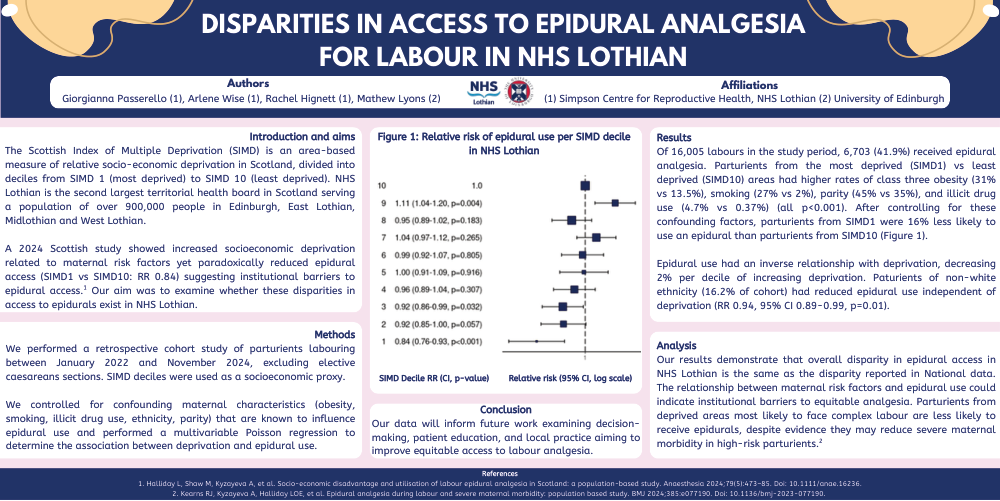
Results: Of 16,005 labours in the study period, 6,703 (41.9%) received epidural analgesia. Parturients from the most deprived (SIMD1) vs least deprived (SIMD10) areas had higher rates of class three obesity (31% vs 13.5%), smoking (27% vs 2%), parity (45% vs 35%), and illicit drug use (4.7% vs 0.37%) (all p<0.001). After controlling for these confounding factors, parturients from SIMD1 were 16% less likely to use an epidural than parturients from SIMD10 (Figure 1).
Epidural use had an inverse relationship with deprivation, decreasing 2% per decile of increasing deprivation. Paturients of non-white ethnicity (16.2% of cohort) had reduced epidural use independent of deprivation (RR 0.94, 95% CI 0.89-0.99, p=0.01).
Analysis: Our results demonstrate that overall disparity in epidural access in NHS Lothian is the same as the disparity reported in National data. The relationship between maternal risk factors and epidural use could indicate institutional barriers to equitable analgesia. Parturients from deprived areas most likely to face complex labour are less likely to receive epidurals, despite evidence they may reduce severe maternal morbidity in high-risk parturients.2
Conclusion: Our data will inform future work examining decision-making, patient education, and local practice aiming to improve equitable access to labour analgesia.
References:
1. Halliday L, Shaw M, Kyzayeva A, et al. Socio-economic disadvantage and utilisation of labour epidural analgesia in Scotland: a population-based study. Anaesthesia 2024;79(5):473–85. Doi: 10.1111/anae.16236.
2. Kearns RJ, Kyzayeva A, Halliday LOE, et al. Epidural analgesia during labour and severe maternal morbidity: population based study. BMJ 2024;385:e077190. Doi: 10.1136/bmj-2023-077190.