226 posters, 5 topics, 20 sessions, 599 authors, 292 institutions
ePostersLive by SciGen Technologies S.A. All rights reserved.
Obstetric Anaesthesia Annual Scientific Meeting 2026
14-15 May 2026 | Liverpool Convention Centre

7158280
Epidural timing and interventional birth across the obesity spectrum: do associations differ by WHO obesity class?
Poster Presenter
Part of Topic
Original Research
Epidural timing and interventional birth across the obesity spectrum
Do associations differ by WHO obesity class?
Mathew Lyons, Julia Critchley, Arlene Wise
Introduction
Current guidelines recommend early epidurals for parturients with Class 3 obesity (BMI ≥40 kg/m²)1. However, whether epidural timing associates with interventional birth rates differentially across obesity classes, and through what pathways obesity affects intervention, remains unknown.
Methods
We examined all non-elective, term, singleton births in NHS Lothian (2022–2024), excluding births indicated for labour dystocia. The primary outcome was interventional birth (caesarean or mid-cavity forceps).
Poisson regression, adjusted for deprivation, parity, labour onset, age, gestational age, membrane rupture duration and birth weight examined associations between epidural timing (early ≤5cm vs late >5cm) and intervention.
Mediation analysis examined whether epidural use and timing explained any of the higher intervention rates in obese vs non-obese parturients.
What is mediation analysis
Mediation analysis asks how much of an exposure's effect on an outcome is carried through a third variable (the mediator). Here, we asked how much of obesity's effect on interventional birth operates through epidural timing.
Results
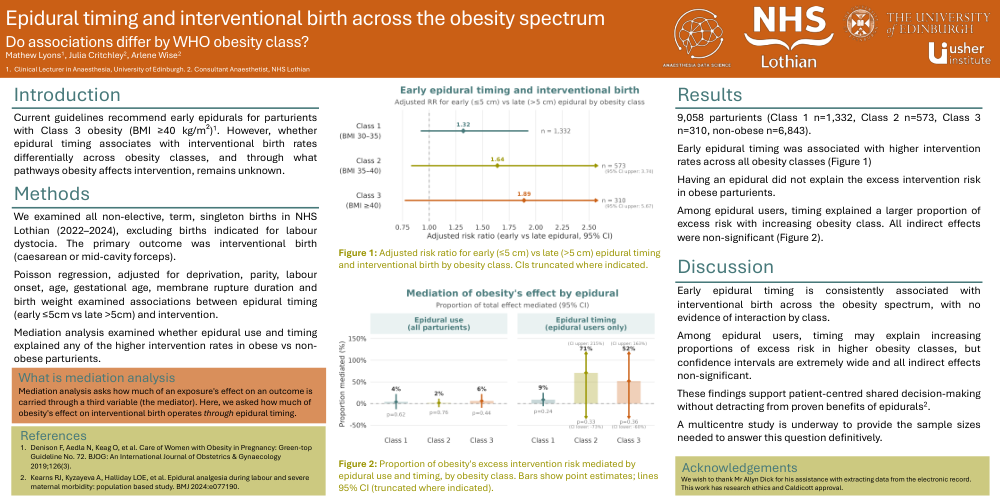
9,058 parturients (Class 1 n=1,332, Class 2 n=573, Class 3 n=310, non-obese n=6,843).
Early epidural timing was associated with higher intervention rates across all obesity classes (Figure 1)
Having an epidural did not explain the excess intervention risk in obese parturients.
Among epidural users, timing explained a larger proportion of excess risk with increasing obesity class. All indirect effects were non-significant (Figure 2).
Discussion
Early epidural timing is consistently associated with interventional birth across the obesity spectrum, with no evidence of interaction by class.
Among epidural users, timing may explain increasing proportions of excess risk in higher obesity classes, but confidence intervals are extremely wide and all indirect effects non-significant.
These findings support patient-centred shared decision-making without detracting from proven benefits of epidurals2.
A multicentre study is underway to provide the sample sizes needed to answer this question definitively.