226 posters, 5 topics, 20 sessions, 599 authors, 292 institutions
ePostersLive by SciGen Technologies S.A. All rights reserved.
Obstetric Anaesthesia Annual Scientific Meeting 2026
14-15 May 2026 | Liverpool Convention Centre

7158048
The effectiveness of timed intermittent epidural bolus versus patient controlled epidural analgesia for primiparous women in a developing country
Part of Topic
Original Research
The effectiveness of timed intermittent epidural bolus versus patient controlled epidural analgesia for primiparous women in a developing country.
1CHUKWU CC, 2IMARENGIAYE CA, 3IMARENGIAYE CO
Senior Registrar, Department of Anaesthesiology, University of Benin Teaching Hospital, Benin, Edo-state, Nigeria.
Email: carolinewemambu@gmail.com
Introduction: The pain of labour could be severe for most women. PIEB provides more consistent analgesia, potentially due to better anaesthetic spread in the epidural space, reducing the need for additional boluses.1 In Nigeria, as in some other developing countries, the lack of appropriate technology hinders clinical care. We investigated the effectiveness of timed intermittent epidural boluses (TIEB) as a surrogate for programmed intermittent epidural boluses (PIEB) for maintaining labour analgesia in primiparous women.
Method: Following Institutional Review Board ethical approval, ADM/E 22/A/VOL.VII/1483011863, eligible consenting primiparous women were recruited for the maintenance of labour analgesia using the Timed intermittent epidural bolus (TIEB) or Patient Controlled Epidural Analgesia (PCEA). The epidural was instituted at the L3/L4 interspace following aseptic preparations and was initiated with 15mL of 0.0625% bupivacaine plus 2ug/ml of fentanyl. For the maintenance of labour analgesia, the women were randomized to receive 5mL of 0.0625% bupivacaine + fentanyl 2ug/ml for TIEB(n=28) every 30 minute or PCEA (n=28) with a lockout interval of 15 minutes. The pain scores (VAS), total epidural analgesic consumption, duration of analgesia, obstetrics and neonatal outcomes were assessed. A p –value of <0.05 was considered significant.
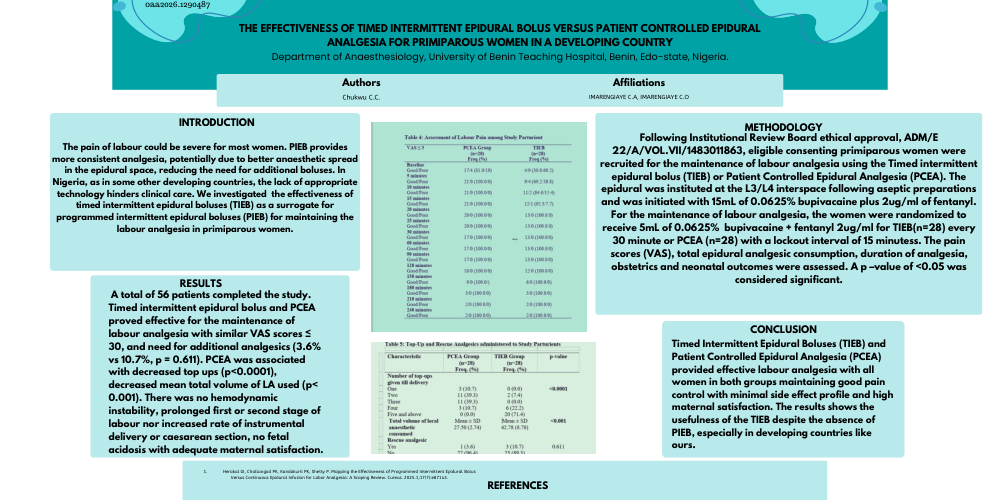
Results: A total of 56 patients completed the study. Timed intermittent epidural bolus and PCEA proved effective for the maintenance of labour analgesia with similar VAS scores ≤ 3 and need for additional analgesics (3.6% vs 10.7%, p = 0.611). PCEA was associated with decreased top ups (p<0.0001), decreased mean total volume of LA used (p< 0.001). There was no hemodynamic instability, prolonged first or second stage of labour nor increased rate of instrumental delivery or caesarean section, no fetal acidosis with adequate maternal satisfaction.
Conclusion: Timed Intermittent Epidural Boluses (TIEB) and Patient Controlled Epidural Analgesia (PCEA) provided effective labour analgesia with all women in both groups maintaining good pain control with minimal side effect profile and high maternal satisfaction. The results shows the usefulness of the TIEB despite the absence of PIEB, especially in developing countries like ours.
References.
Herakal GI, Challangod PK, Kandakurti PK, Shetty P. Mapping the Effectiveness of Programmed Intermittent Epidural Bolus Versus Continuous Epidural Infusion for Labor Analgesia: A Scoping Review. Cureus. 2025.1;17(7):e87143.