226 posters, 5 topics, 20 sessions, 599 authors, 292 institutions
ePostersLive by SciGen Technologies S.A. All rights reserved.
Obstetric Anaesthesia Annual Scientific Meeting 2026
14-15 May 2026 | Liverpool Convention Centre

7157624
Placenta Accreta Spectrum vs uterine dehiscence: interventional radiology and haemorrhage management
Poster Presenter
Authors
Affiliations
Part of Topic
Original Research
Placenta Accreta Spectrum vs uterine dehiscence: comparison of haemorrhage markers & management
Keira Jones, Monica Blair, Malcolm A. Broom.
Dept. of Anaesthesia, Glasgow Royal Infirmary & Princess Royal Maternity Hospital.
Introduction
-
Uterine scar dehiscence is a high-risk condition for major haemorrhage and caesarean hysterectomy.
-
Dehiscence can be difficult to differentiate from Placenta Accreta Spectrum (PAS), antenatally.
-
Our tertiary hospital manages large suspected dehiscence similarly to PAS deliveries; including common iliac arterial balloon placement.
-
We wished to compare and major PAS vs dehiscence deliveries for blood loss, transfusion requirements, and common iliac balloon use.
Methods
Caldicott approval was obtained to retrospectively review routinely collected data for major PAS and dehiscence caesarean deliveries at Glasgow Royal Infirmary from 2019 to 2025. Operation notes and pathology were used to confirm diagnoses, ensuring an accurate comparison between groups .
Results
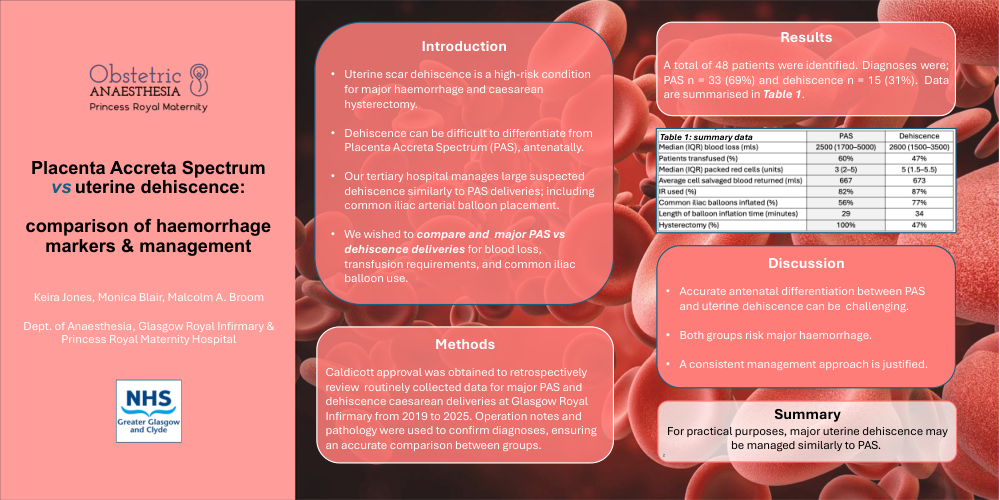
A total of 48 patients were identified. Diagnoses were; PAS n = 33 (69%) and dehiscence n = 15 (31%). Data are summarised in Table 1.
Discusion
-
Accurate antenatal differentiation between PAS and uterine dehiscence can be challenging.
-
Both groups risk major haemorrhage.
-
A consistent management approach is justified.
Summary
For practical purposes, major uterine dehiscence may be managed similarly to PAS.