215 posters, 5 topics, 22 sessions, 596 authors, 283 institutions
ePostersLive by SciGen Technologies S.A. All rights reserved.
Obstetric Anaesthesia Annual Scientific Meeting 2025
May 15 - 16, 2025 | ICC, 2 Lanyon Place, Belfast BT1 3WH

6779127
Post natal neurology - diagnostic challenges.
Poster Presenter
Part of Topic
Case report
Post Natal Neurology – Diagnostic Challenges
Dr Ashley McIlroy, Dr Mairead Savage, Dr Conor Lamb
Ulster Hospital, SEHSCT
Neurological complications resulting from central neuraxial anaesthesia are rare, with a range of 1 in 1000 women for temporary nerve damage to 1 in 250000 for severe injury including paralysis quoted during consent [1]. The majority of nerve injuries in obstetrics result from labour and pregnancy rather than anaesthetic intervention [2]. However, exclusion of complications resulting from obstetric neuraxial anaesthesia is essential following new post-natal neurology. We present the case of a post-natal patient who developed neurological symptoms, initially attributed to her epidural anaesthetic, then instead to a functional neurological disorder and later to an intra-abdominal collection post caesarean section.
Case Study
A 25-year-old female underwent an emergency caesarean section for deteriorating CTG secondary to chorioamnionitis. She had a well working epidural, which had been sited without complication earlier during labour and was topped up with 0.75% ropivacaine for anaesthesia.
Day three following emergency caesarean section, she developed a sudden onset frontal headache with associated photo sensitivity, dizziness, and global weakness. A stroke lysis call was initiated by the obstetric team and the subsequent CT brain and venogram scans reported no abnormality. A diagnosis of migraine was made by the stroke physicians. Therapeutic enoxaparin was administered due to unilateral calf swelling, pending further ultrasound imaging to exclude a deep vein thrombosis.
Six hours later, an ongoing neurological deficit was noted, and anaesthetics were called to review. The patient was unable to straight leg raise and demonstrated ipsilateral altered sensation in L1-3 dermatomes. Given the progressing neurology, administration of therapeutic enoxaparin and a recent epidural, an urgent MRI spine was indicated to exclude an evolving epidural haematoma. To facilitate MRI out of hours, transfer to another hospital was needed, requiring liaison between six different teams over a 6-hour period to organise this. The MRI did not demonstrate any pathology of her spine. She was subsequently assessed by the neurology team, who made a diagnosis of functional neurological disorder (FND) due to a positive Hoover sign.
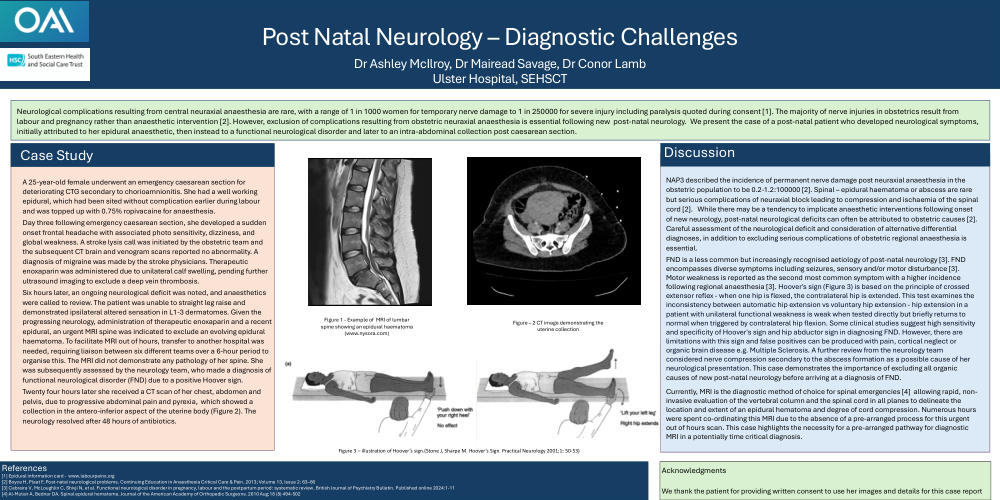
Twenty four hours later she received a CT scan of her chest, abdomen and pelvis, due to progressive abdominal pain and pyrexia, which showed a collection in the antero-inferior aspect of the uterine body (Figure 2). The neurology resolved after 48 hours of antibiotics.
Discussion
NAP3 described the incidence of permanent nerve damage post neuraxial anaesthesia in the obstetric population to be 0.2-1.2:100000 [2]. Spinal – epidural haematoma or abscess are rare but serious complications of neuraxial block leading to compression and ischaemia of the spinal cord [2]. While there may be a tendency to implicate anaesthetic interventions following onset of new neurology, post-natal neurological deficits can often be attributed to obstetric causes [2]. Careful assessment of the neurological deficit and consideration of alternative differential diagnoses, in addition to excluding serious complications of obstetric regional anaesthesia is essential.
FND is a less common but increasingly recognised aetiology of post-natal neurology [3]. FND encompasses diverse symptoms including seizures, sensory and/or motor disturbance [3]. Motor weakness is reported as the second most common symptom with a higher incidence following regional anaesthesia [3]. Hoover's sign (Figure 3) is based on the principle of crossed extensor reflex - when one hip is flexed, the contralateral hip is extended. This test examines the inconsistency between automatic hip extension vs voluntary hip extension - hip extension in a patient with unilateral functional weakness is weak when tested directly but briefly returns to normal when triggered by contralateral hip flexion. Some clinical studies suggest high sensitivity and specificity of Hoover's sign and hip abductor sign in diagnosing FND. However, there are limitations with this sign and false positives can be produced with pain, cortical neglect or organic brain disease e.g. Multiple Sclerosis. A further review from the neurology team considered nerve compression secondary to the abscess formation as a possible cause of her neurological presentation. This case demonstrates the importance of excluding all organic causes of new post-natal neurology before arriving at a diagnosis of FND.
Currently, MRI is the diagnostic method of choice for spinal emergencies [4] allowing rapid, non-invasive evaluation of the vertebral column and the spinal cord in all planes to delineate the location and extent of an epidural hematoma and degree of cord compression. Numerous hours were spent co-ordinating this MRI due to the absence of a pre-arranged process for this urgent out of hours scan. This case highlights the necessity for a pre-arranged pathway for diagnostic MRI in a potentially time critical diagnosis.
References
[1] Epidural information card - www.labourpains.org
[2] Boyce H, Plaat F, Post-natal neurological problems. Continuing Education in Anaesthesia Critical Care & Pain. 2013; Volume 13, Issue 2: 63–66
[3] Cabreira V, McLoughlin C, Shivji N, et al. Functional neurological disorder in pregnancy, labour and the postpartum period: systematic review. British Journal of Psychiatry Bulletin. Published online 2024:1-11
[4] Al-Mutair A, Bednar DA. Spinal epidural hematoma. Journal of the American Academy of Orthopedic Surgeons. 2010 Aug;18 (8) 494-502