215 posters, 5 topics, 22 sessions, 596 authors, 283 institutions
ePostersLive by SciGen Technologies S.A. All rights reserved.
Obstetric Anaesthesia Annual Scientific Meeting 2025
May 15 - 16, 2025 | ICC, 2 Lanyon Place, Belfast BT1 3WH

6765671
Acute obstetric coagulopathy secondary to amniotic fluid embolism
Poster Presenter
Authors
Affiliations
Part of Topic
Case report
Acute obstetric coagulopathy secondary to amniotic fluid embolism
Introduction
Acute obstetric coagulopathy (AOC) is characterised by hyperfibrinolysis and dysfibrinogenaemia. It occurs in 1/1000 cases of major postpartum haemorrhage (PPH), and causes include amniotic fluid embolism (AFE) [1]. Major PPH is still a leading cause of maternal death in the UK [2]. We present a case of AOC secondary to AFE where early detection using local protocols may have prevented a potentially catastrophic deterioration.
Case report
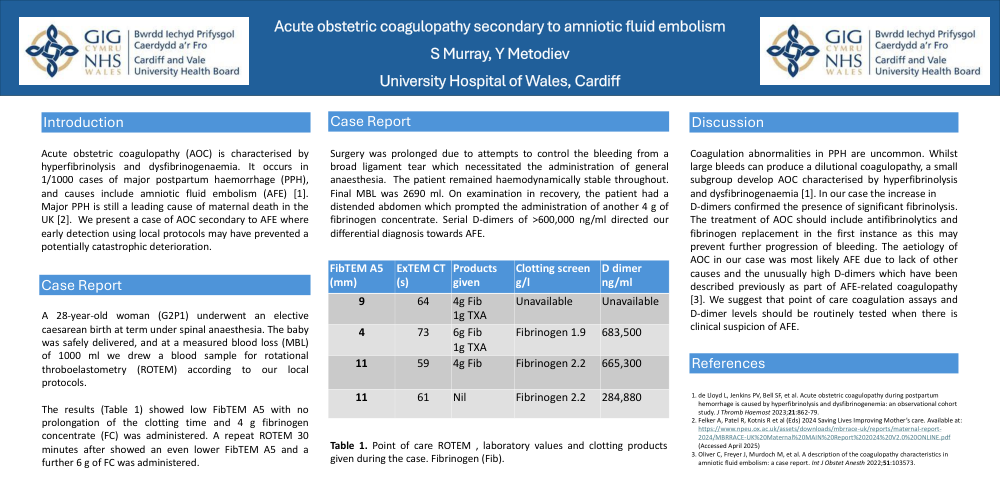
A 28-year-old woman (G2P1) underwent an elective caesarean birth at term under spinal anaesthesia. The baby was safely delivered, and at a measured blood loss (MBL) of 1000 ml we drew a blood sample for rotational throboelastometry (ROTEM) according to our local protocols.
The results (Table 1) showed low FibTEM A5 with no prolongation of the clotting time and 4 g fibrinogen concentrate (FC) was administered. A repeat ROTEM 30 minutes after showed an even lower FibTEMA5 and a further 6 g of FC was administered.
Surgery was prolonged due to attempts to control the bleeding from a broad ligament tear whichnecessitated the administration of general anaesthesia. The patient remained haemodynamically stable throughout. Final MBL was 2690 ml. On examination in recovery, the patient had a distended abdomen which prompted the administration of another 4 g of fibrinogen concentrate. Serial D-dimers of >600,000 ng/ml directed our differential diagnosis towards AFE.
Discussion
Coagulation abnormalities in PPH are uncommon. Whilst large bleeds can produce a dilutional coagulopathy, a small subgroup develop AOC characterised by hyperfibrinolysis and dysfibrinogenaemia [1]. In our case the increase in
D-dimers confirmed the presence of significant fibrinolysis. The treatment of AOC should include antifibrinolytics and fibrinogen replacement in the first instance as this may prevent further progression of bleeding. The aetiology of AOC in our case was most likely AFE due to lack of other causes and the unusually high D-dimers which have been described previously as part of AFE-related coagulopathy [3]. We suggest that point of carecoagulation assays and D-dimer levels should be routinely tested when there is clinical suspicion of AFE.