215 posters, 5 topics, 22 sessions, 596 authors, 283 institutions
ePostersLive by SciGen Technologies S.A. All rights reserved.
Obstetric Anaesthesia Annual Scientific Meeting 2025
May 15 - 16, 2025 | ICC, 2 Lanyon Place, Belfast BT1 3WH

6763331
Management of a Pregnant woman with KILT syndrome
Poster Presenter
Part of Topic
Case report
Introduction
KILT syndrome is a rare condition with less than 20 reported cases in literature. It is characterised by the abnormalities in the kidney, inferior vena cava and idiopathic leg vein thrombosis.[1] Due to its rarity and nonspecific symptoms, KILT syndrome often goes undiagnosed or is misdiagnosed until complications occur.
Case Report
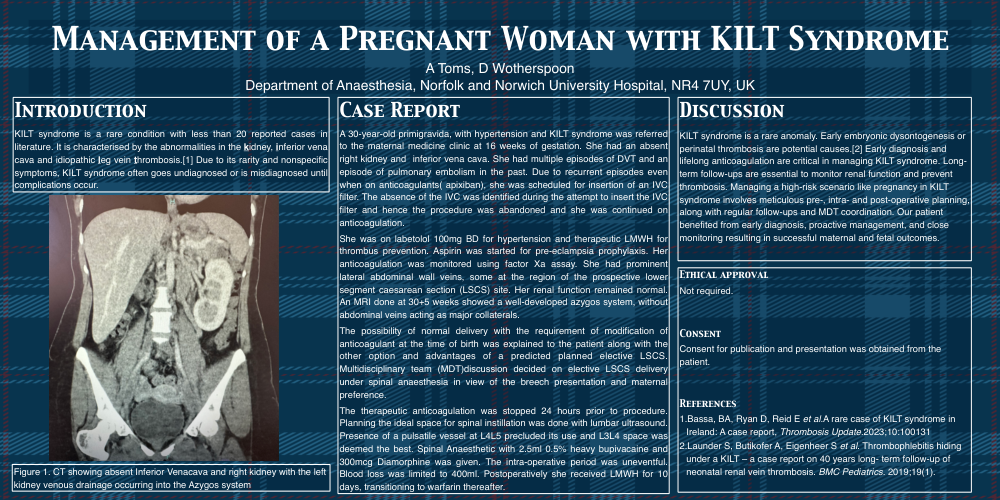
A 30-year-old primigravida, with hypertension and KILT syndrome was referred to the maternal medicine clinic at 16 weeks of gestation. She had an absent right kidney and inferior vena cava. She had multiple episodes of DVT and an episode of pulmonary embolism in the past. Due to recurrent episodes even when on anticoagulants( apixiban), she was scheduled for insertion of an IVC filter. The absence of the IVC was identified during the attempt to insert the IVC filter and hence the procedure was abandoned and she was continued on anticoagulation.
She was on labetolol 100mg BD for hypertension and therapeutic LMWH for thrombus prevention. Aspirin was started for pre-eclampsia prophylaxis. Her anticoagulation was monitored using factor Xa assay. She had prominent lateral abdominal wall veins, some at the region of the prospective lower segment caesarean section (LSCS) site. Her renal function remained normal. An MRI done at 30+5 weeks showed a well-developed azygos system, without abdominal veins acting as major collaterals.
The possibility of normal delivery with the requirement of modification of anticoagulant at the time of birth was explained to the patient along with the other option and advantages of a predicted planned elective LSCS. Multidisciplinary team (MDT)discussion decided on elective LSCS delivery under spinal anaesthesia in view of the breech presentation and maternal preference.
The therapeutic anticoagulation was stopped 24 hours prior to procedure. Planning the ideal space for spinal instillation was done with lumbar ultrasound. Presence of a pulsatile vessel at L4L5 precluded its use and L3L4 space was deemed the best. Spinal Anaesthetic with 2.5ml 0.5% heavy bupivacaine and 300mcg Diamorphine was given. The intra-operative period was uneventful. Blood loss was limited to 400ml. Postoperatively she received LMWH for 10 days, transitioning to warfarin thereafter.
Discussion
KILT syndrome is a rare anomaly. Early embryonic dysontogenesis or perinatal thrombosis are potential causes.[2] Early diagnosis and lifelong anticoagulation are critical in managing KILT syndrome. Long-term follow-ups are essential to monitor renal function and prevent thrombosis. Managing a high-risk scenario like pregnancy in KILT syndrome involves meticulous pre-, intra- and post-operative planning, along with regular follow-ups and MDT coordination. Our patient benefited from early diagnosis, proactive management, and close monitoring resulting in successful maternal and fetal outcomes.
Ethical approval
Not required.
Consent
Consent for publication and presentation was obtained from the patient.
References
- 1.Bassa, BA, Ryan D, Reid E et al.A rare case of KILT syndrome in Ireland: A case report, Thrombosis Update.2023;10:100131
- 2.Launder S, Butikofer A, Eigenheer S et al. Thrombophlebitis hiding under a KILT – a case report on 40 years long- term follow-up of neonatal renal vein thrombosis. BMC Pediatrics. 2019;19(1).