215 posters, 5 topics, 22 sessions, 596 authors, 283 institutions
ePostersLive by SciGen Technologies S.A. All rights reserved.
Obstetric Anaesthesia Annual Scientific Meeting 2025
May 15 - 16, 2025 | ICC, 2 Lanyon Place, Belfast BT1 3WH

6697444
Total Intravenous Anaesthesia (TIVA) in a Hypertensive Patient
Poster Presenter
Authors
Affiliations
Part of Topic
Case report
Total Intravenous Anaesthesia (TIVA) in a Hypertensive Patient
Introduction
Total intravenous anaesthesia (TIVA) is uncommonly used obstetric anaesthesia1. Here we demonstrate using TIVA for a complex obstetric patient.
Case History
A patient with known hypertension presented with challenging blood pressure (BP) control despite labetolol and methyldopa at 30 weeks gestation. She had previous investigation for secondary hypertensive causes including phaeochromocytoma and primary aldosteronism which were negative. She also had renal imaging which showed no abnormality.
Her background included:
Clinical course
She was managed as an inpatient and BP fluctuated from 140mmHg to over 210mmHg systolic but she remained asymptomatic, had stable bloods and the foetus was growing well. She became symptomatic if her systolic BP dropped below 140 mmHg. At 32 weeks the decision was to perform a caesarean section due to a pathological cardiotocograph.
Anaesthesia
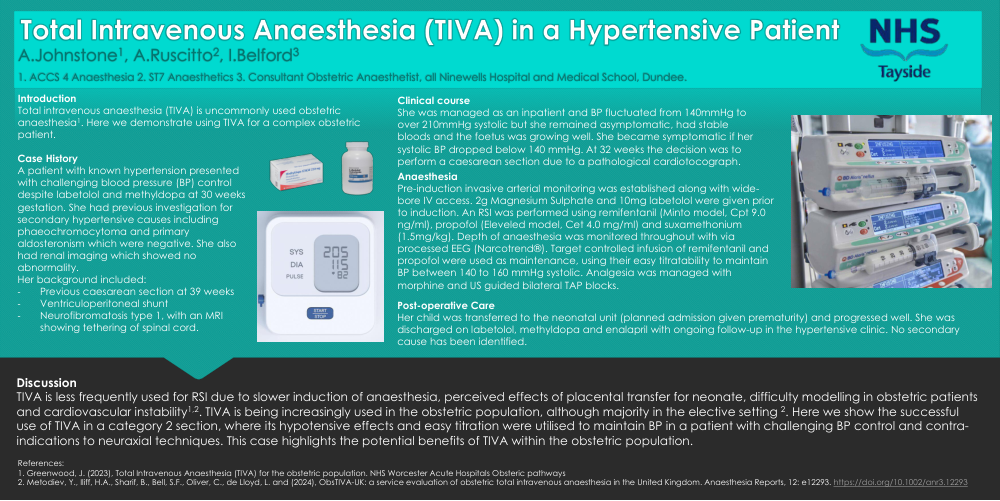
Pre-induction invasive arterial monitoring was established along with wide-bore IV access. 2g Magnesium Sulphate and 10mg labetolol were given prior to induction. An RSI was performed using remifentanil (Minto model, Cpt 9.0 ng/ml), propofol (Eleveled model, Cet 4.0 mg/ml) and suxamethonium (1.5mg/kg). Depth of anaesthesia was monitored throughout with via processed EEG (Narcotrend®). Target controlled infusion of remifentanil and propofol were used as maintenance, using their easy titratability to maintain BP between 140 to 160 mmHg systolic. Analgesia was managed with morphine and US guided bilateral TAP blocks.
Post-operative Care
Her child was transferred to the neonatal unit (planned admission given prematurity) and progressed well. She was discharged on labetolol, methyldopa and enalapril with ongoing follow-up in the hypertensive clinic. No secondary cause has been identified.
Discussion
TIVA is less frequently used for RSI due to slower induction of anaesthesia, perceived effects of placental transfer for neonate, difficulty modelling in obstetric patients and cardiovascular instability1,2. TIVA is being increasingly used in the obstetric population, although majority in the elective setting 2. Here we show the successful use of TIVA in a category 2 section, where its hypotensive effects and easy titration were utilised to maintain BP in a patient with challenging BP control and contra-indications to neuraxial techniques. This case highlights the potential benefits of TIVA within the obstetric population.