215 posters, 5 topics, 22 sessions, 596 authors, 283 institutions
ePostersLive by SciGen Technologies S.A. All rights reserved.
Obstetric Anaesthesia Annual Scientific Meeting 2025
May 15 - 16, 2025 | ICC, 2 Lanyon Place, Belfast BT1 3WH

6773100
Unilateral Horner's Syndrome in a normal BMI patient following labour epidural analgesia: A case report
Part of Topic
Case report
A Case Report: Unilateral Horner’s Syndrome in a Normal BMI Patient Following Labour Epidural Analgesia
Hira, P1 ; Lassota-Korba, B1 ; Gouda, A1 ; Das, S2 ; Chatterjee, N3
1Yeovil District Hospital, Somerset NHS Foundation Trust; 2Buckinghamshire Healthcare NHS Trust; 3Oxford University Hospitals NHS Foundation Trust
INTRODUCTION
Horner’s Syndrome (HS) is a rare complication of lumbar epidural analgesia during labour, caused by unintended cephalad spread of local anaesthetic agents.
CASE PRESENTATION
32-year-old, G1P0, BMI 25.2, mild scoliosis
Epidural: L3–L4, levobupivacaine 0.1% + fentanyl 2mcg/ml via PCEA
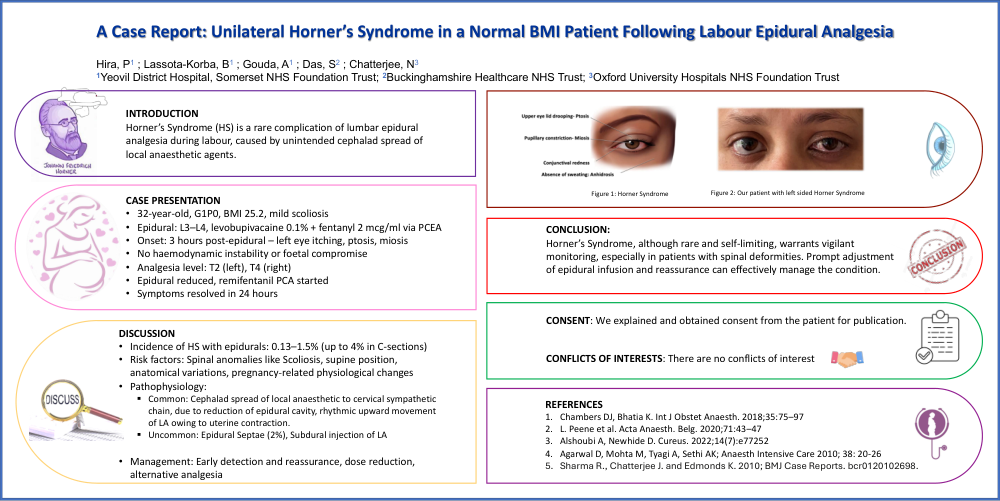
Onset: 3 hours post-epidural – left eye itching, ptosis, miosis
No haemodynamic instability or foetal compromise
Analgesia level: T2 (left), T4 (right)
Epidural reduced, remifentanil PCA started
Symptoms resolved in 24 hours
DISCUSSION
- Incidence of HS with epidurals: 0.13–1.5% (up to 4% in C-sections)
- Risk factors: Spinal anomalies like Scoliosis, supine position, anatomical variations, pregnancy-related physiological changes
- Pathophysiology: Common: Cephalad spread of local anaesthetic to cervical sympathetic chain, due to reduction of epidural cavity, rhythmic upward movement of LA owing to uterine contraction. Uncommon: Epidural Septae (2%), Subdural injection of LA
- Management: Early detection and reassurance, dose reduction, alternative analgesia
CONCLUSION:
Horner’s Syndrome, although rare and self-limiting, warrants vigilant monitoring, especially in patients with spinal deformities. Prompt adjustment of epidural infusion and reassurance can effectively manage the condition
CONSENT: We explained and obtained consent from the patient for publication.
CONFLICTS OF INTERESTS: There are no conflicts of interest
REFERENCES
- Chambers DJ, Bhatia K. Int J Obstet Anaesth. 2018;35:75–97
- L. Peene et al. Acta Anaesth. Belg. 2020;71:43–47
- Alshoubi A, Newhide D. Cureus. 2022;14(7):e77252
- Agarwal D, Mohta M, Tyagi A, Sethi AK; Anaesth Intensive Care 2010; 38: 20-26
- Sharma R., Chatterjee J. and Edmonds K. 2010; BMJ Case Reports. bcr0120102698