215 posters, 5 topics, 22 sessions, 596 authors, 283 institutions
ePostersLive by SciGen Technologies S.A. All rights reserved.
Obstetric Anaesthesia Annual Scientific Meeting 2025
May 15 - 16, 2025 | ICC, 2 Lanyon Place, Belfast BT1 3WH

6772836
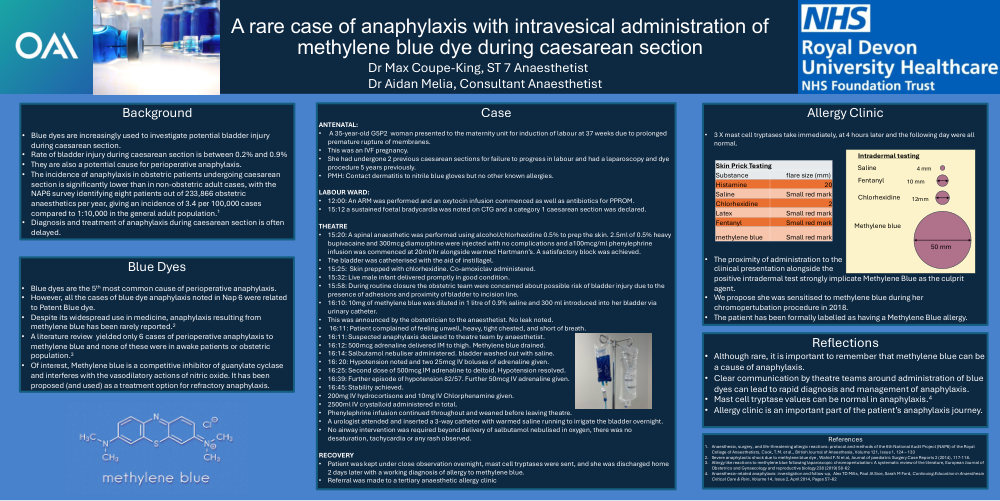
A rare case of anaphylaxis with intravesical administration of methylene blue dye during caesarean section
Poster Presenter
Authors
Affiliations
Part of Topic
Case report
A rare case of anaphylaxis with intravesical administration of methylene blue dye during caesarean section
Dr Max Coupe-King, ST 7 Anaesthetist
Dr Aidan Melia, Consultant Anaesthetist
Background
• Blue dyes are increasingly used to investigate potential bladder injury
during caesarean section.
• Rate of bladder injury during caesarean section is between 0.2% and 0.9%
• They are also a potential cause for perioperative anaphylaxis.
• The incidence of anaphylaxis in obstetric patients undergoing caesarean
section is significantly lower than in non-obstetric adult cases, with the
NAP6 survey identifying eight patients out of 233,866 obstetric
anaesthetics per year, giving an incidence of 3.4 per 100,000 cases.
1
• Diagnosis and treatment of anaphylaxis during caesarean section is often
delayed
Blue Dyes
• Blue dyes are the 5th most common cause of perioperative anaphylaxis.
• However, all the cases of blue dye anaphylaxis noted in Nap 6 were related
to Patent Blue dye.
• Despite its widespread use in medicine, anaphylaxis resulting from
methylene blue has been rarely reported.2
• A literature review yielded only 6 cases of perioperative anaphylaxis to
methylene blue and none of these were in awake patients or obstetric
population.3
• Of interest, Methylene blue is a competitive inhibitor of guanylate cyclase
and interferes with the vasodilatory actions of nitric oxide, it has been used
as a second line agent in the treatment of hypotension in refractory
anaphylaxis
Case
ANTENATAL:
• A 35-year-old G5P2 woman presented to the maternity unit for induction of labour at 37 weeks due to prolonged
premature rupture of membranes.
• This was an IVF pregnancy.
• She had undergone 2 previous caesarean sections for failure to progress in labour and had a laparoscopy and dye
procedure 5 years previously.
• PMH: Contact dermatitis to nitrile blue gloves but no other known allergies.
LABOUR WARD:
• 12:00: An ARM was performed and an oxytocin infusion commenced as well as antibiotics for PPROM.
• 15:12 a sustained foetal bradycardia was noted on CTG and a category 1 caesarean section was declared.
THEATRE
• 15:20: A spinal anaesthetic was performed using alcohol/chlorhexidine 0.5% to prep the skin. 2.5ml of 0.5% heavy
bupivacaine and 300mcg diamorphine were injected with no complications and a100mcg/ml phenylephrine
infusion was commenced at 20ml/hr. A good block was achieved.
• The bladder was catheterised using instillagel.
• 15:25: Skin prepped with chlorhexidine. Co-amoxiclav administered.
• 15:32: Live male infant delivered promptly in good condition.
• 15:58: During routine closure the obstetric team were concerned about possible risk of bladder injury due to the
presence of adhesions and proximity of bladder to incision line.
• 16:10: 10mg of methylene blue was diluted in 1 litre of 0.9% saline and 300 ml introduced into the bladder via
catheter, this was announced by the obstetrician to the anaesthetist. No leak noted.
• 16:11: Patient complained of feeling unwell, heavy, tight chested, and short of breath.
• 16:11: Suspected anaphylaxis declared to theatre team by anaesthetist.
• 16:12: 500mcg adrenaline delivered IM to thigh. Methylene blue drained.
• 16:14: Salbutamol nebuliser administered. bladder washed out with saline.
• 16: 20: Hypotension noted with blood pressure recorded as 46/29.
• 16:21: Two 25mcg IV boluses of adrenaline given, hypotension resolved.
• 16:25: Second dose of 500mcg IM adrenaline to deltoid.
• 16:39: Further episode of hypotension 82/57. Further 50mcg IV adrenaline given.
• 16:45: Stability achieved.
• 200mg IV hydrocortisone and 10mg IV Chlorphenamine given.
• 2500ml IV crystalloid administered in total.
• Phenylephrine infusion continued throughout and weaned before leaving theatre.
• A urologist attended and inserted a 3-way catheter with warmed saline running to irrigate the bladder overnight.
• No airway intervention was required beyond delivery of salbutamol nebulised in oxygen, there was no
desaturation, tachycardia or any rash observed.
• RECOVERY
• Patient was kept under close observation overnight, mast cell tryptases were sent, and she was discharged home
2 days later with a working diagnosis of allergy to methylene blue.
• Referral was made to the allergy clinic.
Allergy Clinic
• 3 X mast cell tryptases taken at the time, 4 hours later and the following day were all
normal.
• The timings and history as well as
the positive intradermal test clearly
show that Methylene Blue was the cause of this reaction.
• She was likely sensitised to methylene blue during her chromopertubation
procedure in 2018.
• The patient has been labelled as having a Methylene Blue allergy.
Reflections
• Although rare, it is important to remember that methylene blue can be
a cause of anaphylaxis.
• Clear communication by theatre teams around administration of blue
dyes can lead to rapid diagnosis and management of anaphylaxis.
• Mast cell tryptase values can be normal in anaphylaxis.
4
• Allergy clinic is an important part of the patient’s anaphylaxis journey