215 posters, 5 topics, 22 sessions, 596 authors, 283 institutions
ePostersLive by SciGen Technologies S.A. All rights reserved.
Obstetric Anaesthesia Annual Scientific Meeting 2025
May 15 - 16, 2025 | ICC, 2 Lanyon Place, Belfast BT1 3WH

6772813
Novel use of dual cell salvage in Jehovah's witness patient presenting with placenta accreta. Should this be the new standard?
Poster Presenter
Part of Topic
Case report
Introduction
Caesarean delivery for patients with placenta accreta frequently results in significant post-partum haemorrhage. However, in patients who decline blood products, the risks of associated morbidity and mortality are significantly higher requiring meticulous multidisciplinary perioperative management.
Case Report
A 25 patient was referred to our institution at 33 weeks’ gestation following a late diagnosis of placenta previa with suspected accreta. She had one previous caesarean section and identified as a Jehovah’s Witness. Her starting Haemoglobin was 97 g/L and Platelets 357.
On arrival an MRI confirmed placenta accreta and an experienced multidisciplinary team was assembled to plan and consent for delivery. A consultant haematologist prescribed both iron infusion and erythropoietin injections to optimise her preoperatively and had perioperative blood product consent completed. Within this she confirmed that she would not accept red blood cells, fresh frozen plasma or platelets but would accept cell salvage, cryoprecipitate and other blood derivatives.
She underwent an elective caesarean delivery at 36 weeks’ gestation. Her preoperative haemoglobin had escalated to 104 g/L. Our anaesthetic approach included a combined spinal epidural which was topped up intraoperatively to good effect, a radial arterial line, two 14-gauge cannula, and internal jugular central venous catheter.
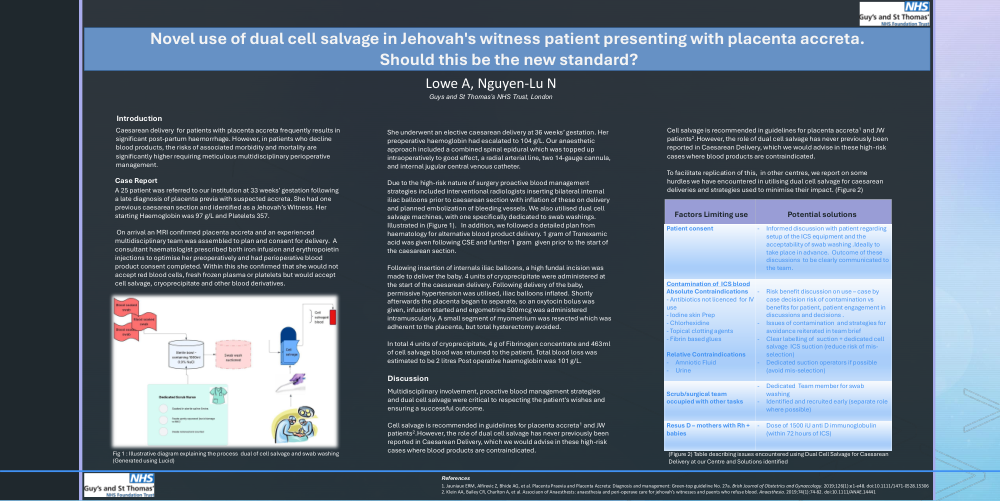
Due to the high-risk nature of surgery proactive blood management strategies included interventional radiologists inserting bilateral internal iliac balloons prior to caesarean section with inflation of these on delivery and planned embolization of bleeding vessels. We also utilised dual cell salvage machines, with one specifically dedicated to swab washings. Illustrated in (Figure 1). In addition, we followed a detailed plan from haematology for alternative blood product delivery. 1 gram of Tranexamic acid was given following CSE and further 1 gram given prior to the start of the caesarean section.
Following insertion of internals iliac balloons, a high fundal incision was made to deliver the baby. 4 units of cryoprecipitate were administered at the start of the caesarean delivery. Following delivery of the baby, permissive hypertension was utilised, iliac balloons inflated. Shortly afterwards the placenta began to separate, so an oxytocin bolus was given, infusion started and ergometrine 500mcg was administered intramuscularly. A small segment of myometrium was resected which was adherent to the placenta, but total hysterectomy avoided.
In total 4 units of cryoprecipitate, 4 g of Fibrinogen concentrate and 463ml of cell salvage blood was returned to the patient. Total blood loss was estimated to be 2 litres Post operative haemoglobin was 101 g/L
Discussion
Multidisciplinary involvement, proactive blood management strategies and dual cell salvage were critical to respecting the patient's wishes and ensuring a successful outcome.
Cell salvage is recommended in guidelines for placenta accreta1 and JW patients2.However, the role of dual cell salvage has never previously been reported in Caesarean Delivery, which we would advise in these high-risk cases where blood products are contraindicated.
Cell salvage is recommended in guidelines for placenta accreta1 and JW patients2.However, the role of dual cell salvage has never previously been reported in Caesarean Delivery, which we would advise in these high-risk cases where blood products are contraindicated.
To facilitate replication of this, in other centres, we report on some hurdles we have encountered in utilising dual cell salvage for caesarean deliveries and strategies used to minimise their impact. (Figure 2)