215 posters, 5 topics, 22 sessions, 596 authors, 283 institutions
ePostersLive by SciGen Technologies S.A. All rights reserved.
Obstetric Anaesthesia Annual Scientific Meeting 2025
May 15 - 16, 2025 | ICC, 2 Lanyon Place, Belfast BT1 3WH

6772268
How low can you go? An Emergency Caesarean Section in a patient with Sickle Cell Disease and Hyperhaemolysis Syndrome
Poster Presenter
Authors
Affiliations
Part of Topic
Case report
|
How low can you go? An Emergency Caesarean Section in a patient with Sickle Cell Disease and Hyperhaemolysis Syndrome |
Introduction
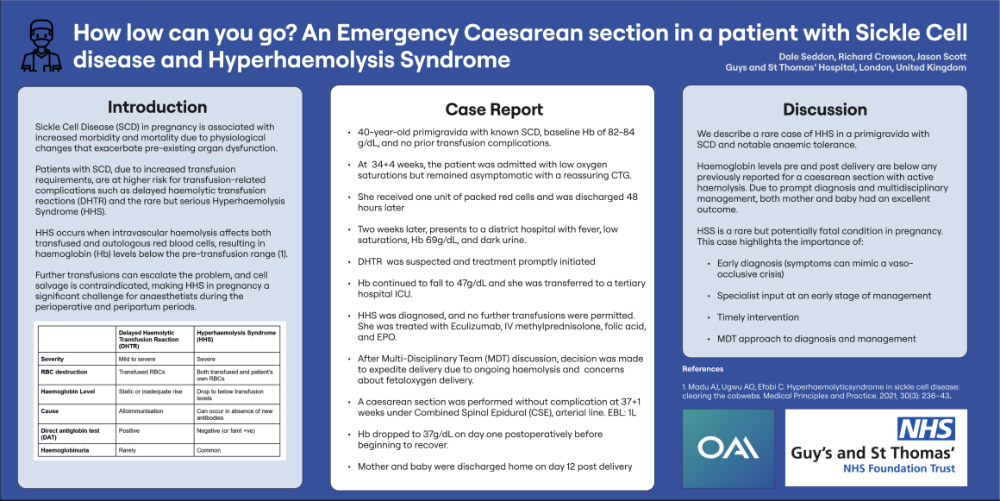
Sickle Cell Disease (SCD) in pregnancy is associated with increased morbidity and mortality due to physiological changes that exacerbate pre-existing organ dysfunction. Patients with SCD, due to their increased transfusion requirements, are at higher risk for transfusion-related complications such as delayed haemolytic transfusion reactions (DHTR) and the rare but serious Hyperhaemolysis Syndrome (HHS). HHS occurs when intravascular haemolysis affects both transfused and autologous red blood cells, resulting in haemoglobin (Hb) levels below the pre-transfusion range1. Further transfusions can escalate the problem, and cell salvage is contraindicated, making HHS in pregnancy a significant challenge for anaesthetists during the perioperative and peripartum periods.
Case Report
We present a 40-year-old primigravida with known SCD, baseline Hb of 82-84 g/dL, and no prior transfusion complications. At 34+4 weeks, she was admitted to the antenatal ward with low oxygen saturations but remained asymptomatic with a reassuring cardiotocograph. She received one unit of packed red cells and was discharged after 48 hours. Two weeks later, she presented to a district hospital with fever, low saturations, Hb 69g/dL, and dark urine. DHTR was suspected, and treatment was promptly started. Her Hb continued to fall, reaching 47g/dL, and she was transferred to a tertiary hospital ICU. HHS was diagnosed, and no further transfusions were permitted. She was treated with Eculizumab, IV methylprednisolone, folic acid, and EPO. After multidisciplinary discussion, a decision was made to expedite delivery due to ongoing haemolysis despite maximal medical therapy and concerns about fetal oxygen delivery. A caesarean section was performed without complication at 37+1 weeks under Combined Spinal Epidural (CSE) anaesthesia. Her Hb dropped to 37g/dL on day one postoperatively before beginning to recover. Both mother and baby were discharged home on day 12 post op.
Discussion
We describe a rare case of HHS in a primigravida with SCD and notable anaemic tolerance. Haemoglobin levels pre and post delivery are below any previously reported for a caesarean section with active haemolysis. Due to prompt diagnosis and multidisciplinary management, both mother and baby had an excellent outcome. This case highlights the importance of early diagnosis and timely intervention in managing HHS, a rare but potentially fatal condition in pregnancy.
Madu AJ, Ugwu AO, Efobi C. Hyperhaemolytic syndrome in sickle cell disease: clearing the cobwebs. Medical Principles and Practice. 2021; 30(3): 236–43.