215 posters, 5 topics, 22 sessions, 596 authors, 283 institutions
ePostersLive by SciGen Technologies S.A. All rights reserved.
Obstetric Anaesthesia Annual Scientific Meeting 2025
May 15 - 16, 2025 | ICC, 2 Lanyon Place, Belfast BT1 3WH

6771878
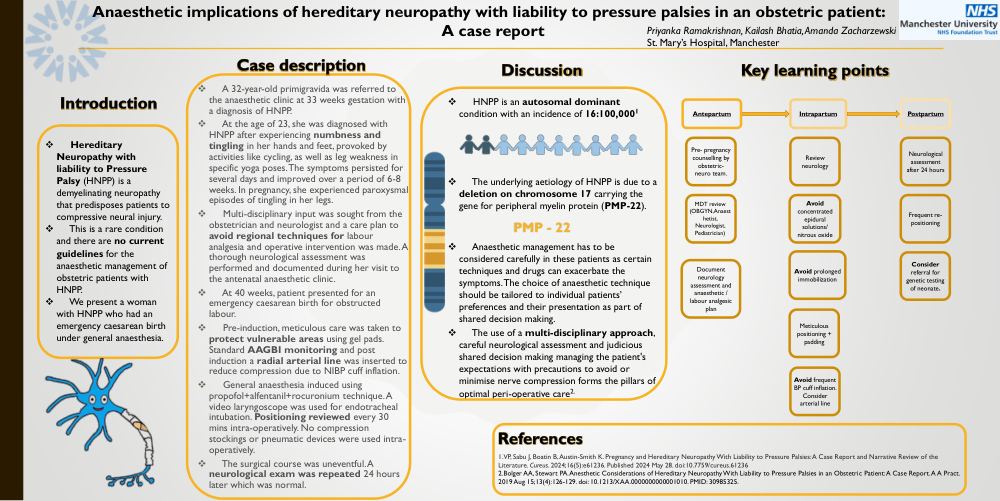
Anaesthetic implications of hereditary neuropathy with liability to pressure palsies in an obstetric patient: a case report
Part of Topic
Case report
Anaesthetic implications of hereditary neuropathy with liability to pressure palsies in an obstetric patient:
A case report
Priyanka Ramakrishnan, Kailash Bhatia, Amanda Zacharzewski
St. Mary’s Hospital, Manchester
Introduction
Hereditary Neuropathy with liability to Pressure Palsy (HNPP) is a demyelinating neuropathy that predisposes patients to compressive neural injury. ❖ This is a rare condition and there are no current guidelines for the anaesthetic management of obstetric patients with HNPP. ❖ We present a woman with HNPP who had an emergency caesarean birth under general anaesthesia.
Case description
A 32-year-old primigravida was referred to the anaesthetic clinic at 33 weeks gestation with a diagnosis of HNPP. ❖ At the age of 23, she was diagnosed with HNPP after experiencing numbness and tingling in her hands and feet, provoked by activities like cycling, as well as leg weakness in specific yoga poses. The symptoms persisted for several days and improved over a period of 6-8 weeks. In pregnancy, she experienced paroxysmal episodes of tingling in her legs. ❖ Multi-disciplinary input was sought from the obstetrician and neurologist and a care plan to avoid regional techniques for labour analgesia and operative intervention was made. A thorough neurological assessment was performed and documented during her visit to the antenatal anaesthetic clinic. ❖ At 40 weeks, patient presented for an emergency caesarean birth for obstructed labour. ❖ Pre-induction, meticulous care was taken to protect vulnerable areas using gel pads. Standard AAGBI monitoring and post induction a radial arterial line was inserted to reduce compression due to NIBP cuff inflation. ❖ General anaesthesia induced using propofol+alfentanil+rocuronium technique. A video laryngoscope was used for endotracheal intubation. Positioning reviewed every 30 mins intra-operatively. No compression stockings or pneumatic devices were used intra-operatively. ❖ The surgical course was uneventful. A neurological exam was repeated 24 hours which was normal.
Discussion
HNPP is an autosomal dominant condition with an incidence of 16:100,0001 ❖ The underlying aetiology of HNPP is due to a deletion on chromosome 17 carrying the gene for peripheral myelin protein (PMP-22). ❖ Anaesthetic management has to be considered carefully in these patients as certain techniques and drugs can exacerbate the symptoms. The choice of anaesthetic technique should be tailored to individual patients’ preferences and their presentation as part of shared decision making. ❖ The use of a multi-disciplinary approach, careful neurological assessment and judicious shared decision making managing the patient's expectations with precautions to avoid or minimise nerve compression forms the pillars of optimal peri- operative care.
Key learning points
Antepartum
Pre- pregnancy counselling by obstetric-neuro team.
MDT review (OBGYN,Anaest hetist, Neurologist, Pediatrician)
Document neurology assessment and anaesthetic / labour analgesic plan.
Intrapartum
Avoid concentrated epidural solutions/ nitrous oxide
Avoid prolonged immobilization
Meticulous positioning + padding
Avoid frequent BP cuff inflation. Consider arterial line
Postpartum
Neurological assessment after 24 hours
Frequent re-positioning
Consider referral for genetic testing of neonate.
References
1.VP, Sabu J, Boatin B, Austin-Smith K. Pregnancy and Hereditary Neuropathy With Liability to Pressure Palsies: A Case Report and Narrative Review of the Literature. Cureus. 2024;16(5):e61236. Published 2024 May 28. doi:10.7759/cureus.61236
2.Bolger AA, Stewart PA. Anesthetic Considerations of Hereditary Neuropathy With Liability to Pressure Palsies in an Obstetric Patient: A Case Report. A A Pract. 2019 Aug 15;13(4):126-129. doi: 10.1213/XAA.0000000000001010. PMID: 30985325