215 posters, 5 topics, 22 sessions, 596 authors, 283 institutions
ePostersLive by SciGen Technologies S.A. All rights reserved.
Obstetric Anaesthesia Annual Scientific Meeting 2025
May 15 - 16, 2025 | ICC, 2 Lanyon Place, Belfast BT1 3WH

6771267
Thrombotic thrombocytopenic purpura in pregnancy: two case reports.
Poster Presenter
Part of Topic
Case report
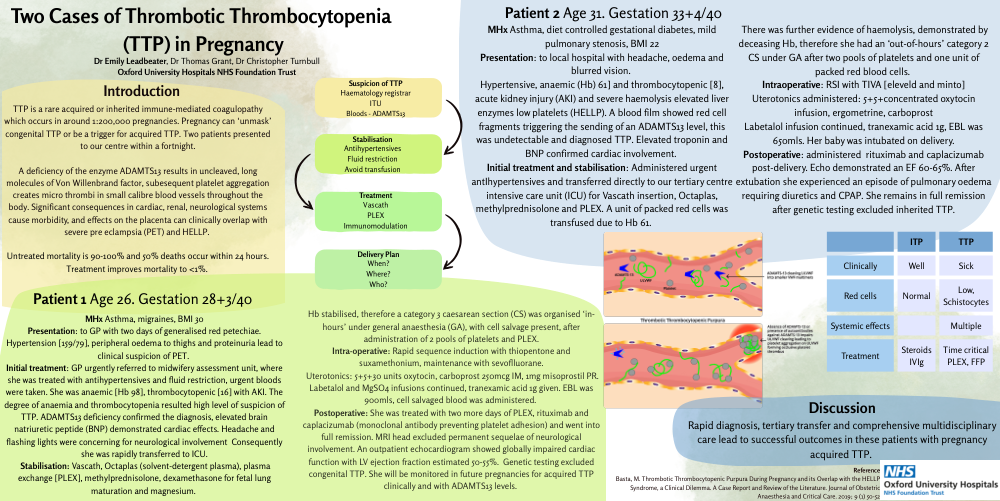
Two Cases of Thrombotic Thrombocytopenia (TTP) in Pregnancy
Dr Emily Leadbeater, Dr Thomas Grant, Dr Christopher Turnbull
Oxford University Hospitals NHS Foundation Trust
TTP is a rare acquired or inherited immune-mediated coagulopathy which occurs in around 1:200,000 pregnancies. Pregnancy can ‘unmask’ congenital TTP or be a trigger for acquired TTP. Two patients presented to our centre within a fortnight.
A deficiency of the enzyme ADAMTS13 results in uncleaved, long molecules of Von Willenbrand factor, subesequent platelet aggregation creates micro thrombi in small calibre blood vessels throughout the body. Significant consequences in cardiac, renal, neurological systems cause morbidity, and effects on the placenta can clinically overlap with severe pre eclampsia (PET) and HELLP.
Untreated mortality is 90-100% and 50% deaths occur within 24 hours.
Treatment improves mortality to <1%.
Patient 1 Age 26. Gestation 28+3/40
MHx Asthma, migraines, BMI 30
Presentation: to GP with two days of generalised red petechiae. Hypertension [159/79], peripheral oedema to thighs and proteinuria lead to clinical suspicion of PET.
Initial treatment: GP urgently referred to midwifery assessment unit, where she was treated with antihypertensives and fluid restriction, urgent bloods were taken. She was anaemic [Hb 98], thrombocytopenic [16] with AKI. The degree of anaemia and thrombocytopenia resulted high level of suspicion of TTP. ADAMTS13 deficiency confirmed the diagnosis, elevated brain natriuretic peptide (BNP) demonstrated cardiac effects. Headache and flashing lights were concerning for neurological involvement Consequently she was rapidly transferred to ICU.
Stabilisation: Vascath, Octaplas (solvent-detergent plasma), plasma exchange [PLEX], methylprednisolone, dexamethasone for fetal lung maturation and magnesium.
Hb stabilised, therefore a category 3 caesarean section (CS) was organised ‘in-hours’ under general anaesthesia (GA), with cell salvage present, after administration of 2 pools of platelets and PLEX.
Intra-operative: Rapid sequence induction with thiopentone and suxamethonium, maintenance with sevoflluorane.
Uterotonics: 5+5+30 units oxytocin, carboprost 250mcg IM, 1mg misoprostil PR.
Labetalol and MgSO4 infusions continued, tranexamic acid 1g given. EBL was 900mls, cell salvaged blood was administered.
Postoperative: She was treated with two more days of PLEX, rituximab and caplacizumab (monoclonal antibody preventing platelet adhesion) and went into full remission. MRI head excluded permanent sequelae of neurological involvement. An outpatient echocardiogram showed globally impaired cardiac function with LV ejection fraction estimated 50-55%. Genetic testing excluded congenital TTP. She will be monitored in future pregnancies for acquired TTP clinically and with ADAMTS13 levels.
Patient 2 Age 31. Gestation 33+4/40
MHx Asthma, diet controlled gestational diabetes, mild pulmonary stenosis, BMI 22
Presentation: to local hospital with headache, oedema and blurred vision.
Hypertensive, anaemic (Hb) 61] and thrombocytopenic [8], acute kidney injury (AKI) and severe haemolysis elevated liver enzymes low platelets (HELLP). A blood film showed red cell fragments triggering the sending of an ADAMTS13 level, this was undetectable and diagnosed TTP. Elevated troponin and BNP confirmed cardiac involvement.
Initial treatment and stabilisation: Administered urgent antIhypertensives and transferred directly to our tertiary centre intensive care unit (ICU) for Vascath insertion, Octaplas, methylprednisolone and PLEX. A unit of packed red cells was transfused due to Hb 61.
There was further evidence of haemolysis, demonstrated by deceasing Hb, therefore she had an ‘out-of-hours’ category 2 CS under GA after two pools of platelets and one unit of packed red blood cells.
Intraoperative: RSI with TIVA [eleveld and minto]
Uterotonics administered: 5+5+concentrated oxytocin infusion, ergometrine, carboprost
Labetalol infusion continued, tranexamic acid 1g, EBL was 650mls. Her baby was intubated on delivery.
Postoperative: administered rituximab and caplacizumab post-delivery. Echo demonstrated an EF 60-65%. After extubation she experienced an episode of pulmonary oedema requiring diuretics and CPAP. She remains in full remission after genetic testing excluded inherited TTP.
Discussion
Rapid diagnosis, tertiary transfer and comprehensive multidisciplinary care lead to successful outcomes in these patients with pregnancy acquired TTP.