215 posters, 5 topics, 22 sessions, 596 authors, 283 institutions
ePostersLive by SciGen Technologies S.A. All rights reserved.
Obstetric Anaesthesia Annual Scientific Meeting 2025
May 15 - 16, 2025 | ICC, 2 Lanyon Place, Belfast BT1 3WH

6771013
Ruptured Splenic Artery Aneurysm in Pregnancy: A Critical Multidisciplinary Approach to Timely Diagnosis and Management
Part of Topic
Case report
Ruptured splenic artery aneurysm in pregnancy: a critical multidisciplinary approach to timely diagnosis and management
Kuwaiti Board Of Anesthesia
Ruptured Splenic Artery Aneurysm in Pregnancy: A Critical Multidisciplinary Approach to Timely Diagnosis and Management
Mohammed Zalzalah 1, Nazha B Alfaraj 2, Fatemah Qasem 1,3
- Kuwait Board of Anesthesia, Kuwait Institute for Medical Specialization, Kuwait
- Kuwait Board of Obstetric and Gynecology, Kuwait Institute for Medical Specialization, Kuwait
- Department of Anesthesia and ICU, Maternity Hospital, Kuwait
Introductionn
- Splenic artery aneurysms (SAA):
• The most common aneurysm type in pregnancy.
• Rupture rates reach 20-50% in pregnant women, with maternal mortality as high as 75% and fetal mortality up to 95%.
• Often misdiagnosed as uterine rupture (up to 70%) requiring thorough consideration and a multidisciplinary approach for timely intervention.
• Possible risk factors include: pregnancy, atherosclerosis, portal hypertension, liver transplantation, and pancreatitis.
• Rapid growth or growth beyond 2cm in diameter increases its risk of rupture.
• This case illustrates a complex scenario where initial clinical presentation was non-specific, requiring surgical exploration.
Case Description
- A 29-year-old G1P0 woman, at 27 weeks of gestation, presented to the emergency department after a sudden collapse, losing consciousness and experiencing convulsions at home.
- Immediate obstetric ultrasound and CTG revealed fetal bradycardia (60–80 bpm) and free intra-abdominal fluid.
- Patient transferred urgently to the operating room for an exploratory laparotomy. Approximately 2.5 liters of blood were discovered that had accumulated in the lesser sac.
- Exploratory laparotomy was performed, with BP falling to 40/20 and requiring inotropic support.
- The patient required a total of 8 PRBC, 6 FFP, 6 fibrinogen, and 1 amp. of NovoSeven (factor VII).
- Active bleeding was found over the superior border of the pancreas and a ruptured splenic artery aneurysm was identified.
- Due to ongoing fetal bradycardia, an emergency cesarean section was performed simultaneously, delivering a 1.1 kg neonate.
- The splenic artery aneurysm was clipped and surgically repaired.
- The patient was then transferred to the ICU and required several blood transfusions with an estimated loss of 9L.
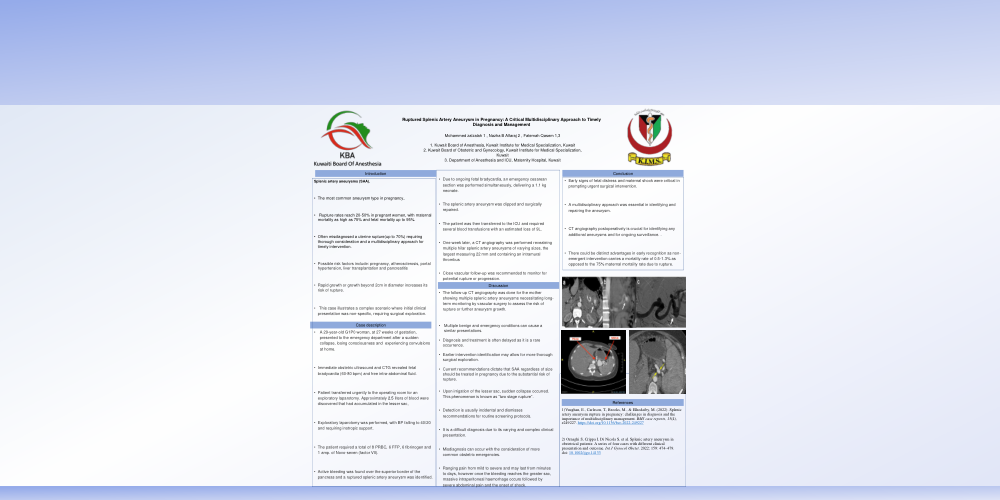
- One week later, a CT angiography was performed revealing multiple hilar splenic artery aneurysms of varying sizes, the largest measuring 22 mm and containing an intramural thrombus.
- Close vascular follow-up was recommended to monitor for potential rupture or progression.
- The follow-up CT angiography was done for the mother showing multiple splenic artery aneurysms necessitating long-term monitoring by vascular surgery to assess the risk of rupture or further aneurysm growth.
Discussionn
- Early signs of fetal distress and maternal shock were critical in prompting urgent surgical intervention.
- A multidisciplinary approach was essential in identifying and repairing the aneurysm.
- CT angiography postoperatively is crucial for identifying any additional aneurysms and for ongoing surveillance.
- There could be distinct advantages in early recognition as non-emergent intervention carries a mortality rate of 0.5–1.3% as opposed to the 75% maternal mortality rate due to rupture.
- SAA is found more frequently in women vs. men in a ratio of 4:1 and 58% are diagnosed in women of childbearing age.
- Multiple benign and emergency conditions can cause similar presentations.
- Diagnosis and treatment are often delayed as it is a rare occurrence.
- Earlier intervention identification may allow for more thorough surgical exploration.
- Current recommendations dictate that SAA regardless of size should be treated in pregnancy due to the substantial risk of rupture.
- Upon irrigation of the lesser sac, sudden collapse occurred. This phenomenon is known as “two-stage rupture.”
- Detection is usually incidental and dismisses recommendations for routine screening protocols.
- It is a difficult diagnosis due to its varying and complex clinical presentation.
- Misdiagnosis can occur with the consideration of more common obstetric emergencies.
- Ranging pain from mild to severe and may last from minutes to days, however once the bleeding reaches the greater sac, massive intraperitoneal hemorrhage occurs followed by severe abdominal pain and the onset of shock.
Conclusion
Early signs of fetal distress and maternal shock were critical in prompting urgent surgical intervention.
A multidisciplinary approach was essential in identifying and repairing the aneurysm.
CT angiography postoperatively is crucial for identifying any additional aneurysms and for ongoing surveillance.
There could be distinct advantages in early recognition as non-emergent intervention carries a mortality rate of 0.5–1.3% as opposed to the 75% maternal mortality rate due to rupture.
SAA is found more frequently in women vs. men in a ratio of 4:1 and 58% are diagnosed in women of childbearing age.
References
- Vaughan, E., Carlsson, T., Brooks, M., & Elhodaiby, M. (2022). Splenic artery aneurysm rupture in pregnancy: challenges in diagnosis and the importance of multidisciplinary management. BMJ Case Reports, 15(4), e249227. https://doi.org/10.1136/bcr-2022-249227
- Ornaghi S, Crippa I, Di Nicola S, et al. Splenic artery aneurysm in obstetrical patients: A series of four cases with different clinical presentation and outcome. Int J Gynecol Obstet. 2022; 159: 474–479. doi: 10.1002/ijgo.14133
Would you like this turned into a formal document or PowerPoint?