215 posters, 5 topics, 22 sessions, 596 authors, 283 institutions
ePostersLive by SciGen Technologies S.A. All rights reserved.
Obstetric Anaesthesia Annual Scientific Meeting 2025
May 15 - 16, 2025 | ICC, 2 Lanyon Place, Belfast BT1 3WH

6766432
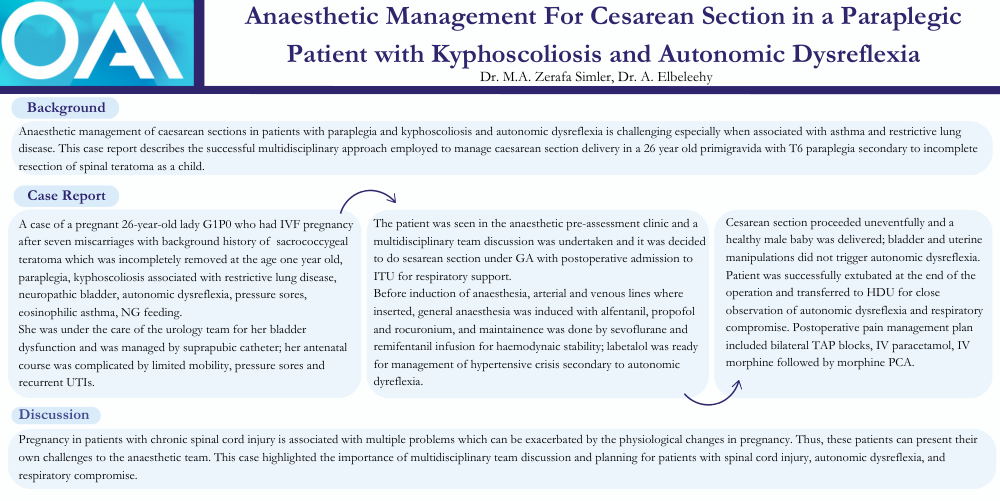
Anaesthetic management For Cesarean Section in Paraplegic patient with kyphoscoliosis and Autonomic dysreflexia
Poster Presenter
Part of Topic
Case report
Background:
Anaesthetic management of Caesarean Sections in patients with paraplegia and kyphoscoliosis and Autonomic dysreflexia is challenging especially when associated with asthma and restrictive lung disease.This case report describes the successful multidisciplinary approach employed to manage caesarean section delivery in a 26 year old primigravida with T6 paraplegia secondary to incomplete resection of spinal teratoma as a child.
Case Report:
A case of a pregnant 26-year-old lady G1P0 who had IVF pregnancy after seven miscarriages with background history of sacrococcygeal teratoma which was incompletely removed at the age one year old, paraplegia, Kyphoscoliosis associated with restrictive lung disease, neuropathic bladder, autonomic dysreflexia, pressure sores, Eosinophilic asthma, NG feeding. She was under the care of the urology team for her bladder dysfunction and was managed by suprapubic catheter; her antenatal course was complicated by limited mobility, pressure sores and recurrent UTIs. The patient was seen in the anaesthetic pre-assessment clinic and a multidisciplinary team discussion was undertaken and it was decided to do cesarean section under GA with postoperative admission to ITU for respiratory support. Before induction of anaesthesia, arterial and venous lines where inserted, general anaesthesia was induced with alfentanil, propofol and rocuronium, and maintainence was done by sevoflurane and remifentanil infusion for haemodynaic stability; labetalol was ready for management of hypertensive crisis secondary to autonomic dyreflexia. Cesarean section proceeded uneventally and a healthy male baby was delivered; bladder and uterine manipulations did not trigger autonomic dysreflexia. Patient was successfully extubated at the end of the operation and transferred to HDU for close observation of autonomic dysreflexia and respiratory compromise. Postoperative pain management plan included bilateral TAP blocks, IV paracetamol, IV morphine followed by morphine PCA.
Discussion:
Pregnancy in patients with chronic spinal cord injury is associated with multiple problems which can be exacerbated by the physiological changes in pregnancy. Thus, these patients can present their own challenges to the anaesthetic team. This case highlighted the importance of multidisciplinary team discussion and planning for patients with spinal cord injury, autonomic dysreflexia, and respiratory compromise.