215 posters, 5 topics, 22 sessions, 596 authors, 283 institutions
ePostersLive by SciGen Technologies S.A. All rights reserved.
Obstetric Anaesthesia Annual Scientific Meeting 2025
May 15 - 16, 2025 | ICC, 2 Lanyon Place, Belfast BT1 3WH

6766248
Therapeutic fondaparinux for deep vein thrombosis in pregnancy and peri-partum at elective caesarean delivery: a case report
Poster Presenter
Part of Topic
Case report
Therapeutic fondaparinux for deep vein thrombosis in pregnancy and peri-partum at elective caesarean delivery: a case report
Introduction
• Venous thromboembolism (VTE) is the leading cause of maternal morbidity and mortality in the UK and Ireland1.
• Low molecular weight heparin (LMWH) hypersensitivity reactions are not uncommon in pregnant women. Management of heparin skin allergies include antihistamines, topical steroids and switching to alternative LMWH. However, as LMWHs have similar pharmacological profiles, it is unlikely that switching between different types of LMWH may help in reduction of the skin allergy. Therefore alternatives to LMWH are needed for pregnant women with heparin intolerance who require anti-coagulation.
• Fondaparinux is a synthetic pentasaccharide that can be considered when allergies or adverse reactions prevent LMWH use. Although, fondaparinux is generally safe during pregnancy, there are practical issues due to limited experience managing it around delivery, which may lead to adverse outcomes.
• We present the case of a woman who underwent an elective caesarean delivery while on therapeutic fondaparinux for an occlusive deep vein thrombosis in her left leg.
Case Report
•A 32-year-old primiparous woman underwent an elective caesarean delivery at 38 weeks’ gestation.
• At 28 weeks, she developed progressive pain and swelling in her left leg, with an elevated d-dimer 2.04mg.L-1. Ultrasound confirmed occlusive thrombus in her left common iliac, common femoral, femoral and popliteal veins.
• She started therapeutic tinzaparin but switched to enoxaparin due to injection site reactions. With input from haematology, she was commenced on 10 mg fondaparinux for hypersensitivity intolerance.
• Following multidisciplinary team (MDT) input, she underwent an elective caesarean delivery under general anaesthesia, reducing her fondaparinux dose to 2.5mg the day prior to surgery and omitting it on the morning of surgery.
• The procedure was uncomplicated, with minimal blood loss, and post- operative pain was managed using systemic opioids and bilateral transabdominal plane blocks.
• She resumed fondaparinux on the first post-operative day and was successfully discharged home on the third post-operative day with a healthy baby girl.
Discussion:
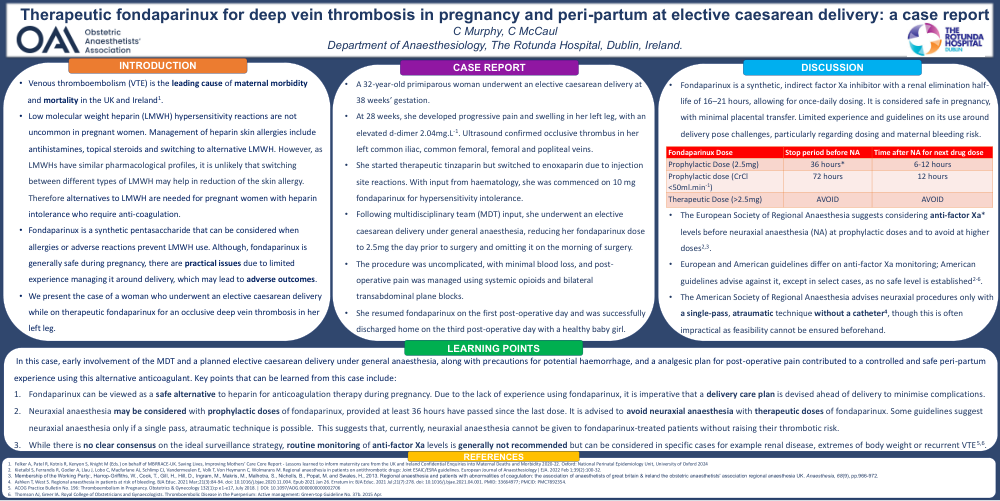
• Fondaparinux is a synthetic, indirect factor Xa inhibitor with a renal elimination half- life of 16–21 hours, allowing for once-daily dosing. It is considered safe in pregnancy, with minimal placental transfer. Limited experience and guidelines on its use around delivery pose challenges, particularly regarding dosing and maternal bleeding risk.
• The European Society of Regional Anaesthesia suggests considering anti-factor Xa* levels before neuraxial anaesthesia (NA) at prophylactic doses and to avoid at higher doses2,3.
• European and American guidelines differ on anti-factor Xa monitoring; American guidelines advise against it, except in select cases, as no safe level is established2-6.
• The American Society of Regional Anaesthesia advises neuraxial procedures only with a single-pass, atraumatic technique without a catheter4, though this is often impractical as feasibility cannot be ensured beforehand.
Learning Points:
In this case, early involvement of the MDT and a planned elective caesarean delivery under general anaesthesia, along with precautions for potential haemorrhage, and a analgesic plan for post-operative pain contributed to a controlled and safe peri-partum
experience using this alternative anticoagulant. Key points that can be learned from this case include:
1. Fondaparinux can be viewed as a safe alternative to heparin for anticoagulation therapy during pregnancy. Due to the lack of experience using fondaparinux, it is imperative that a delivery care plan is devised ahead of delivery to minimise complications.
2. Neuraxial anaesthesia may be considered with prophylactic doses of fondaparinux, provided at least 36 hours have passed since the last dose. It is advised to avoid neuraxial anaesthesia with therapeutic doses of fondaparinux. Some guidelines suggest
neuraxial anaesthesia only if a single pass, atraumatic technique is possible. This suggests that, currently, neuraxial anaesthesia cannot be given to fondaparinux-treated patients without raising their thrombotic risk.
3. While there is no clear consensus on the ideal surveillance strategy, routine monitoring of anti-factor Xa levels is generally not recommended but can be considered in specific cases for example renal disease, extremes of body weight or recurrent VTE5,6.
References:
1. Felker A, Patel R, Kotnis R, Kenyon S, Knight M (Eds.) on behalf of MBRRACE-UK. Saving Lives, Improving Mothers’ Care Core Report - Lessons learned to inform maternity care from the UK and Ireland Confidential Enquiries into Maternal Deaths and Morbidity 2020-22. Oxford: National Perinatal Epidemiology Unit, University of Oxford 2024
2. Kietaibl S, Ferrandis R, Godier A, Llau J, Lobo C, Macfarlane AJ, Schlimp CJ, Vandermeulen E, Volk T, Von Heymann C, Wolmarans M. Regional anaesthesia in patients on antithrombotic drugs: Joint ESAIC/ESRA guidelines. European Journal of Anaesthesiology| EJA. 2022 Feb 1;39(2):100-32.
3. Membership of the Working Party:, Harrop‐Griffiths, W., Cook, T., Gill, H., Hill, D., Ingram, M., Makris, M., Malhotra, S., Nicholls, B., Popat, M. and Swales, H., 2013. Regional anaesthesia and patients with abnormalities of coagulation: the association of anaesthetists of great britain & ireland the obstetric anaesthetists' association regional anaesthesia UK. Anaesthesia, 68(9), pp.966-972.
4. Ashken T, West S. Regional anaesthesia in patients at risk of bleeding. BJA Educ. 2021 Mar;21(3):84-94. doi: 10.1016/j.bjae.2020.11.004. Epub 2021 Jan 26. Erratum in: BJA Educ. 2021 Jul;21(7):278. doi: 10.1016/j.bjae.2021.04.001. PMID: 33664977; PMCID: PMC7892354.
5. ACOG Practice Bulletin No. 196: Thromboembolism in Pregnancy. Obstetrics & Gynecology 132(1):p e1-e17, July 2018. | DOI: 10.1097/AOG.0000000000002706
6. Thomson AJ, Greer IA. Royal College of Obstetricians and Gynaecologists. Thromboembolic Disease in the Puerperium: Active management: Green‐top Guideline No. 37b. 2015 Apr.