215 posters, 5 topics, 22 sessions, 596 authors, 283 institutions
ePostersLive by SciGen Technologies S.A. All rights reserved.
Obstetric Anaesthesia Annual Scientific Meeting 2025
May 15 - 16, 2025 | ICC, 2 Lanyon Place, Belfast BT1 3WH

6765833
A case of masseter spasm and a difficult airway following suxamethonium administration in a category 1 caesarean section
Poster Presenter
Part of Topic
Case report
CLINICAL VIGNETTE
A multiparous 37-year-old, 50kg lady presented in labour. She had no significant past medical history and had never received general anaesthesia. She had previously undergone Caesereansection under spinal anaesthesia. Mouth opening was normal and there were no concerning features on airway examination. A category 1 Caesereansection was called for prolonged foetaldistress in the context of scar tenderness.
Anesthesia was induced with 200mg propofol and 100mg suxemethonium. The patient demonstrated fasciculations without subsequent muscle relaxation, thereafter she had generalised rigidity with marked masseter spasm. A ‘cannot intubate, cannot oxygenate’ situation developed. A critical incident was declared with desaturation to SpO2 70%.
A further propofol 100mg and rocuronium 50mg were given. Equipment for emergency front-of-neck access requested. Facemask ventilation was established after approximately 3-4 minutes. A two-handed technique with high PEEP was needed with addition of a Guedel airway when possible. Adequate oxygenation (SpO2 100%) and anaesthesia (Sevoflurane MAC >1.0) were achieved. Delivery of the foetus required bilateral division of rectus abdominis as the patient demonstrated persistent hypertonia.
The patient was intubated following delivery using a videolaryngoscopy and stylet. Mouth opening remained very limited. Malignant hyperthermia was considered. The operation was completed and TAP blocks performed. The patient was extubated awake after a prolonged period of observation and full reversal of neuromuscular blockade.
Critical Incident Time Points
03:30 – Emergency Call: Category 1 Delivery
03:40 – Induction of Anaesthesia
03:41 – Critical Incident Declared - Can’t Intubate, Can’t Oxygenate
03:43 – Facemask Ventilation Established
03:45 – Knife to Skin
03:50 – Delivery of the Foetus
03:55 - Intubation
The mother required a PCA for pain but had no other postoperative issues. Serum creatine kinase was 500 units/L. The neonate had delayed transition, with initial drowsiness and hypoventilation attributed to retained anaesthesia.
Events were explained to the mother and staff were debriefed. An adverse drug reaction was recorded, and a letter was sent to the mother’s GP. The mother was referred to the Malignant Hyperthermia Unit in Leeds for further investigation.
LEARNING POINTS
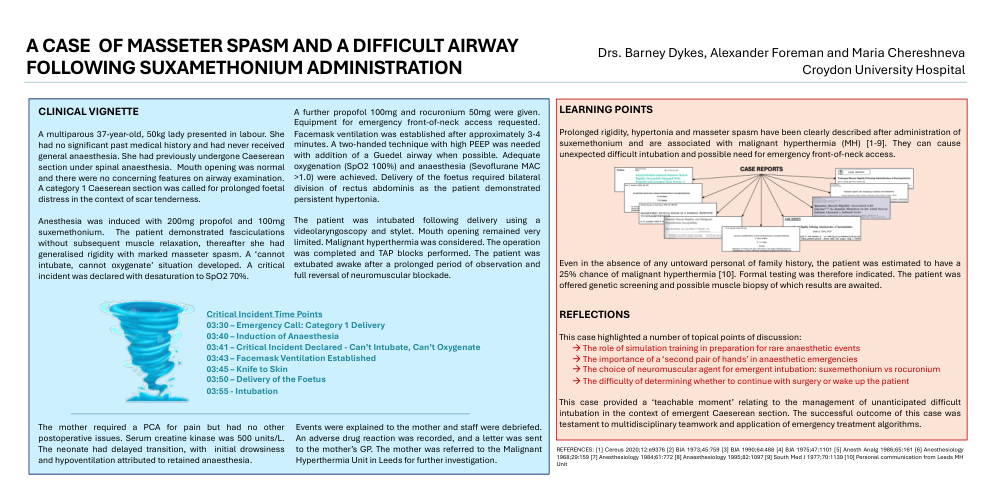
Prolonged rigidity, hypertonia and masseter spasm have been clearly described after administration of suxemethonium and are associated with malignant hyperthermia. They can cause unexpected difficult intubation and possible need for emergency front-of-neck access.
Even in the absence of any untoward personal of family history, the patient was estimated to have a 25% chance of malignant hyperthermia [10]. Formal testing was therefore indicated. The patient was offered genetic screening and possible muscle biopsy of which results are awaited.
REFLECTIONS
This case highlighted a number oftopical points of discussion:
- The role of simulation training in preparation for rare anaesthetic events
- The importance of a ‘second pair of hands’ in anaesthetic emergencies
- The choice of neuromuscular agent for emergent intubation: suxemethonium vs rocuronium
- The difficulty of determining whether to continue with surgery or wake up the patient
This case provided a ‘teachable moment’ relating to the management of unanticipated difficult intubation in the context of emergent Caeserean section. The successful outcome of this case was testament to multidisciplinary teamwork and application of emergency treatment algorithms.