215 posters, 5 topics, 22 sessions, 596 authors, 283 institutions
ePostersLive by SciGen Technologies S.A. All rights reserved.
Obstetric Anaesthesia Annual Scientific Meeting 2025
May 15 - 16, 2025 | ICC, 2 Lanyon Place, Belfast BT1 3WH

6781084
When a patient's headache, becomes their anaesthetist's - An unusual case of post-instrumentation headache.
Poster Presenter
Authors
Affiliations
Part of Topic
Case report
Introduction
We report a case of post-epidural headache occurring with unusual features, leading to the diagnosis of pneumocephalus, managed with conservative measures and epidural blood patch.
Case-Report
A well, primiparous, caucasian, 35 year old presented for a seated epidural complemented vaginal delivery, being discharged the following day with thromboprophylaxis.
She re-presented complaining primarily of neck and shoulder discomfort, with headache extending towards the vertex and frontal regions associated with tinnitus and nausea. Physical examination was normal. Symptoms began minutes after loss of resistance to air (LORA) epidural, with the operator documenting ‘drops’ of clear fluid at this time.
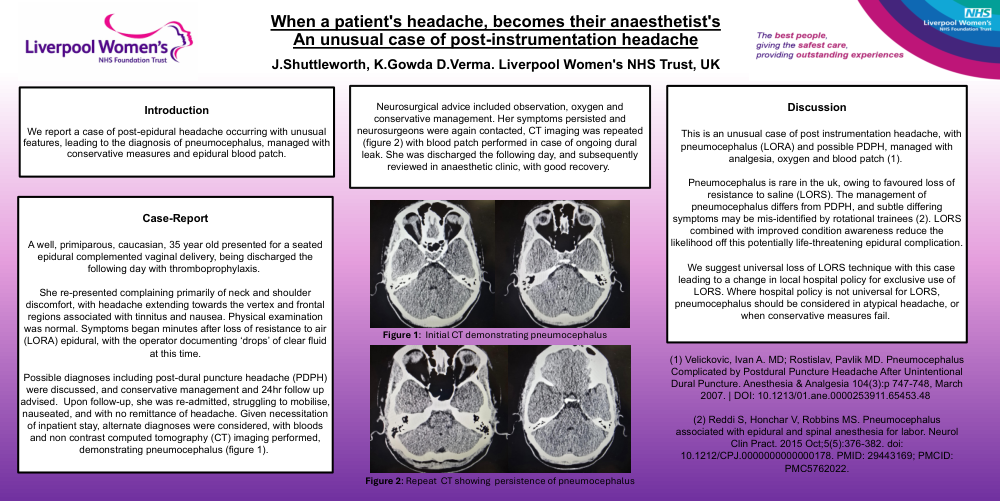
Possible diagnoses including post-dural puncture headache (PDPH) were discussed, and conservative management and 24hr follow up advised. Upon follow-up, she was re-admitted, struggling to mobilise, nauseated, and with no remittance of headache. Given necessitation of inpatient stay, alternate diagnoses were considered, with bloods and non contrast computed tomography (CT) imaging performed, demonstrating pneumocephalus (figure 1).
Neurosurgical advice included observation, oxygen and conservative management. Her symptoms persisted and neurosurgeons were again contacted, CT imaging was repeated (figure 2) with blood patch performed in case of ongoing dural leak. She was discharged the following day, and subsequently reviewed in anaesthetic clinic, with good recovery.
Discussion
This is an unusual case of post instrumentation headache, with pneumocephalus (LORA) and possible PDPH, managed with analgesia, oxygen and blood patch (1).
Pneumocephalus is rare in the uk, owing to favoured loss of resistance to saline (LORS). The management of pneumocephalus differs from PDPH, and subtle differing symptoms may be mis-identified by rotational trainees (2). LORS combined with improved condition awareness reduce the likelihood off this potentially life-threatening epidural complication.
We suggest universal loss of LORS technique with this case leading to a change in local hospital policy for exclusive use of LORS. Where hospital policy is not universal for LORS, pneumocephalus should be considered in atypical headache, or when conservative measures fail.
(1) Velickovic, Ivan A. MD; Rostislav, Pavlik MD. Pneumocephalus Complicated by Postdural Puncture Headache After Unintentional Dural Puncture. Anesthesia & Analgesia 104(3):p 747-748, March 2007. | DOI: 10.1213/01.ane.0000253911.65453.48
(2) Reddi S, Honchar V, Robbins MS. Pneumocephalus associated with epidural and spinal anesthesia for labor. Neurol Clin Pract. 2015 Oct;5(5):376-382. doi: 10.1212/CPJ.0000000000000178. PMID: 29443169; PMCID: PMC5762022.