215 posters, 5 topics, 22 sessions, 596 authors, 283 institutions
ePostersLive by SciGen Technologies S.A. All rights reserved.
Obstetric Anaesthesia Annual Scientific Meeting 2025
May 15 - 16, 2025 | ICC, 2 Lanyon Place, Belfast BT1 3WH

6780249
Horner's syndrome with ipsilateral upper limb parasthesia following epidural top-up for caesarean section: a case report.
Poster Presenter
Authors
Affiliations
Part of Topic
Case report
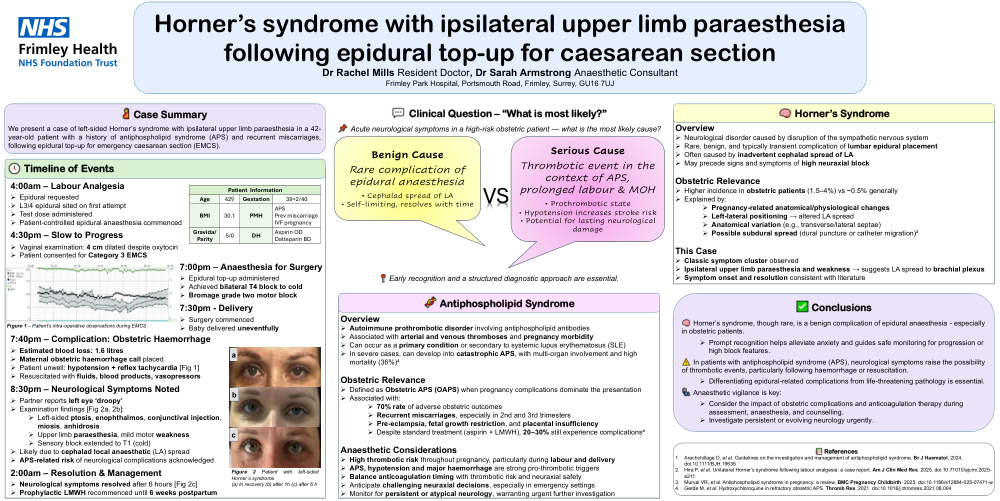
Horner’s syndrome with ipsilateral upper limb paraesthesia following epidural top-up for caesarean section
Dr Rachel Mills Resident Doctor, Dr Sarah Armstrong Anaesthetic Consultant
Frimley Park Hospital, Portsmouth Road, Frimley, Surrey, GU16 7UJ
Case Summary
We present a case of left-sided Horner’s syndrome with ipsilateral upper limb paraesthesia in a 42-year-old patient with a history of antiphospholipid syndrome (APS) and recurrent miscarriages, following epidural top-up for emergency caesarean section (EMCS).
Timeline of Events
4:00am – Labour Analgesia
➢ Epidural requested
➢ L3/4 epidural sited on first attempt
➢ Test dose administered
➢ Patient-controlled epidural anaesthesia commenced
4:30pm – Slow to Progress
➢ Vaginal examination: 4 cm dilated despite oxytocin
➢ Patient consented for Category 3 EMCS
7:00pm – Anaesthesia for Surgery
➢ Epidural top-up administered
➢ Achieved bilateral T4 block to cold
➢ Bromage grade two motor block
7:30pm - Delivery
➢ Surgery commenced
➢ Baby delivered uneventfully
igure 1 – Patient’s intra-operative observations during EMCS
➢ Baby delivered uneventfully
7:40pm – Complication: Obstetric Haemorrhage
➢ Estimated blood loss: 1.6 litres
➢ Maternal obstetric haemorrhage call placed
➢ Patient unwell: hypotension + reflex tachycardia [Fig 1]
➢ Resuscitated with fluids, blood products, vasopressors
8:30pm – Neurological Symptoms Noted
➢ Partner reports left eye ‘droopy’
➢ Examination findings [Fig 2a, 2b]:
➢ Left-sided ptosis, enophthalmos, conjunctival injection, miosis, anhidrosis
➢ Upper limb paraesthesia, mild motor weakness
➢ Sensory block extended to T1 (cold)
➢ Likely due to cephalad local anaesthetic (LA) spread
➢ APS-related risk of neurological complications acknowledged
2:00am – Resolution & Management
➢ Neurological symptoms resolved after 6 hours [Fig 2c]
➢ Prophylactic LMWH recommenced until 6 weeks postpartum
Clinical Question – “What is most likely?”
Acute neurological symptoms in a high-risk obstetric patient — what is the most likely cause?
Early recognition and a structured diagnostic approach are essential.
Antiphospholipid Syndrome
Overview
➢ Autoimmune prothrombotic disorder involving antiphospholipid antibodies
➢ Associated with arterial and venous thromboses and pregnancy morbidity
➢ Can occur as a primary condition or secondary to systemic lupus erythematosus (SLE)
➢ In severe cases, can develop into catastrophic APS, with multi-organ involvement and high
mortality (36%)4
Obstetric Relevance
➢ Defined as Obstetric APS (OAPS) when pregnancy complications dominate the presentation
➢ Associated with:
➢ 70% rate of adverse obstetric outcomes
➢ Recurrent miscarriages, especially in 2nd and 3rd trimesters
➢ Pre-eclampsia, fetal growth restriction, and placental insufficiency
➢ Despite standard treatment (aspirin + LMWH), 20–30% still experience complications⁴
Anaesthetic Considerations
➢ High thrombotic risk throughout pregnancy, particularly during labour and delivery
➢ APS, hypotension and major haemorrhage are strong pro-thrombotic triggers
➢ Balance anticoagulation timing with thrombotic risk and neuraxial safety
➢ Anticipate challenging neuraxial decisions, especially in emergency settings
➢ Monitor for persistent or atypical neurology, warranting urgent further investigation
Horner’s Syndrome
Overview
➢ Neurological disorder caused by disruption of the sympathetic nervous system
➢ Rare, benign, and typically transient complication of lumbar epidural placement
➢ Often caused by inadvertent cephalad spread of LA
➢ May precede signs and symptoms of high neuraxial block
Obstetric Relevance
➢ Higher incidence in obstetric patients (1.5–4%) vs ~0.5% generally
➢ Explained by:
➢ Pregnancy-related anatomical/physiological changes
➢ Left-lateral positioning → altered LA spread
➢ Anatomical variation (e.g., transverse/lateral septae)
➢ Possible subdural spread (dural puncture or catheter migration)²
This Case
➢ Classic symptom cluster observed
➢ Ipsilateral upper limb paraesthesia and weakness → suggests LA spread to brachial plexus
➢ Symptom onset and resolution consistent with literature
Conclusions
Horner’s syndrome, though rare, is a benign complication of epidural anaesthesia - especially
in obstetric patients.
➢ Prompt recognition helps alleviate anxiety and guides safe monitoring for progression or
high block features.
In patients with antiphospholipid syndrome (APS), neurological symptoms raise the possibility
of thrombotic events, particularly following haemorrhage or resuscitation.
➢ Differentiating epidural-related complications from life-threatening pathology is essential.
Anaesthetic vigilance is key:
➢ Consider the impact of obstetric complications and anticoagulation therapy during
assessment, anaesthesia, and counselling.
➢ Investigate persistent or evolving neurology urgently.