215 posters, 5 topics, 22 sessions, 596 authors, 283 institutions
ePostersLive by SciGen Technologies S.A. All rights reserved.
Obstetric Anaesthesia Annual Scientific Meeting 2025
May 15 - 16, 2025 | ICC, 2 Lanyon Place, Belfast BT1 3WH

6779782
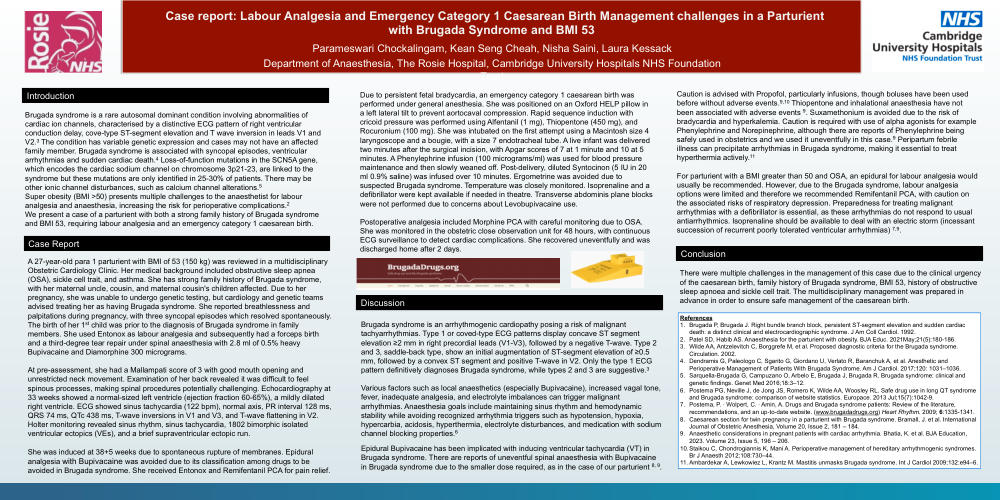
Labour Analgesia and Emergency Category 1 Caesarean Birth Management challenges in a Parturient with Brugada Syndrome and BMI 53
Part of Topic
Case report
Case report: Labour Analgesia and Emergency Category 1 Caesarean Birth Management challenges in a Parturient
with Brugada Syndrome and BMI 53.
Introduction:
Brugada syndrome is a rare autosomal dominant condition involving abnormalities of cardiac ion channels, characterised by a distinctive ECG pattern of right ventricular conduction delay, cove-type ST-segment elevation and T wave inversion in leads V1 and V2.3 The condition has variable genetic expression and cases may not have an affected family member. Brugada syndrome is associated with syncopal episodes, ventricular arrhythmias and sudden cardiac death.4 Loss-of-function mutations in the SCN5A gene, which encodes the cardiac sodium channel on chromosome 3p21-23, are linked to the syndrome but these mutations are only identified in 25-30% of patients. There may be other ionic channel disturbances, such as calcium channel alterations.5 Super obesity (BMI >50) presents multiple challenges to the anaesthetist for labour analgesia and anaesthesia, increasing the risk for perioperative complications.2 We present a case of a parturient with both a strong family history of Brugada syndrome and BMI 53, requiring labour analgesia and an emergency category 1 caesarean birth.
Case report:
A 27-year-old para 1 parturient with BMI of 53 (150 kg) was reviewed in a multidisciplinary Obstetric Cardiology Clinic. Her medical background included obstructive sleep apnea (OSA), sickle cell trait, and asthma. She has strong family history of Brugada syndrome, with her maternal uncle, cousin, and maternal cousin's children affected. Due to her pregnancy, she was unable to undergo genetic testing, but cardiology and genetic teams advised treating her as having Brugada syndrome. She reported breathlessness and palpitations during pregnancy, with three syncopal episodes which resolved spontaneously. The birth of her 1st child was prior to the diagnosis of Brugada syndrome in family members. She used Entonox as labour analgesia and subsequently had a forceps birth and a third-degree tear repair under spinal anaesthesia with 2.8 ml of 0.5% heavy Bupivacaine and Diamorphine 300 micrograms. At pre-assessment, she had a Mallampati score of 3 with good mouth opening and unrestricted neck movement. Examination of her back revealed it was difficult to feel spinous processes, making spinal procedures potentially challenging. Echocardiography at 33 weeks showed a normal-sized left ventricle (ejection fraction 60-65%), a mildly dilated right ventricle. ECG showed sinus tachycardia (122 bpm), normal axis, PR interval 128 ms, QRS 74 ms, QTc 438 ms, T-wave inversions in V1 and V3, and T-wave flattening in V2. Holter monitoring revealed sinus rhythm, sinus tachycardia, 1802 bimorphic isolated ventricular ectopics (VEs), and a brief supraventricular ectopic run. She was induced at 38+5 weeks due to spontaneous rupture of membranes. Epidural analgesia with Bupivacaine was avoided due to its classification among drugs to be avoided in Brugada syndrome. She received Entonox and Remifentanil PCA for pain relief. Due to persistent fetal bradycardia, an emergency category 1 caesarean birth was performed under general anesthesia. She was positioned on an Oxford HELP pillow in a left lateral tilt to prevent aortocaval compression. Rapid sequence induction with cricoid pressure was performed using Alfentanil (1 mg), Thiopentone (450 mg), and Rocuronium (100 mg). She was intubated on the first attempt using a Macintosh size 4 laryngoscope and a bougie, with a size 7 endotracheal tube. A live infant was delivered two minutes after the surgical incision, with Apgar scores of 7 at 1 minute and 10 at 5 minutes. A Phenylephrine infusion (100 micrograms/ml) was used for blood pressure maintenance and then slowly weaned off. Post-delivery, diluted Syntocinon (5 IU in 20 ml 0.9% saline) was infused over 10 minutes. Ergometrine was avoided due to suspected Brugada syndrome. Temperature was closely monitored. Isoprenaline and a defibrillator were kept available if needed in theatre. Transverse abdominis plane blocks were not performed due to concerns about Levobupivacaine use.
Postoperative analgesia included Morphine PCA with careful monitoring due to OSA. She was monitored in the obstetric close observation unit for 48 hours, with continuous ECG surveillance to detect cardiac complications. She recovered uneventfully and was discharged home after 2 days.
Discussion:
Brugada syndrome is an arrhythmogenic cardiopathy posing a risk of malignant tachyarrhythmias. Type 1 or coved-type ECG patterns display concave ST segment elevation ≥2 mm in right precordial leads (V1-V3), followed by a negative T-wave. Type 2 and 3, saddle-back type, show an initial augmentation of ST-segment elevation of ≥0.5 mm, followed by a convex ST segment and positive T-wave in V2. Only the type 1 ECG pattern definitively diagnoses Brugada syndrome, while types 2 and 3 are suggestive.3 Various factors such as local anaesthetics (especially Bupivacaine), increased vagal tone, fever, inadequate analgesia, and electrolyte imbalances can trigger malignant arrhythmias. Anaesthesia goals include maintaining sinus rhythm and hemodynamic stability while avoiding recognized arrhythmia triggers such as hypotension, hypoxia, hypercarbia, acidosis, hyperthermia, electrolyte disturbances, and medication with sodium channel blocking properties.6 Epidural Bupivacaine has been implicated with inducing ventricular tachycardia (VT) in Brugada syndrome. There are reports of uneventful spinal anaesthesia with Bupivacaine in Brugada syndrome due to the smaller dose required, as in the case of our parturient 8, 9. Caution is advised with Propofol, particularly infusions, though boluses have been used before without adverse events.9,10 Thiopentone and inhalational anaesthesia have not been associated with adverse events 9. Suxamethonium is avoided due to the risk of bradycardia and hyperkalemia. Caution is required with use of alpha agonists for example Phenylephrine and Norepinephrine, although there are reports of Phenylephrine being safely used in obstetrics and we used it uneventfully in this case.9 Peripartum febrile illness can precipitate arrhythmias in Brugada syndrome, making it essential to treat hyperthermia actively.11 For parturient with a BMI greater than 50 and OSA, an epidural for labour analgesia would usually be recommended. However, due to the Brugada syndrome, labour analgesia options were limited and therefore we recommended Remifentanil PCA, with caution on the associated risks of respiratory depression. Preparedness for treating malignant arrhythmias with a defibrillator is essential, as these arrhythmias do not respond to usual antiarrhythmics. Isoprenaline should be available to deal with an electric storm (incessant succession of recurrent poorly tolerated ventricular arrhythmias) 7,9.
Conclusion:
There were multiple challenges in the management of this case due to the clinical urgency of the caesarean birth, family history of Brugada syndrome, BMI 53, history of obstructive sleep apnoea and sickle cell trait. The multidisciplinary management was prepared in advance in order to ensure safe management of the caesarean birth.