215 posters, 5 topics, 22 sessions, 596 authors, 283 institutions
ePostersLive by SciGen Technologies S.A. All rights reserved.
Obstetric Anaesthesia Annual Scientific Meeting 2025
May 15 - 16, 2025 | ICC, 2 Lanyon Place, Belfast BT1 3WH

6781263
Life threatening arterial haemorrhage due to endometriosis
Poster Presenter
Authors
Affiliations
Part of Topic
Case report
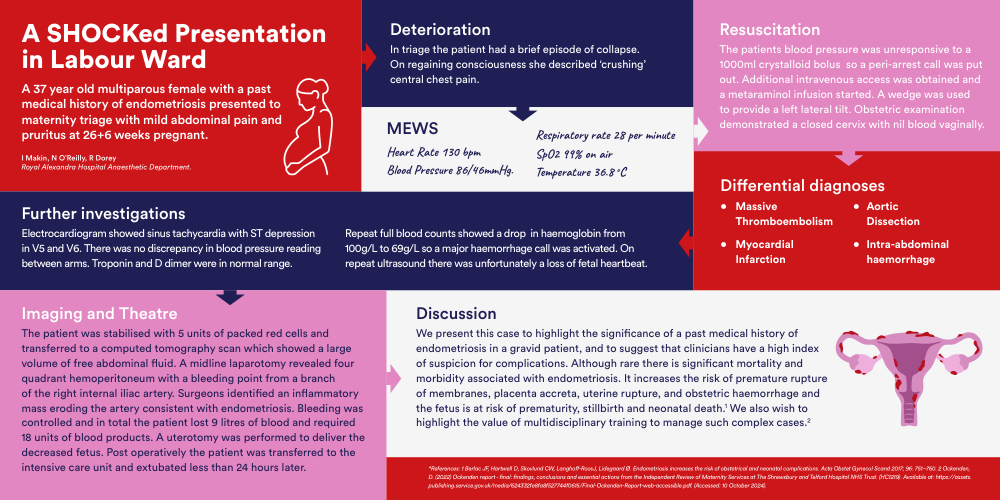
A SHOCKed Presentation
in Labour Ward
I Makin, N O’Reilly, R Dorey
Royal Alexandra Hospital Anaesthetic Department.
A 37 year old multiparous female with a past medical history of endometriosis presented to maternity triage with mild abdominal pain and pruritus at 26+6 weeks pregnant.
Deterioration
In triage the patient had a brief episode of collapse. On regaining consciousness she described ‘crushing’ central chest pain.
MEWS
Heart Rate 130 bpm
Blood Pressure 86/46mmHg.
Respiratory rate 28 per minute
SpO2 99% on air
Temperature 36.8 oC
Resuscitation
The patients blood pressure was unresponsive to a 1000ml crystalloid bolus so a peri-arrest call was put out. Additional intravenous access was obtained and a metaraminol infusion started. A wedge was used to provide a left lateral tilt. Obstetric examination demonstrated a closed cervix with nil blood vaginally.
Differential diagnoses
•Massive Thromboembolism
•Myocardial Infarction
•Aortic Dissection
•Intra-abdominal haemorrhage
Further investigations
Electrocardiogram showed sinus tachycardia with ST depression in V5 and V6. There was no discrepancy in blood pressure reading between arms. Troponin and D dimer were in normal range. Repeat full blood counts showed a drop in haemoglobin from 100g/L to 69g/L so a major haemorrhage call was activated. On repeat ultrasound there was unfortunately a loss of fetal heartbeat.
Imaging and Theatre
The patient was stabilised with 5 units of packed red cells and transferred to a computed tomography scan which showed a large volume of free abdominal fluid. A midline laparotomy revealed four quadrant hemoperitoneum with a bleeding point from a branch of the right internal iliac artery. Surgeons identified an inflammatory mass eroding the artery consistent with endometriosis. Bleeding was controlled and in total the patient lost 9 litres of blood and required 18 units of blood products. A uterotomy was performed to deliver the decreased fetus. Post operatively the patient was transferred to the intensive care unit and extubated less than 24 hours later.
Discussion
We present this case to highlight the significance of a past medical history of endometriosis in a gravid patient, and to suggest that clinicians have a high index of suspicion for complications. Although rare there is significant mortality and morbidity associated with endometriosis. It increases the risk of premature rupture of membranes, placenta accreta, uterine rupture, and obstetric haemorrhage and the fetus is at risk of prematurity, stillbirth and neonatal death.1 We also wish to highlight the value of multidisciplinary training to manage such complex cases.2
*References: 1 Berlac JF, Hartwell D, Skovlund CW, Langhoff-RoosJ, Lidegaard Ø. Endometriosis increases the risk of obstetrical and neonatal complications. Acta Obstet Gynecol Scand 2017; 96: 751–760. 2 Ockenden, D. (2022) Ockenden report - final: findings, conclusions and essential actions from the Independent Review of Maternity Services at The Shrewsbury and Telford Hospital NHS Trust. (HC1219). Available at: https://assets.publishing.service.gov.uk/media/624332fe8fa8f527744f0615/Final-Ockenden-Report-web-accessible.pdf. (Accessed: 10 October 2024).