215 posters, 5 topics, 22 sessions, 596 authors, 283 institutions
ePostersLive by SciGen Technologies S.A. All rights reserved.
Obstetric Anaesthesia Annual Scientific Meeting 2025
May 15 - 16, 2025 | ICC, 2 Lanyon Place, Belfast BT1 3WH

6781168
Doctor, I Can't Move My Arm! A Case of Temporary Upper Limb Monoparesis following Epidural Top-Up for Instrumental Delivery
Part of Topic
Case report
Doctor, I Can't Move My Arm! A Case of Temporary Upper Limb Monoparesis following Epidural Top-Up for Instrumental Delivery
Introduction
Subdural blocks are a rare and often under-recognized complication of neuraxial anaesthesia [1]. Occurring when local anaesthetic is inadvertently administered into the potential space between the dura mater and arachnoid membrane (Figure 1), subdural blocks can result in unpredictable and atypical patterns of sensory and motor blockade. Clinical presentation often deviates from that of epidural or subarachnoid blocks, leading to diagnostic challenges and potential delays in appropriate management. Awareness of this is important in obstetric settings where neuraxial techniques are frequently employed. In this case report, we present a case of an unintentional subdural block following epidural catheter placement, highlighting its clinical features, diagnosis, and management.
Case Report
A 35-year-old primiparous woman at term was admitted for induction of labour. On request, an epidural catheter was placed uneventfully at the L3–L4 interspace by a resident anaesthetist. Analgesia was maintained effectively over 15 hours with eight top-ups of 15 mL 0.1% bupivacaine and 2 mcg/mL fentanyl. Thereafter, a trial of instrumental delivery was required in theatre. After negative aspiration, 15 mL of 0.75% ropivacaine with 50 mcg fentanyl was titrated over 10 minutes. This produced a bilateral sensory block to cold at T3. Her blood pressure and pulse remained stable throughout without vasopressor support. On the left, motor block was minimal; but on the right-hand side the patient could only move her foot.
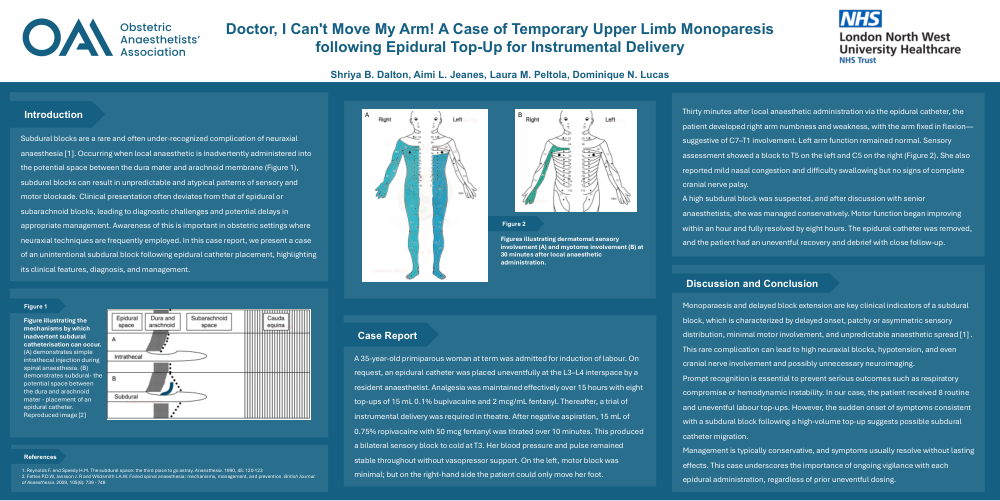
Thirty minutes after local anaesthetic administration via the epidural catheter, the patient developed right arm numbness and weakness, with the arm fixed in flexion—suggestive of C7–T1 involvement. Left arm function remained normal. Sensory assessment showed a block to T5 on the left and C5 on the right (Figure 2). She also reported mild nasal congestion and difficulty swallowing but no signs of complete cranial nerve palsy.
A high subdural block was suspected, and after discussion with senior anaesthetists, she was managed conservatively. Motor function began improving within an hour and fully resolved by eight hours. The epidural catheter was removed, and the patient had an uneventful recovery and debrief with close follow-up.
Discussion and Conclusion
Monoparaesis and delayed block extension are key clinical indicators of a subdural block, which is characterized by delayed onset, patchy or asymmetric sensory distribution, minimal motor involvement, and unpredictable anaesthetic spread [1] . This rare complication can lead to high neuraxial blocks, hypotension, and even cranial nerve involvement and possibly unnecessary neuroimaging.
Prompt recognition is essential to prevent serious outcomes such as respiratory compromise or hemodynamic instability. In our case, the patient received 8 routine and uneventful labour top-ups. However, the sudden onset of symptoms consistent with a subdural block following a high-volume top-up suggests possible subdural catheter migration.
Management is typically conservative, and symptoms usually resolve without lasting effects. This case underscores the importance of ongoing vigilance with each epidural administration, regardless of prior uneventful dosing.