215 posters, 5 topics, 22 sessions, 596 authors, 283 institutions
ePostersLive by SciGen Technologies S.A. All rights reserved.
Obstetric Anaesthesia Annual Scientific Meeting 2025
May 15 - 16, 2025 | ICC, 2 Lanyon Place, Belfast BT1 3WH

6779622
Heart Failure in Pregnancy: A Case of Patient Empowerment
Poster Presenter
Part of Topic
Case report
Heart Failure in Pregnancy: A Case of Patient Empowerment
Introduction
Heart failure is the leading complication of cardiac disease in pregnancy1 and according to the MBRRACE report from 2023, cardiac disease is the second most common indirect cause of maternal death.
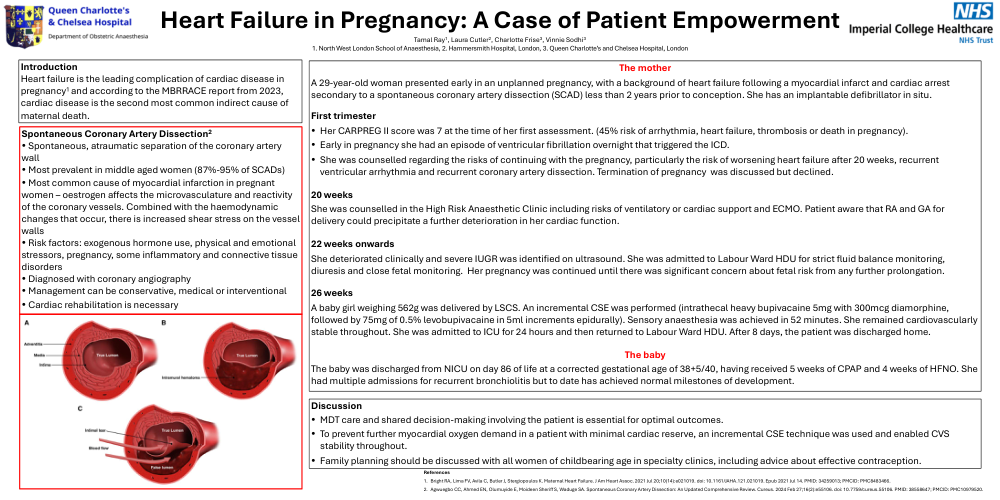
Spontaneous Coronary Artery Dissection2
Spontaneous, atraumatic separation of the coronary artery wall
Most prevalent in middle aged women (87%-95% of SCADs)
Most common cause of myocardial infarction in pregnant women – oestrogen affects the microvasculature and reactivity of the coronary vessels. Combined with the haemodynamic changes that occur, there is increased shear stress on the vessel walls
Risk factors: exogenous hormone use, physical and emotional stressors, pregnancy, some inflammatory and connective tissue disorders
Diagnosed with coronary angiography
Management can be conservative, medical or interventional
Cardiac rehabilitation is necessary
The mother
A 29-year-old woman presented early in an unplanned pregnancy, with a background of heart failure following a myocardial infarct and cardiac arrest secondary to a spontaneous coronary artery dissection (SCAD) less than 2 years prior to conception. She has an implantable defibrillator in situ.
First trimester
20 weeks
She was counselled in the High Risk Anaesthetic Clinic including risks of ventilatory or cardiac support and ECMO. Patient aware that RA and GA for delivery could precipitate a further deterioration in her cardiac function.
22 weeks onwards
She deteriorated clinically and severe IUGR was identified on ultrasound. She was admitted to Labour Ward HDU for strict fluid balance monitoring, diuresis and close fetal monitoring. Her pregnancy was continued until there was significant concern about fetal risk from any further prolongation.
26 weeks
A baby girl weighing 562g was delivered by LSCS. An incremental CSE was performed (intrathecal heavy bupivacaine 5mg with 300mcg diamorphine, followed by 75mg of 0.5% levobupivacaine in 5ml increments epidurally). Sensory anaesthesia was achieved in 52 minutes. She remained cardiovascularly stable throughout. She was admitted to ICU for 24 hours and then returned to Labour Ward HDU. After 8 days, the patient was discharged home.
The baby
The baby was discharged from NICU on day 86 of life at a corrected gestational age of 38+5/40, having received 5 weeks of CPAP and 4 weeks of HFNO. She had multiple admissions for recurrent bronchiolitis but to date has achieved normal milestones of development.