215 posters, 5 topics, 22 sessions, 596 authors, 283 institutions
ePostersLive by SciGen Technologies S.A. All rights reserved.
Obstetric Anaesthesia Annual Scientific Meeting 2025
May 15 - 16, 2025 | ICC, 2 Lanyon Place, Belfast BT1 3WH

6781106
Case Report: Rare Cause of Primary Postpartum Hemorrhage
Poster Presenter
Part of Topic
Case report
Case Report: Rare Cause of Primary Postpartum Hemorrhage
Introduction
Postpartum hemorrhage (PPH) is excessive blood loss occurring within 24 hours of delivery (primary PPH) or up to 12 weeks postpartum (secondary PPH). Primary PPH is more common and typically results from the "4 Ts": Tone (uterine atony), Trauma (lacerations, rupture),Tissue (retained products of pregnancy), and Thrombin (coagulopathies). Rare causes, such as arterial bleeding from the internal pudendal artery, can lead to severe hemorrhage, demanding prompt intervention.
Case report
A 43-year-old healthy primigravida underwent vaginal delivery with epidural analgesia. The newborn boy weighed 4100 g and measured 57 cm in length. Delivery resulted in a first-degree vaginal laceration. Six hours postpartum the patient reported weakness and difficulty lifting her right leg, along with tingling and pain in the right leg and hip.
A CT scan revealed a 4x2x4.5 cm hematoma near the right obturator internus muscle. The hematoma was surrounded by hemorrhagic pus, totaling 6x2.5 cm, but neural structures were unaffected. There was no evidence of intraspinal or epidural hematoma. The next day patient developed urinary retention and a gluteal hematoma with severe right leg pain, weakness and a pressing sensation in the buttock. Follow-up CT showed that hematoma had enlarged to 7.5x4.8x8.4 cm with active extravasation.
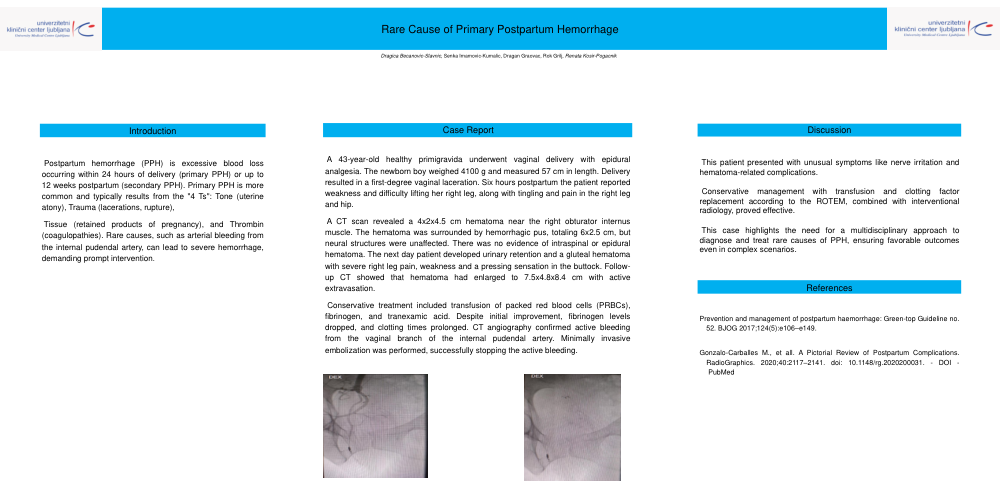
Conservative treatment included transfusion of packed red blood cells (PRBCs), fibrinogen, and tranexamic acid. Despite initial improvement, fibrinogen levels dropped, and clotting times prolonged. CT angiography confirmed active bleeding from the vaginal branch of the internal pudendal artery. Minimally invasive embolization was performed, successfully stopping the active bleeding.
Discussion
This patient presented with unusual symptoms like nerve irritation and hematoma-related complications.Conservative management with transfusion and clotting factor replacement according to the ROTEM, combined with interventional radiology, proved effective.This case highlights the need for a multidisciplinary approach to diagnose and treat rare causes of PPH, ensuring favorable outcomes even in complex scenarios.
References
Prevention and management of postpartum haemorrhage: Green-top Guideline no. 52. BJOG 2017;124(5):e106–e149.
Gonzalo-Carballes M., et all. A Pictorial Review of Postpartum Complications. RadioGraphics. 2020;40:2117–2141. doi: 10.1148/rg.2020200031. - DOI - PubMed